
No products in the cart.
Sale
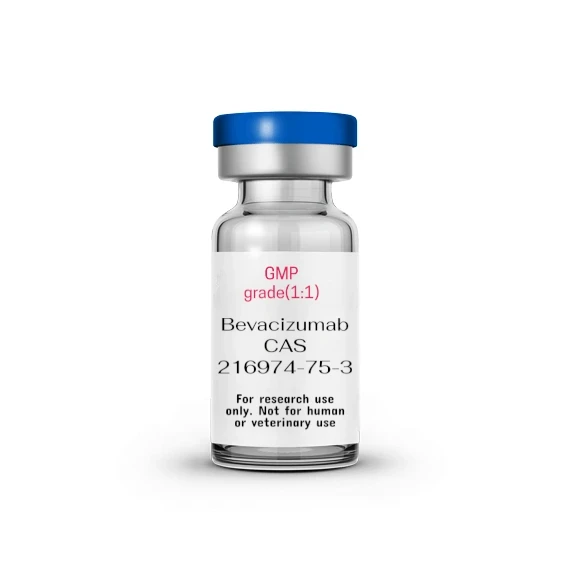
Bevacizumab | CAS 216974-75-3 | High-Purity Sterile Solution for Angiogenesis Inhibition Research and GMP OEM Production
Original price was: $3.00.$2.00Current price is: $2.00.
Bevacizumab (CAS 216974-75-3) is a high-purity sterile solution formulated for advanced angiogenesis research. As a monoclonal antibody that selectively binds VEGF-A, Bevacizumab enables precise inhibition of vascular endothelial signaling in cellular, tissue, and preclinical experimental systems. Its stable sterile-solution format supports reproducible functional assays, tumor microenvironment studies, endothelial biology, organoid development research, and translational pharmacology programs.

Description
Product Description
Bevacizumab (CAS 216974-75-3) is a recombinant humanized monoclonal IgG1 antibody targeting VEGF-A, a critical regulator of angiogenesis and vascular permeability. By binding VEGF-A isoforms, Bevacizumab prevents their interaction with VEGFR-1 and VEGFR-2 receptors, blocking downstream signaling pathways such as PI3K/Akt, MAPK/ERK, and PLCγ. This inhibition reduces endothelial cell proliferation, migration, tube formation, and survival.
The sterile solution format allows direct application in endothelial cell culture, 3D vascular organoids, microfluidic angiogenesis models, and tumor microenvironment assays. Researchers can use Bevacizumab to dissect VEGF-dependent mechanisms, evaluate anti-angiogenic therapeutics, and model vascular normalization in preclinical studies. Its high purity and GMP-grade production ensure reproducible outcomes across laboratories, making it suitable for bulk research, OEM projects, and high-throughput experimentation.
Bevacizumab’s structural integrity, including proper glycosylation and Fc region configuration, ensures stable VEGF-A binding, minimal aggregation, and preserved biological activity. The solution has been validated for low endotoxin levels, sterility, and consistent bioactivity, supporting long-term research workflows. Its applications include tumor angiogenesis inhibition, endothelial permeability modulation, vascular sprouting studies, and organoid vascular network formation.
Product Specifications
| Parameter | Details |
|---|---|
| Chemical Name / Synonyms | Bevacizumab, rhuMAb VEGF, Avastin (research use) |
| CAS Number | 216974-75-3 |
| Molecular Formula | C₆₅₀₀H₁₀₀₀₀N₁₇₀₀O₂₀₀₀S₄₀ (approx.) |
| Molecular Weight | ~149 kDa |
| Purity | ≥99% (HPLC-SEC verified) |
| Appearance | Clear to slightly opalescent sterile solution |
| Dosage Form | Sterile solution |
| Solubility | Fully soluble in aqueous buffers, physiological pH |
| Concentration | Customizable (1–25 mg/mL) |
| Storage Temperature | 2–8°C |
| Stability | Maintains VEGF-A binding and monomeric state during shelf life |
| Analytical Methods | HPLC-SEC, SDS-PAGE, LC-MS, bioassays |
| Mechanistic Target | VEGF-A |
| Structural Category | Humanized monoclonal IgG1 antibody |
| Applications | Endothelial assays, tube formation, organoid vascularization, microfluidic angiogenesis models |
| Batch Consistency | GMP-compliant production and QC verified |
| Regulatory Notes | Research-use only, not for human or veterinary use |
| Origin | Recombinant expression in mammalian cells |
| Additional Data | CoA, endotoxin ≤0.1 EU/mg, functional bioactivity confirmed |
Mechanism of Action
Bevacizumab binds VEGF-A isoforms with high affinity, preventing interaction with VEGFR-1 and VEGFR-2 on endothelial cells. This blockade inhibits receptor dimerization and downstream phosphorylation events, suppressing pathways that control cell proliferation, migration, tube formation, and survival. The antibody also reduces vascular permeability by stabilizing endothelial tight junctions, and it impairs sprouting angiogenesis in both 2D and 3D in vitro models.
In tumor microenvironment research, Bevacizumab reduces neovascularization, normalizes vessel structure, and modulates extracellular matrix interactions. Its sterility and high purity allow reproducible applications in organoids, co-culture systems, and microfluidic models. Mechanistic studies demonstrate its efficacy in inhibiting PI3K/Akt and MAPK/ERK signaling, making it a robust tool for angiogenesis research, drug screening, and translational preclinical studies.
Side Effects
As a research-use-only reagent, Bevacizumab may exhibit cell-line-specific cytotoxicity or off-target effects when used at high concentrations. In vitro, it can induce endothelial growth arrest, reduce migration, or alter tube formation in sensitive cell types. Handling precautions include using sterile techniques, avoiding repeated freeze-thaw cycles, and minimizing light exposure. Laboratory personnel should follow biosafety guidelines for recombinant antibodies.
Bevacizumab is designed for experimental research; effects observed are limited to cellular and tissue models. Care should be taken to accurately titrate doses to avoid confounding experimental outcomes. Stability under recommended storage ensures consistent functional activity, reducing variability in long-term studies.
Keywords
Bevacizumab, CAS 216974-75-3, sterile solution, VEGF-A inhibitor, high-purity antibody, research reagent, endothelial assays, angiogenesis studies, organoid vascularization, tumor microenvironment, GMP OEM, bulk supply, recombinant monoclonal antibody, small-molecule supplier, China chemical manufacturer, high-purity chemical, laboratory reagent, preclinical research, bulk production, research-grade antibody
Shipping Guarantee
Bevacizumab sterile solution is shipped under cold chain conditions with ice packs or dry ice, ensuring stable temperature control throughout transit. Packaging is leak-proof and sterile to maintain product integrity. Global tracking and insurance are provided, ensuring reliable delivery for research laboratories worldwide. Bulk orders and OEM shipments are managed with stringent temperature monitoring to prevent degradation.
Trade Assurance
Each batch of Bevacizumab is verified for ≥99% purity via HPLC-SEC and bioactivity assays. Certificates of Analysis (CoA) are provided with each shipment. The GMP-compliant production process guarantees batch consistency. Returns and exchanges are supported for QC-related issues, ensuring reliable supply for research and preclinical studies.
Payment Support
Payments are accepted via PayPal, T/T, international bank transfer, credit card, USDT, Bitcoin, and Ethereum. Encrypted verification ensures secure transactions for bulk and OEM orders. Global support for multiple currencies is available for research institutions and commercial laboratories.
Disclaimer
Bevacizumab is intended for laboratory research only. It is not for human or veterinary use. Follow all biosafety regulations when handling, and use appropriate sterile techniques. The product is provided as GMP-compliant research reagent only, not as a therapeutic agent.
References
PubChem: https://pubchem.ncbi.nlm.nih.gov/
ChEMBL: https://www.ebi.ac.uk/chembl/
DrugBank: https://go.drugbank.com/
PubMed: https://pubmed.ncbi.nlm.nih.gov/
IUPHAR/BPS: https://www.guidetopharmacology.org/
Additional information
| Weight | 1.1 kg |
|---|---|
| Dimensions | 18 × 16 × 18 cm |
1 review for Bevacizumab | CAS 216974-75-3 | High-Purity Sterile Solution for Angiogenesis Inhibition Research and GMP OEM Production
1. What is Bevacizumab used for in research?
Bevacizumab is primarily used to study VEGF-A–dependent angiogenesis, endothelial cell proliferation, and vascular normalization in vitro and in preclinical models. It is widely applied in organoid and tumor microenvironment studies.
2. How should Bevacizumab sterile solution be stored?
Store at 2–8°C, protect from light, and avoid repeated freeze-thaw cycles to preserve VEGF-A binding and functional activity.
3. Can Bevacizumab be ordered in bulk for OEM?
Yes, bulk production and GMP OEM customization are available, with CoA and QC verification included.
4. What concentration is recommended for endothelial assays?
Concentrations vary depending on assay type; titration is recommended for reproducible results in tube formation and migration studies.
5. Is Bevacizumab compatible with organoid vascularization studies?
Yes, the sterile solution format is ideal for direct addition to organoid and microfluidic systems, supporting reproducible VEGF-A inhibition.
6. Are endotoxin levels controlled?
Yes, endotoxin is ≤0.1 EU/mg, verified for sterility and assay compatibility.
7. What analytical methods confirm purity?
HPLC-SEC, SDS-PAGE, LC-MS, and bioactivity assays confirm purity, monomeric state, and VEGF-A binding.
8. Can Bevacizumab affect endothelial migration?
Yes, it inhibits VEGF-mediated migration and sprouting, useful for mechanistic studies of angiogenesis.
9. Is batch-to-batch consistency ensured?
Yes, all batches are GMP-compliant and undergo QC to maintain consistent bioactivity and purity.
10. How long is the shelf life?
Shelf life is stable under recommended storage (2–8°C) and sterile handling, typically 12–24 months depending on formulation.
11. Can it be used for high-throughput screening?
Yes, the sterile solution and high-purity format support multi-well screening and automated assays.
12. Are there any safety concerns in the lab?
Follow standard recombinant antibody handling and biosafety guidelines. Avoid ingestion, inhalation, or contact with skin/eyes.
13. Does it require reconstitution?
No, the sterile solution is ready-to-use, eliminating preparation errors.
14. Can OEM labeling be customized?
Yes, labeling, fill volume, and packaging can be customized per client requirements.
Related products
Fulvestrant (Faslodex) 250mg — Laboratory Research Grade Reagent
Fulvestrant (Faslodex) is a high-purity steroidal compound for in vitro molecular mechanism studies, including nuclear receptor binding, transcriptional modulation, and protein interaction research. It is intended exclusively for laboratory research and mechanistic investigations, enabling controlled experimental analysis in biochemical and cellular assays. Original price was: $6.00.$2.00Current price is: $2.00.Temozolomide 100mg — Laboratory Research Grade Chemical
Temozolomide is a high-purity alkylating research compound widely used in in vitro molecular mechanism studies focusing on DNA methylation, damage response pathways, and cell cycle regulation. It is suitable for laboratory-based biochemical and mechanistic research applications only.
Original price was: $6.00.$3.00Current price is: $3.00.Telpegfilgrastim Solution 99% High purity | Factory manufactured
High-purity Telpegfilgrastim Solution, factory-manufactured for in vitro molecular mechanism studies and biochemical pathway research. Supplied as a stable solution, ideal for laboratories requiring bulk, wholesale, or customized research-grade supply. $2.00Propranolol Hydrochloride Solution 10 mg/mL (40 mL)
Propranolol Hydrochloride Solution (10 mg/mL, 40 mL) is a high-purity small-molecule reagent manufactured under controlled factory conditions for laboratory research and in vitro molecular mechanism studies. The solution format enables precise concentration control, reproducible assay preparation, and seamless integration into biochemical and signaling pathway research workflows.
$1.00


Carlos –
Shipping process was straightforward.