
No products in the cart.
Sale
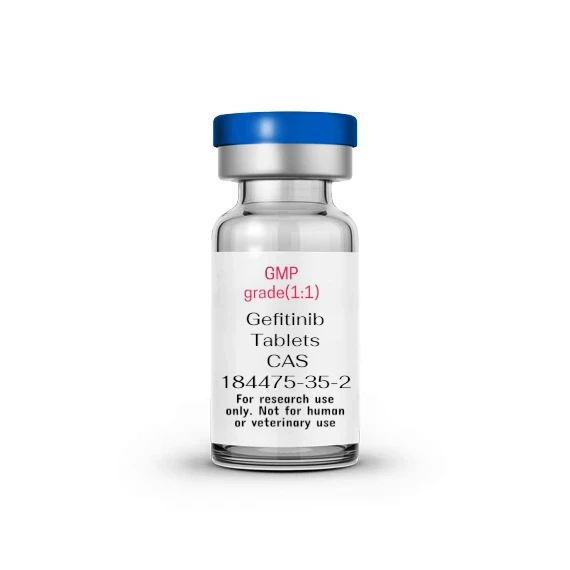

Gefitinib Tablets | CAS 184475-35-2 | EGFR Tyrosine Kinase Inhibitor for Anticancer and Molecular Targeted Research
Original price was: $3.00.$2.00Current price is: $2.00.
Gefitinib is a selective EGFR tyrosine kinase inhibitor widely used in preclinical research to study receptor-mediated signaling, tumor cell proliferation, apoptosis, and drug resistance mechanisms. It provides a model for investigating EGFR-dependent pathways and evaluating small-molecule kinase inhibition in vitro and in vivo.

Description
Product Description
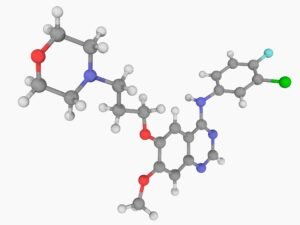
Gefitinib (CAS 184475-35-2) is a small-molecule anilinoquinazoline derivative that acts as a reversible inhibitor of the epidermal growth factor receptor (EGFR) tyrosine kinase. By targeting the ATP-binding site of EGFR, Gefitinib suppresses receptor autophosphorylation, thereby inhibiting downstream signaling pathways such as RAS-RAF-MEK-ERK and PI3K-AKT, which regulate cell proliferation, survival, and apoptosis.
Physical and Chemical Properties:
Molecular formula: C22H24ClFN4O3
Molecular weight: 446.9 g/mol
Appearance: White to off-white crystalline powder
Solubility: Soluble in DMSO, ethanol; low aqueous solubility
Stability: Stable at 2–8 °C; protect from light and moisture
Research Applications:
EGFR Signaling Studies: Gefitinib is extensively used to study EGFR phosphorylation, receptor internalization, and downstream signaling in cancer cell lines.
Antiproliferative Assays: Blocks proliferation of EGFR-dependent tumor cells; ideal for in vitro growth inhibition studies.
Apoptosis Research: Induces caspase-mediated apoptosis via inhibition of survival pathways (PI3K-AKT, ERK).
Drug Resistance Mechanisms: Useful for investigating acquired resistance, EGFR mutations (L858R, T790M), and compensatory pathway activation.
Combination Therapy Modeling: Evaluates synergy with other kinase inhibitors, chemotherapy agents, or immunomodulators.
Animal Models: Employed in murine xenografts and in vivo pharmacokinetic/pharmacodynamic studies.
Molecular Mechanistic Research: Studies EGFR internalization, ubiquitination, and feedback loop regulation, as well as crosstalk with other receptor tyrosine kinases.
Experimental Considerations:
Handling: Powder should be managed with gloves, lab coat, and eye protection.
Dosing: Concentration ranges depend on cell type and intended pathway inhibition.
Solvent Compatibility: Dissolve in DMSO or ethanol prior to dilution in culture medium; verify solubility for experimental conditions.
Storage: Store at 2–8 °C; avoid repeated freeze-thaw cycles to preserve chemical stability.
Gefitinib’s selective EGFR inhibition, high purity (≥99%), and well-characterized molecular mechanism make it an indispensable tool for research in targeted cancer therapy, receptor signaling, apoptosis, and drug resistance studies.
Product Specifications
| Parameter | Specification / Data |
|---|---|
| Chemical Name / Synonyms | Gefitinib; Iressa®; ZD1839; 4-(3-Chloro-4-fluoroanilino)-7-methoxyquinazoline |
| CAS Number | 184475-35-2 |
| Molecular Formula | C22H24ClFN4O3 |
| Molecular Weight | 446.9 g/mol |
| Purity / Assay | ≥99% |
| Appearance | White to off-white crystalline powder |
| Solubility | Soluble in DMSO, ethanol; low aqueous solubility |
| Melting Point | 187–190 °C |
| Storage Temperature | 2–8 °C |
| Stability | Stable under refrigeration; avoid prolonged light exposure |
| Analytical Methods | HPLC, MS, NMR verified; batch-to-batch consistency confirmed |
| Mechanistic Target | EGFR tyrosine kinase inhibition, apoptosis induction, cell cycle arrest |
| Structural Category | Anilinoquinazoline small-molecule inhibitor |
| Applications | Preclinical cancer research, EGFR signaling studies, apoptosis research, drug resistance evaluation |
| Batch Consistency | Verified by HPLC, MS, NMR |
| Regulatory Notes | For laboratory research use only |
| Origin | Factory peptide/small-molecule supplier, China peptide manufacturer, OEM & bulk production available |
| Additional Data | SMILES: CN1C2=C(C(=NC=C2OC)C3=CC(=C(C=C3)F)Cl)C=NC=N1; CoA provided for each batch |
Mechanism of Action
Gefitinib is a selective inhibitor of the epidermal growth factor receptor (EGFR) tyrosine kinase. It binds reversibly to the ATP-binding site of the EGFR intracellular domain, preventing autophosphorylation and subsequent activation of downstream signaling pathways.
Key Molecular Mechanisms:
EGFR Inhibition: Blocks receptor tyrosine kinase activity, suppressing phosphorylation at critical tyrosine residues (Tyr1068, Tyr1173) on EGFR.
Downstream Signaling Suppression: Inhibits the RAS-RAF-MEK-ERK and PI3K-AKT-mTOR pathways, which regulate cell proliferation, survival, and apoptosis.
Apoptosis Induction: Interruption of survival pathways leads to activation of caspases, mitochondrial depolarization, and Bcl-2 family modulation.
Cell Cycle Modulation: Gefitinib causes G1-phase arrest by downregulating cyclin D1 and CDK4/6, contributing to antiproliferative effects.
Drug Resistance Studies: Serves as a model for analyzing resistance mechanisms, including EGFR mutations (L858R, T790M) and compensatory pathway activation (MET, HER2, AXL).
Experimental Applications:
In vitro: Assess EGFR phosphorylation, cell viability, apoptosis, signaling pathway modulation, and combination effects with other kinase inhibitors or chemotherapy agents.
In vivo: Xenograft tumor models, pharmacokinetic/pharmacodynamic studies, and evaluation of tumor growth inhibition.
Mechanistic Studies: Investigate receptor internalization, ubiquitination, feedback loops, and cross-talk with other receptor tyrosine kinases for pathway analysis.
Gefitinib’s selective EGFR inhibition and well-characterized molecular effects make it an indispensable tool in preclinical studies of receptor-mediated signaling, apoptosis, and targeted cancer therapy.
Side Effects
Gefitinib is a research-grade compound. Laboratory handling requires caution:
Cytotoxicity: In vitro studies may show apoptosis, growth arrest, and reduced proliferation in EGFR-dependent and sensitive cell lines.
Immune Modulation: Can indirectly influence cytokine production in some cell models.
Handling Precautions:
Wear gloves, lab coat, and eye protection.
Handle in a fume hood to prevent inhalation.
Storage: Keep at 2–8 °C; protect from light and moisture. Avoid repeated freeze-thaw cycles.
Environmental Precautions: Dispose of contaminated materials according to biosafety protocols.
Experimental Observations:
In vitro: Reduced EGFR phosphorylation, apoptosis induction, cell cycle arrest.
In vivo: Tumor growth inhibition, signaling pathway modulation, pharmacokinetic effects.
Keywords
Gefitinib, CAS 184475-35-2, EGFR inhibitor, tyrosine kinase inhibitor, anticancer research, molecular targeted therapy, apoptosis induction, cell cycle arrest, RAS-RAF-MEK-ERK, PI3K-AKT, high purity, ≥99% purity, factory peptide/small-molecule supplier, peptide wholesale China, China peptide manufacturer, OEM & bulk peptide production.
Shipping Guarantee
All Gefitinib Tablets shipments of Gefitinib are handled via validated cold-chain logistics to maintain chemical stability. The powder is sealed in moisture-proof, light-protected containers with secondary packaging. Full tracking, insurance coverage, and international courier support are provided to ensure secure delivery.
Trade Assurance
Gefitinib authenticity is guaranteed, with ≥99% purity verified by HPLC, MS, and NMR. Each batch includes a Certificate of Analysis (CoA). Trade assurance covers replacement or refund for deviations from specifications, ensuring consistent high-purity product for preclinical research.
Payment Support
Secure global payment options: PayPal, major credit cards (Visa, MasterCard, American Express), telegraphic transfer (T/T), and cryptocurrencies (USDT, Bitcoin, Ethereum). All transactions are encrypted and verified for confidentiality and fund protection.
Disclaimer
This Gefitinib Tablets product is intended for laboratory research use only. It is not for human or veterinary administration. Researchers must follow institutional safety protocols. Data generated with Gefitinib should not be interpreted as clinical or therapeutic guidance.
References

Additional information
| Weight | 1.1 kg |
|---|---|
| Dimensions | 18 × 16 × 18 cm |
Q1: What is Gefitinib used for in research?
A1: Gefitinib is used to study EGFR signaling, cell proliferation, apoptosis, and drug resistance in preclinical cancer models.
Q2: What is the purity of Gefitinib?
A2: ≥99% purity ensures reliable activity in molecular and cellular studies.
Q3: Can Gefitinib be used in vivo?
A3: Yes, it is suitable for xenograft and pharmacokinetic studies in animal models.
Q4: How should Gefitinib be stored?
A4: Store at 2–8 °C, protect from light and moisture, avoid repeated freeze-thaw cycles.
Q5: What are common synonyms for Gefitinib?
A5: Iressa®, ZD1839, 4-(3-Chloro-4-fluoroanilino)-7-methoxyquinazoline.
Q6: Is OEM & bulk production available?
A6: Yes, factory suppliers provide CoA-verified high-purity Gefitinib for research use.
Q7: How is Gefitinib analytically verified?
A7: Verified via HPLC, MS, and NMR to confirm identity, purity, and batch consistency.
Q8: Can Gefitinib be combined with other anticancer agents?
A8: Yes, commonly used to investigate synergy and resistance mechanisms with chemotherapeutics or kinase inhibitors.
Q9: What laboratory safety precautions are recommended?
A9: Use gloves, lab coat, eye protection, and fume hood handling; follow biosafety disposal protocols.
Q10: Can it be sourced from peptide wholesale China suppliers?
A10: Yes, ensuring CoA verification, high purity, and secure cold-chain shipping.
Q11: What makes a factory peptide supplier reliable for Gefitinib?
A11: Verified ≥99% purity, CoA documentation, consistent batch quality, and secure shipping.
Q12: Beyond EGFR inhibition, what applications exist?
A12: Apoptosis research, cell cycle regulation, drug resistance evaluation, targeted therapy studies, and combination studies.
Q13: How does Gefitinib induce apoptosis?
A13: By inhibiting EGFR signaling, suppressing survival pathways (PI3K-AKT, ERK), and activating caspase-mediated cell death.
Q14: How is EGFR pathway inhibition measured experimentally?
A14: Via phospho-EGFR western blot, kinase assays, cell viability assays, flow cytometry, and reporter assays.
Q15: How does trade assurance protect Gefitinib orders?
A15: Ensures CoA verification, high-purity product, secure cold-chain shipping, insurance coverage, and replacement/refund for specification deviations.
Related products
Toremifene Citrate 60mg for scientific research
High-purity Toremifene Citrate Tablets designed exclusively for in vitro molecular mechanism research, receptor-binding analysis, and biochemical pathway modulation studies. Factory-manufactured with consistent batch quality, suitable for bulk and wholesale supply.(For research use only. Not for human or veterinary use.) $1.00Rilertinib Mesylate 100mg – High Purity | Factory Manufactured | For laboratory use only
High-purity Rilertinib Mesylate, manufactured under controlled factory conditions for in vitro pathway analysis, receptor-binding studies, and molecular mechanism research. Available in bulk and wholesale quantities with consistent batch quality and secure global shipping. $1.00Cetuximab NO1 100 mg/50 mL | High purity | Factory manufactured
Cetuximab NO1 (100 mg/50 mL, Solution) is a high-purity monoclonal antibody solution manufactured under stringent factory-controlled conditions for in vitro laboratory research and molecular mechanism studies. Its solution format facilitates precise dosing, reproducible assay preparation, and integration into receptor-binding and signaling pathway research workflows.
Original price was: $3.00.$2.00Current price is: $2.00.Propranolol Hydrochloride Solution 10 mg/mL (40 mL)
Propranolol Hydrochloride Solution (10 mg/mL, 40 mL) is a high-purity small-molecule reagent manufactured under controlled factory conditions for laboratory research and in vitro molecular mechanism studies. The solution format enables precise concentration control, reproducible assay preparation, and seamless integration into biochemical and signaling pathway research workflows.
$1.00


Reviews
There are no reviews yet.