
No products in the cart.
Sale
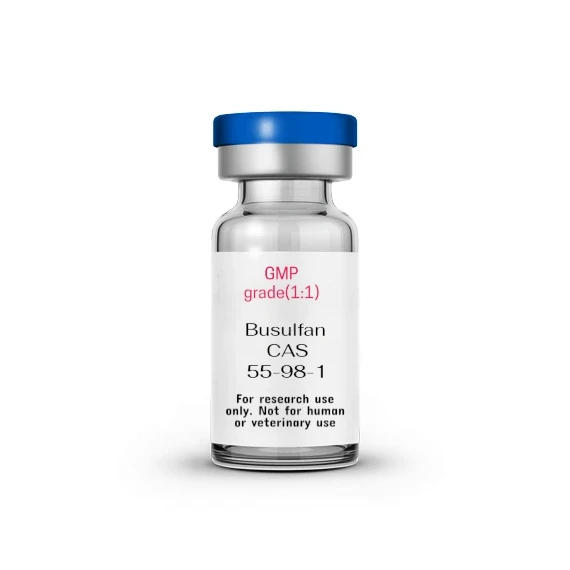

Busulfan | CAS 55-98-1 | Alkylating Agent for DNA Crosslinking and Anticancer Research
Original price was: $3.00.$2.00Current price is: $2.00.
Busulfan is a bifunctional alkylating agent used in preclinical research to study DNA crosslinking, apoptosis induction, and cytotoxicity. It serves as a model compound for investigating alkylation-mediated DNA damage, cell cycle arrest, and chemotherapeutic resistance mechanisms.

Description
Product Description
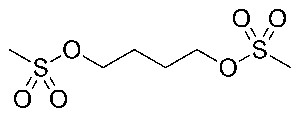
Busulfan (CAS 55-98-1) is a small-molecule bifunctional alkylating agent belonging to the class of sulfonate esters. Its chemical structure allows the formation of covalent interstrand and intrastrand DNA crosslinks, disrupting replication and transcription in rapidly dividing cells. This mechanism underpins its use as a chemotherapeutic and as a research model to study DNA damage-mediated cytotoxicity.
Physical and Chemical Properties:
Molecular formula: C8H16O4S4
Molecular weight: 246.33 g/mol
Appearance: White crystalline powder
Solubility: Soluble in DMSO, ethanol, and aqueous buffers
Stability: Stable at 2–8 °C; sensitive to light and moisture over extended periods
Research Applications:
Busulfan is widely utilized in preclinical studies to model DNA alkylation, apoptosis, and cytotoxicity:
DNA Crosslinking Studies: Busulfan forms covalent adducts between guanine bases across complementary DNA strands, creating interstrand crosslinks that interfere with replication fork progression.
Apoptosis and Cell Cycle Research: By triggering DNA damage response (DDR), Busulfan activates p53-dependent pathways, upregulates cyclin-dependent kinase inhibitors, and induces caspase-mediated programmed cell death.
Drug Resistance Mechanisms: It is used to study nucleotide excision repair (NER), base excision repair (BER), and mismatch repair (MMR) in chemotherapeutic resistance models.
Combination Therapy Modeling: Busulfan serves as a standard agent for evaluating synergistic effects of combination regimens with other chemotherapeutic or targeted molecules.
In Vivo Models: Preclinical studies in murine and hematopoietic models use Busulfan to investigate marrow ablation, stem cell transplantation, and systemic cytotoxicity.
Cellular and Molecular Pathways: Research often focuses on DDR signaling, reactive oxygen species (ROS) induction, mitochondrial perturbation, and modulation of apoptotic proteins such as Bcl-2 family members.
Experimental Considerations:
Handling: Powder should be managed with gloves, lab coat, and eye protection.
Dosing: Concentrations are chosen based on cell type and experimental goals; cytotoxic effects are dose-dependent.
Solvent Compatibility: Compatible with DMSO, ethanol, and aqueous buffers; solubility should be verified in intended experimental conditions.
Busulfan’s reproducible mechanism, high purity (≥99%), and well-characterized cytotoxic profile make it an indispensable tool for research in DNA damage, chemotherapeutic modeling, apoptosis induction, and drug resistance studies.
Product Specifications
| Parameter | Specification / Data |
|---|---|
| Chemical Name / Synonyms | Busulfan; Myleran®; 1,4-Butanediol dimethanesulfonate; Bu-24 |
| CAS Number | 55-98-1 |
| Molecular Formula | C8H16O4S4 |
| Molecular Weight | 246.33 g/mol |
| Purity / Assay | ≥99% |
| Appearance | White crystalline powder |
| Solubility | Soluble in DMSO, ethanol, aqueous buffers |
| Melting Point | 99–102 °C |
| Storage Temperature | 2–8 °C |
| Stability | Stable under refrigeration; avoid prolonged light exposure |
| Analytical Methods | HPLC, MS, NMR verified; batch-to-batch consistency confirmed |
| Mechanistic Target | DNA crosslinking, apoptosis induction, cell cycle arrest |
| Structural Category | Alkylating agent |
| Applications | Preclinical cancer research, DNA damage studies, apoptosis research, drug resistance evaluation |
| Batch Consistency | Verified by HPLC, MS, NMR |
| Regulatory Notes | For laboratory research use only |
| Origin | Factory peptide and small molecule supplier, China peptide manufacturer, OEM & bulk production available |
| Additional Data | SMILES: CS(=O)(=O)OCCSCCSCCOS(=O)(=O)C; CAS verification documented in CoA |
Mechanism of Action
Busulfan exerts its effects as a bifunctional alkylating agent, covalently binding to N7 positions of guanine residues on DNA, forming interstrand and intrastrand crosslinks. These crosslinks:
Prevent DNA replication and transcription, stalling replication forks.
Activate DNA damage response (DDR) pathways, including ATM/ATR kinases.
Induce p53-dependent cell cycle arrest at G1/S and G2/M checkpoints.
Trigger apoptosis via caspase activation, mitochondrial perturbation, and ROS generation.
Research Insights:
Interstrand crosslinks are highly cytotoxic; they require specialized repair pathways, allowing study of nucleotide excision repair (NER) and homologous recombination.
DNA adduct formation by Busulfan is dose- and time-dependent, offering a reproducible model for studying chemotherapeutic kinetics.
Busulfan is frequently used in combination with other DNA-damaging agents to investigate synergy, resistance, and repair pathway modulation.
In hematopoietic stem cell research, Busulfan-induced myeloablation is a standard model for evaluating engraftment and bone marrow transplantation outcomes.
Comparative Studies:
Compared to other alkylating agents (e.g., cyclophosphamide, melphalan), Busulfan exhibits unique bifunctional crosslinking properties and lower systemic toxicity in experimental models.
Studies comparing Busulfan to platinum compounds highlight differences in DNA adduct structure, repair sensitivity, and apoptotic signaling activation.

Side Effects
For laboratory research, Busulfan should be handled with care:
Toxicity: Cytotoxic effects include apoptosis, cell cycle arrest, DNA fragmentation, and mitochondrial dysfunction. Effects are dose-dependent and vary by cell type.
Handling Safety: Use gloves, lab coat, protective eyewear, and work in a fume hood. Avoid inhalation, ingestion, and skin/eye contact.
Environmental Precautions: Dispose of any waste according to institutional chemical safety protocols.
Long-term Stability: Powder is stable at 2–8 °C but may degrade if exposed to light, moisture, or high temperatures for extended periods.
Experimental Observations:
In vitro: DNA crosslinking, cytotoxicity in cancer cell lines, apoptosis induction.
In vivo: Myeloablation, stem cell depletion, dose-dependent cytotoxicity.
Busulfan is strictly for research use only and should not be administered to humans or animals outside regulated experimental settings.
Keywords
CAS 55-98-1, alkylating agent, DNA crosslinking, apoptosis induction, cell cycle arrest, chemotherapeutic cytotoxicity, preclinical cancer research, DNA damage response, high purity, ≥99% purity, factory peptide supplier, peptide wholesale China, China peptide manufacturer, OEM & bulk peptide production.
Shipping Guarantee
All shipments of Busulfan are handled with validated cold-chain logistics to ensure compound stability and integrity. The powder is sealed in moisture-proof, light-protected containers with secondary protective wrapping. Packages are shipped with full tracking, insurance coverage, and international courier support.
Trade Assurance
Busulfan authenticity is guaranteed, analytically verified using HPLC, MS, and NMR. Each batch comes with a Certificate of Analysis (CoA) confirming ≥99% purity. Trade assurance covers replacement or refund in case of deviation from listed specifications. Quality, batch consistency, and shipping conditions are strictly monitored.
Payment Support
We provide secure, global payment options including PayPal, major credit cards (Visa, MasterCard, American Express), telegraphic transfer (T/T), and cryptocurrencies (USDT, Bitcoin, Ethereum). All transactions are encrypted and verified to ensure confidentiality and fund protection.
Disclaimer
This product is intended for laboratory research use only. It is not for human or veterinary administration. Users must follow standard safety protocols. Data generated with Busulfan should not be interpreted as clinical guidance or therapeutic advice.
References
Additional information
| Weight | 1.1 kg |
|---|---|
| Dimensions | 18 × 16 × 18 cm |
Q1: What is Busulfan used for in research?
A1: Busulfan is used in preclinical studies to investigate DNA crosslinking, apoptosis, cell cycle arrest, and chemotherapeutic cytotoxicity in cellular and animal models.
Q2: What is the purity of Busulfan?
A2: ≥99% purity, ensuring reliable and reproducible results in DNA damage and apoptosis studies.
Q3: Can Busulfan be used in vivo?
A3: Yes, it is suitable for in vivo models, including murine and hematopoietic studies, to evaluate DNA crosslinking and cytotoxic effects.
Q4: How should Busulfan be stored?
A4: Store at 2–8 °C in tightly sealed, moisture-proof, and light-protected containers. Avoid exposure to heat or light.
Q5: What are common synonyms for Busulfan?
A5: Myleran®, 1,4-Butanediol dimethanesulfonate, Bu-24.
Q6: Is OEM & bulk production available for Busulfan?
A6: Yes, with CoA certification, high-purity verification, and cold-chain shipping.
Q7: How is Busulfan analytically verified?
A7: Using HPLC, MS, and NMR to confirm identity, purity, and batch-to-batch consistency.
Q8: Can Busulfan be combined with other chemotherapeutics in research?
A8: Yes, it is often studied in combination with other DNA-damaging agents to evaluate synergy and resistance mechanisms.
Q9: What laboratory safety precautions are recommended?
A9: Use gloves, lab coat, and eye protection; avoid ingestion or inhalation; follow institutional disposal protocols.
Q10: Can Busulfan be sourced from peptide wholesale China suppliers?
A10: Yes, provided suppliers offer CoA documentation, high-purity verification, and secure cold-chain shipping.
Q11: What makes a factory peptide supplier reliable for Busulfan?
A11: Verified ≥99% purity, CoA certification, consistent batch quality, and secure shipping.
Q12: Beyond DNA crosslinking, what research applications exist?
A12: Apoptosis studies, cell cycle regulation, chemotherapeutic cytotoxicity research, drug resistance evaluation, and preclinical cancer modeling.
Q13: How does Busulfan induce apoptosis?
A13: Through DNA crosslink formation that activates p53, triggers cell cycle arrest, and initiates caspase-mediated programmed cell death.
Q14: How is DNA crosslinking measured in laboratory experiments?
A14: Using comet assays, γ-H2AX phosphorylation analysis, DNA fragmentation assays, and other molecular biology techniques.
Q15: How does trade assurance protect Busulfan orders?
A15: Ensures CoA verification, high-purity confirmation, cold-chain shipping, insurance coverage, and replacement/refund for any deviation from listed specifications.
Related products
Regorafenib 40mg | High Purity | Factory Manufactured | Laboratory Research Use Only
High-purity Regorafenib, factory-manufactured for in vitro mechanistic studies and molecular pathway research. Supplied as a stable solution or powder for laboratories requiring bulk, wholesale, or customized research-grade supply. Original price was: $3.00.$2.00Current price is: $2.00.Toremifene Citrate 60mg for scientific research
High-purity Toremifene Citrate Tablets designed exclusively for in vitro molecular mechanism research, receptor-binding analysis, and biochemical pathway modulation studies. Factory-manufactured with consistent batch quality, suitable for bulk and wholesale supply.(For research use only. Not for human or veterinary use.) $1.00Fulvestrant (Faslodex) 250mg — Laboratory Research Grade Reagent
Fulvestrant (Faslodex) is a high-purity steroidal compound for in vitro molecular mechanism studies, including nuclear receptor binding, transcriptional modulation, and protein interaction research. It is intended exclusively for laboratory research and mechanistic investigations, enabling controlled experimental analysis in biochemical and cellular assays. Original price was: $6.00.$2.00Current price is: $2.00.Iparomlimab and Tuvonralimab 50 mg/2 mL Solution
Iparomlimab and Tuvonralimab is a high-purity monoclonal antibody solution supplied at 50 mg/2 mL by factory manufacturing with low-price wholesale availability. Designed exclusively for in vitro molecular mechanism studies, protein interaction assays, and signaling pathway research, it provides reproducible and reliable experimental performance. Strictly for laboratory research use. $1.00


Reviews
There are no reviews yet.