
No products in the cart.
Sale
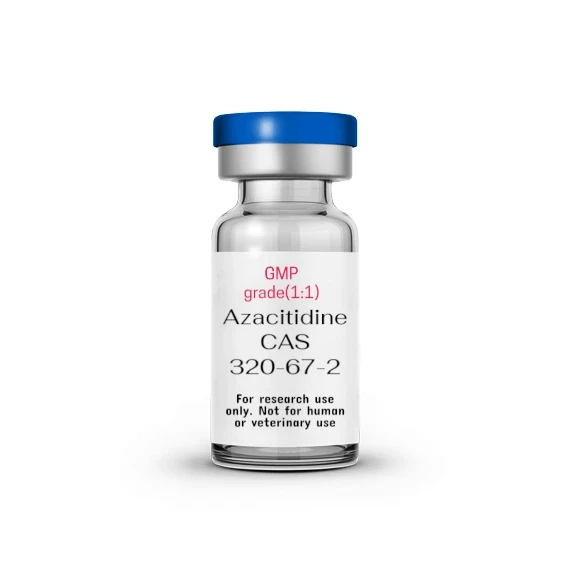
Azacitidine | CAS 320-67-2 | DNA Methyltransferase Inhibitor for Preclinical Oncology Research
Original price was: $3.00.$2.00Current price is: $2.00.
Azacitidine (CAS 320-67-2) is a potent nucleoside analogue that inhibits DNA methyltransferases, widely used in preclinical oncology research to study epigenetic regulation, tumor suppression, and gene reactivation mechanisms.
Description
Product Description
Azacitidine is a chemically synthesized nucleoside analogue designed to inhibit DNA methyltransferase enzymes, thereby preventing aberrant DNA methylation and allowing reactivation of silenced genes in preclinical research models. Its molecular structure incorporates a cytidine base modified at the 5-position, which is essential for covalent binding to DNMTs and subsequent hypomethylation of DNA.
In vitro studies demonstrate that Azacitidine incorporates into DNA and RNA during replication and transcription, resulting in inhibition of methylation and alterations in gene expression patterns. Preclinical tumor models have shown that Azacitidine treatment leads to cell cycle arrest, apoptosis induction, and suppression of proliferation in various cancer cell lines.
Azacitidine is highly soluble in aqueous buffers and DMSO, facilitating use in in vitro assays and experimental cell culture studies. It is also stable under recommended laboratory storage conditions, with a verified purity of ≥99%, ensuring reproducibility across experiments.
Experimental applications of Azacitidine include:
Epigenetic studies: Investigating DNA hypomethylation and reactivation of silenced tumor suppressor genes.
Cancer biology research: Studying cell cycle regulation, apoptosis pathways, and tumor suppression mechanisms.
Combination therapy assessments: Evaluating synergistic effects with chemotherapeutics, immunomodulators, or other epigenetic modulators.
Gene expression profiling: Using genome-wide methylation and transcriptional analysis to assess epigenetic changes.
Mechanistic research: Exploring DNMT inhibition kinetics, cellular uptake, and dose-response relationships.
Azacitidine’s high selectivity, metabolic stability, and reproducible in vitro incorporation make it a valuable tool for laboratory research in epigenetics, oncology, and preclinical pharmacology.
Product Specifications
| Item | Details |
|---|---|
| Product Name | Azacitidine |
| CAS Number | 320-67-2 |
| Synonyms | 5-Azacytidine; Vidaza; NSC-102816 |
| Molecular Formula | C8H12N4O5 |
| Molecular Weight | 244.20 g/mol |
| Purity | ≥99% |
| Appearance | White to off-white crystalline powder |
| Solubility | Soluble in water and DMSO; slightly soluble in ethanol |
| Storage Temperature | 2–8 °C, protected from light and moisture |
| Category | Nucleoside analogue, DNMT inhibitor |
| Applications | Epigenetic research, DNA methylation studies, tumor suppression research |
| Formulation | Suitable for in vitro assays, cell culture, and preclinical models |
| Stability | Stable under recommended laboratory conditions |
| Shelf Life | 24 months |
| Supplier Type | Research chemical supplier |
| Intended Use | For laboratory research use only |
| Packaging Options | 10 mg – 1 kg sealed powder in moisture-proof containers |
| Delivery Mode | Cold-chain logistics with tracking and insurance |
Mechanism of Action
Azacitidine functions primarily as a DNA methyltransferase inhibitor by incorporating into DNA and RNA, forming covalent complexes with DNMT enzymes. This leads to the hypomethylation of DNA and reactivation of silenced genes, particularly tumor suppressor genes, enabling detailed preclinical studies of epigenetic regulation.
DNMT Inhibition:
Azacitidine binds covalently to DNMTs during DNA replication, preventing methylation of cytosine residues in CpG islands. This inhibition allows previously silenced genes to be transcribed, facilitating the study of epigenetic mechanisms and gene expression modulation.
Gene Reactivation:
Through hypomethylation, Azacitidine reactivates tumor suppressor genes and regulatory RNAs, enabling investigations into the functional consequences of epigenetic changes on tumor growth, cell cycle progression, and apoptosis.
Downstream Effects:
By modulating methylation patterns, Azacitidine impacts cellular proliferation, apoptosis induction, and differentiation pathways. Researchers employ Azacitidine to explore global methylation changes, epigenome editing, and therapeutic targets in preclinical models.
Experimental Applications:
In vitro DNA methylation assays and RNA transcription studies
Preclinical tumor models for epigenetic therapy research
Combination studies with chemotherapeutic or immunomodulatory agents
High-throughput epigenetic screenings

Azacitidine
Side Effects
In laboratory studies, Azacitidine shows effects consistent with DNMT inhibition:
Cell cycle arrest: Typically at S-phase due to incorporation into DNA.
Apoptosis induction: Activation of intrinsic and extrinsic pathways in tumor cells.
Gene expression modulation: Reactivation of silenced genes and non-coding RNAs.
Cytotoxicity: Dose-dependent effects observed in high-concentration in vitro studies.
Laboratory Safety Guidelines:
Handle with gloves, lab coat, and eye protection.
Use in a fume hood to avoid inhalation.
Avoid direct skin contact and ingestion.
Dispose of waste according to institutional chemical safety protocols.
Azacitidine is intended strictly for laboratory research and is not approved for human or veterinary use.
Usage Instructions
Dissolve in sterile water or DMSO for in vitro studies; typical concentrations range from 1–10 μM depending on experimental design.
Store reconstituted solutions at –80 °C for short-term use, and freeze-dried powder at 2–8 °C protected from light for up to 24 months.
Perform all experiments following institutional biosafety guidelines.
Application Cases
Case 1: Epigenetic reactivation of tumor suppressor genes in leukemia cell lines using Azacitidine, assessing cell cycle arrest and apoptosis markers.
Case 2: Combination therapy study with Azacitidine and histone deacetylase inhibitors to evaluate synergistic effects on gene expression and tumor cell viability.
Case 3: Preclinical tumor xenograft study measuring the effect of Azacitidine on DNA methylation patterns and tumor growth inhibition.
Shipping Guarantee
All shipments of Azacitidine are handled using validated cold-chain logistics to preserve compound integrity. Each package is sealed in moisture-proof containers with secondary protective wrapping and continuous temperature monitoring. Products are shipped via express international couriers with tracking and insurance. Customers receive real-time updates on shipment status to ensure timely and secure delivery.
Trade Assurance
We guarantee the authenticity and ≥99% purity of Azacitidine in compliance with HPLC, MS, and NMR analytical standards. Each batch is accompanied by a Certificate of Analysis (CoA). Our trade assurance policy ensures replacement or full refund in the unlikely event of deviation from the listed specifications. We adhere strictly to quality management systems to provide reliable research-grade chemicals.
Payment Support
We accept flexible and secure global payment methods including PayPal, major credit cards (Visa, MasterCard, American Express), telegraphic transfer (T/T), and cryptocurrencies (USDT, Bitcoin, Ethereum). All transactions are encrypted and verified to ensure confidentiality and fund security. Invoices and payment confirmations are provided for every order.
Keywords
Azacitidine, DNA methyltransferase inhibitor, DNMT inhibitor, nucleoside analogue, epigenetic research, tumor suppression studies, gene reactivation, preclinical oncology research, small-molecule epigenetic modulator, laboratory research chemical, research chemical supplier, high-purity Azacitidine
Disclaimer
All products listed are intended solely for laboratory research use. They are not drugs, medical devices, or diagnostics and should not be administered to humans or animals. Researchers must handle all materials according to institutional biosafety and chemical safety guidelines. The information provided is for scientific reference only and does not imply therapeutic efficacy, safety, or regulatory approval.

Additional information
| Weight | 1.1 kg |
|---|---|
| Dimensions | 18 × 16 × 18 cm |
1. What is Azacitidine used for?
It is used in preclinical oncology and epigenetic research to study DNA methylation, gene reactivation, and tumor suppression mechanisms.
2. Is Azacitidine a high-purity compound?
Yes, each batch is verified ≥99% purity using HPLC and MS analyses.
3. How should Azacitidine be stored?
Freeze-dried powder: 2–8 °C, protected from light; reconstituted solutions: –80 °C.
4. Can Azacitidine be dissolved in DMSO or water?
Yes, it is soluble in both water and DMSO for laboratory experiments.
5. Can Azacitidine be used in combination studies?
Yes, it is commonly used with chemotherapeutics, epigenetic modulators, or immunotherapeutic agents in preclinical research.
6. What documentation is provided?
Each batch includes a Certificate of Analysis (CoA) confirming purity ≥99%.
7. Is bulk or OEM supply available?
Yes, OEM and bulk production services are offered through certified research chemical suppliers.
8. Is Azacitidine stable during storage?
Yes, it remains stable for up to 24 months under recommended storage conditions.
9. Which research areas utilize Azacitidine?
Epigenetics, DNA methylation analysis, tumor biology, preclinical oncology studies, and gene expression research.
10. What safety precautions are recommended?
Use personal protective equipment, handle in a fume hood, avoid skin contact, and follow institutional safety protocols.
11. Does Azacitidine affect RNA as well as DNA?
Yes, incorporation into RNA can influence transcription and gene regulation studies.
12. Are there in vivo research applications?
Yes, Azacitidine is employed in preclinical xenograft and animal models under approved experimental protocols.
13. Can Azacitidine analogues be synthesized?
Yes, analogues and derivatives can be produced via OEM services for research purposes.
14. How is shipping ensured for sensitive compounds?
Cold-chain logistics with real-time temperature monitoring preserves compound integrity.
15. Why is Azacitidine valuable for research?
Its selective DNMT inhibition and ≥99% purity provide reliable tools for mechanistic studies of epigenetics, gene reactivation, and tumor suppression.
Related products
Mechlorethamine Hydrochloride High Purity | Factory Manufactured | Laboratory Research Use Only
High-purity Mechlorethamine Hydrochloride Solution manufactured under strict factory-controlled conditions, designed exclusively for in vitro, biochemical, and molecular mechanism research. Suitable for laboratories requiring bulk, wholesale, or customized research-grade supply.
$1.00Fulvestrant (Faslodex) 250mg — Laboratory Research Grade Reagent
Fulvestrant (Faslodex) is a high-purity steroidal compound for in vitro molecular mechanism studies, including nuclear receptor binding, transcriptional modulation, and protein interaction research. It is intended exclusively for laboratory research and mechanistic investigations, enabling controlled experimental analysis in biochemical and cellular assays. Original price was: $6.00.$2.00Current price is: $2.00.Pirtobrutinib 100mg | High purity | Factory manufactured
Pirtobrutinib is a high-purity small-molecule research compound, factory manufactured and supplied at low-price wholesale scale, specifically developed for in vitro biochemical assays, molecular interaction analysis, and signaling pathway investigations. This product is intended exclusively for laboratory research use. $2.00Granisetron Hydrochloride Dispersible 1mg
High-purity Granisetron Hydrochloride Dispersible is a factory-manufactured research reagent optimized for in vitro receptor binding studies, 5-HT3 receptor mechanistic analysis, and molecular signaling research. Available for bulk and wholesale laboratory use with batch-verified purity and reproducible performance. $1.00


Reviews
There are no reviews yet.