
No products in the cart.
Sale

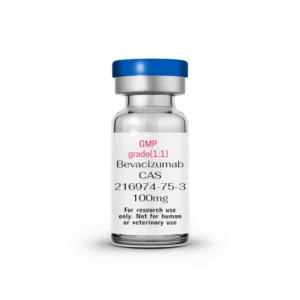
Bevacizumab 100mg | CAS 216974-75-3 | VEGF Inhibitor for Angiogenesis and Cancer Research
Original price was: $3.00.$2.00Current price is: $2.00.
Bevacizumab is a recombinant humanized monoclonal antibody targeting vascular endothelial growth factor A (VEGF-A). It is widely used in preclinical research to study angiogenesis, tumor progression, and VEGF-mediated signaling pathways in cancer and vascular biology models.
Description
Product Description
Bevacizumab (CAS 216974-75-3) is a recombinant humanized monoclonal antibody specifically targeting vascular endothelial growth factor A (VEGF-A), a key mediator of angiogenesis and vascular permeability. By binding to VEGF-A, Bevacizumab prevents its interaction with VEGF receptors on endothelial cells, inhibiting downstream signaling cascades involved in angiogenic processes.
In preclinical research, Bevacizumab is used to study mechanisms of tumor angiogenesis, vascular remodeling, and VEGF-dependent cell signaling. It is particularly valuable in evaluating the role of VEGF-A in cancer progression, endothelial cell proliferation, and migration in both in vitro and in vivo models. By blocking VEGF-A, researchers can examine changes in microvascular density, vessel maturation, and tumor microenvironment interactions.
Bevacizumab’s high specificity allows mechanistic studies without significant off-target effects. Researchers employ it to investigate:
VEGF-mediated angiogenesis in tumor and normal tissue models.
Endothelial cell proliferation, migration, and tube formation assays.
Tumor progression and vascularization in xenograft and syngeneic animal models.
Synergistic or combinatorial effects with chemotherapy or other targeted therapies.
The antibody is provided as a lyophilized, high-purity powder (≥99%), suitable for laboratory research. It is soluble in PBS or other physiological buffers, facilitating in vitro and in vivo applications. Each batch is verified using ELISA, SDS-PAGE, and Western blot to confirm activity, purity, and structural integrity.
Bevacizumab is also utilized as a mechanistic probe to explore VEGF-A-dependent signaling, including the PI3K/AKT, MAPK/ERK, and NF-κB pathways. Preclinical studies can leverage this compound to model anti-angiogenic therapy, evaluate compensatory vascular signaling, and investigate endothelial cell responses in tumor and tissue microenvironments.
Its application extends to research on vascular biology, tumor microenvironment modulation, and translational studies evaluating novel anti-angiogenic strategies. Bevacizumab’s specificity, reproducibility, and high purity make it an essential reagent for mechanistic studies in oncology and angiogenesis research.
Product Specifications
| Parameter | Specification / Data |
|---|---|
| Chemical Name / Synonyms | Bevacizumab; Avastin®; VEGF-A antibody; recombinant humanized monoclonal antibody |
| CAS Number | 216974-75-3 |
| Molecular Formula | C6458H9914N1710O2016S44 (approx.) |
| Molecular Weight | ~149 kDa |
| Purity / Assay | ≥99% |
| Appearance | White to off-white lyophilized powder |
| Solubility | Soluble in PBS, physiological buffers |
| Storage Temperature | 2–8 °C |
| Analytical Methods | ELISA, SDS-PAGE, Western blot verified |
| Mechanistic Target | VEGF-A inhibitor |
| Structural Category | Recombinant humanized monoclonal antibody |
| Applications | Angiogenesis research, VEGF signaling studies, tumor progression modeling |
| Batch Consistency | Verified by analytical testing (ELISA, SDS-PAGE, Western blot) |
| Origin | Factory peptide and antibody supplier, China peptide manufacturer, OEM & bulk production available |
Mechanism of Action
Bevacizumab is a recombinant humanized monoclonal antibody that specifically binds to vascular endothelial growth factor A (VEGF-A), preventing it from interacting with VEGF receptors (VEGFR-1 and VEGFR-2) on endothelial cells.
This blockade inhibits VEGF-mediated signaling pathways, including PI3K/AKT, MAPK/ERK, and NF-κB, leading to reduced endothelial cell proliferation, migration, and tube formation. In preclinical cancer models, this mechanism suppresses angiogenesis, tumor microvascular density, and vascular permeability, making Bevacizumab a critical tool for studying VEGF-dependent processes and anti-angiogenic therapies.
Side Effects
For laboratory use, handle Bevacizumab with standard precautions:
Avoid inhalation, ingestion, and skin or eye contact.
Use gloves, lab coat, and protective eyewear.
Perform experiments in a well-ventilated area or biosafety cabinet.
Dispose of contaminated materials following institutional safety guidelines.
Experimental endpoints may include inhibition of endothelial proliferation or vascular remodeling in vitro or in vivo. This product is for research use only.
Keywords
Bevacizumab, CAS 216974-75-3, VEGF inhibitor, anti-VEGF antibody, angiogenesis research, tumor progression, endothelial cell signaling, monoclonal antibody, recombinant humanized antibody, high purity, ≥99% purity, factory peptide supplier, peptide wholesale China, China peptide manufacturer, OEM & bulk peptide production.
Shipping Guarantee
All Bevacizumab shipments are managed using validated cold-chain logistics to maintain antibody stability. Lyophilized powders are sealed in moisture-proof, light-protected containers with secondary protective wrapping. Packages include full tracking and insurance coverage to ensure safe delivery worldwide.
Trade Assurance
Bevacizumab Product authenticity and analytical verification are guaranteed via ELISA, SDS-PAGE, and Western blot. Each batch includes a Certificate of Analysis (CoA) confirming ≥99% purity. Replacement or refund is provided for any deviation from listed specifications.
Payment Support
Accepted global payment methods include PayPal, major credit cards (Visa, MasterCard, American Express), telegraphic transfer (T/T), and cryptocurrencies (USDT, Bitcoin, Ethereum). All transactions are encrypted and verified for confidentiality and security.
Disclaimer
This Bevacizumab product is intended for laboratory research use only. It is not for human or veterinary administration. Researchers must follow appropriate safety protocols. Data generated with Bevacizumab should not be interpreted as clinical evidence or therapeutic guidance.
References
ChEMBL Database: Bevacizumab Bioactivity Summary (ChEMBL ID CHEMBL1201581)
DrugBank: Bevacizumab – DB00356 (Mechanism and Pharmacology Data)
PubMed ID 19075214 – VEGF blockade and angiogenesis in preclinical models
IUPHAR/BPS Guide to Pharmacology: VEGF inhibitors and selectivity profiles

Additional information
| Weight | 1.1 kg |
|---|---|
| Dimensions | 18 × 16 × 18 cm |
Q1: What is Bevacizumab used for in preclinical research?
A1: It is used to study VEGF-mediated angiogenesis, endothelial cell signaling, and tumor vascularization in laboratory models.
Q2: What is the purity of Bevacizumab?
A2: ≥99%. High purity ensures reproducibility in angiogenesis assays and VEGF signaling studies.
Q3: Can Bevacizumab be used in in vivo studies?
A3: Yes, it is commonly applied in animal models to investigate tumor vascularization and anti-angiogenic mechanisms.
Q4: How should Bevacizumab be stored?
A4: Store lyophilized powder at 2–8 °C in moisture-proof, light-protected containers.
Q5: What are common synonyms for Bevacizumab?
A5: Avastin®, VEGF-A antibody, recombinant humanized monoclonal antibody.
Q6: Is OEM & bulk production available?
A6: Yes, with CoA certification, cold-chain shipping, and global logistics support.
Q7: How is Bevacizumab verified analytically?
A7: ELISA, SDS-PAGE, and Western blot ensure identity, activity, and purity.
Q8: Can Bevacizumab be combined with other agents in research?
A8: Yes, commonly used with chemotherapeutics or targeted therapies to study combinatorial anti-angiogenic effects.
Q9: What laboratory safety precautions are recommended?
A9: Gloves, lab coat, and eye protection; avoid ingestion or inhalation; follow institutional disposal guidelines.
Q10: Can Bevacizumab be purchased from peptide wholesale China suppliers?
A10: Yes, ensure the supplier provides CoA, verified purity, and cold-chain shipping.
Q11: What makes a factory peptide supplier reliable?
A11: Verified ≥99% purity, CoA documentation, cold-chain logistics, and batch-to-batch consistency.
Q12: What are additional research applications?
A12: Studying endothelial cell biology, vascular remodeling, tumor microenvironment modulation, and anti-angiogenic strategies.
Q13: How does Bevacizumab inhibit VEGF signaling?
A13: It binds VEGF-A, blocking receptor activation and downstream pathways controlling angiogenesis.
Q14: How is VEGF inhibition measured in lab experiments?
A14: Endothelial proliferation, tube formation, migration assays, and downstream signaling analysis.
Q15: How does trade assurance protect my Bevacizumab order?
A15: Guarantees CoA verification, cold-chain shipping, insurance coverage, and replacement/refund for quality deviations.
Related products
Fulzerasib 150mg High Purity | Factory Manufactured
High-purity Fulzerasib (also known as IBI351, GFH925) is a factory-manufactured small-molecule research reagent optimized for in vitro mechanistic studies, KRAS G12C pathway inhibition analysis, and molecular signaling research. Available for bulk and wholesale laboratory use with batch-verified purity and consistent quality. $1.00Granisetron Hydrochloride Dispersible 1mg
High-purity Granisetron Hydrochloride Dispersible is a factory-manufactured research reagent optimized for in vitro receptor binding studies, 5-HT3 receptor mechanistic analysis, and molecular signaling research. Available for bulk and wholesale laboratory use with batch-verified purity and reproducible performance. $1.00Fulvestrant (Faslodex) 250mg — Laboratory Research Grade Reagent
Fulvestrant (Faslodex) is a high-purity steroidal compound for in vitro molecular mechanism studies, including nuclear receptor binding, transcriptional modulation, and protein interaction research. It is intended exclusively for laboratory research and mechanistic investigations, enabling controlled experimental analysis in biochemical and cellular assays. Original price was: $6.00.$2.00Current price is: $2.00.Regorafenib 40mg | High Purity | Factory Manufactured | Laboratory Research Use Only
High-purity Regorafenib, factory-manufactured for in vitro mechanistic studies and molecular pathway research. Supplied as a stable solution or powder for laboratories requiring bulk, wholesale, or customized research-grade supply. Original price was: $3.00.$2.00Current price is: $2.00.


Reviews
There are no reviews yet.