
No products in the cart.
Sale
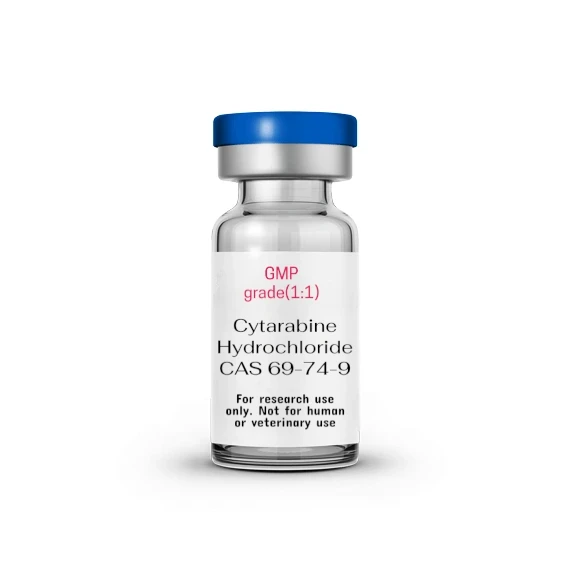
Cytarabine Hydrochloride | CAS 69-74-9 | Nucleoside Analog for Preclinical DNA Synthesis and Apoptosis Research
Original price was: $3.00.$2.00Current price is: $2.00.
Cytarabine Hydrochloride (CAS 69-74-9) is a high-purity nucleoside analog supplied as powder for preclinical research. It is used to investigate DNA synthesis inhibition, S-phase arrest, apoptosis induction, and cytotoxicity mechanisms in cellular and molecular oncology studies.
Description
Contents
hide
Product Description
Cytarabine Hydrochloride (Ara-C HCl), CAS 69-74-9, is a synthetic pyrimidine nucleoside analog widely used in preclinical oncology research to inhibit DNA synthesis and induce apoptosis in rapidly proliferating cells. Structurally related to deoxycytidine, Cytarabine incorporates into DNA during replication, leading to chain termination, S-phase arrest, and activation of DNA damage responses.
Its high-purity powder form allows precise dosing in in vitro and in vivo studies, enabling researchers to investigate cellular mechanisms underlying cytotoxicity, DNA replication stress, cell-cycle regulation, and apoptotic pathways. Cytarabine Hydrochloride is a vital tool for exploring drug resistance mechanisms, combination therapy effects, and DNA damage repair pathways in cancer research.
Upon cellular uptake, Cytarabine is phosphorylated by deoxycytidine kinase to its active triphosphate form, Ara-CTP. Ara-CTP competes with deoxycytidine triphosphate during DNA synthesis, resulting in chain termination and stalled replication forks. The accumulation of DNA damage triggers ATR/ATM-mediated checkpoint signaling, leading to cell-cycle arrest and apoptosis via caspase-dependent pathways.
Cytarabine Hydrochloride is widely used in combination studies with kinase inhibitors, chemotherapeutic agents, or DNA repair modulators to evaluate synergistic or antagonistic cytotoxic effects. Its powder formulation ensures high stability, accurate quantification, and reproducibility for both in vitro cytotoxicity assays and in vivo preclinical models.
Product Specifications
| Parameter | Specification / Data |
|---|---|
| Chemical Name / Synonyms | Cytarabine Hydrochloride; Ara-C HCl; C9H14N3O5·HCl |
| CAS Number | 69-74-9 |
| Molecular Formula | C9H14N3O5·HCl |
| Molecular Weight | 243.64 g/mol |
| Purity / Assay | ≥99% |
| Appearance | White to off-white crystalline powder |
| Dosage Form | Powder for research use |
| Solubility | Soluble in water, DMSO, or other laboratory-grade solvents |
| Concentration | Typically prepared 1–10 mM solutions for in vitro assays |
| Storage Temperature | 2–8 °C; protect from light and moisture |
| Stability | Stable under refrigeration; avoid repeated freeze-thaw cycles |
| Analytical Methods | HPLC, MS, NMR verified; batch consistency confirmed |
| Mechanistic Target | DNA polymerase, DNA synthesis, S-phase arrest, apoptosis |
| Structural Category | Nucleoside analog, DNA synthesis inhibitor |
| Applications | Cytotoxicity studies, DNA synthesis inhibition, apoptosis research, cell-cycle analysis, combination therapy research, drug resistance modeling |
| Batch Consistency | Verified by HPLC, MS, NMR |
| Regulatory Notes | For laboratory research use only |
| Origin | Factory small-molecule supplier, China chemical manufacturer, OEM & bulk production available |
| Additional Data | SMILES: C1=NC(=NC(=O)N1C2C(C(C(O2)CO)O)O)N.Cl; CoA provided for each batch |
Mechanism of Action
DNA Synthesis Inhibition
Cytarabine Hydrochloride is phosphorylated intracellularly to Ara-CTP, which competes with deoxycytidine triphosphate during DNA synthesis. Incorporation into DNA leads to chain termination, replication fork stalling, and S-phase arrest.
DNA Damage Response Activation
Stalled replication forks trigger ATR/ATM-mediated checkpoint signaling.
CHK1 and CHK2 phosphorylation occurs, initiating DNA repair pathways.
p53-dependent and independent apoptosis pathways are engaged.
Apoptosis Induction
Mitochondrial depolarization and cytochrome c release.
Reactive oxygen species (ROS) generation contributes to cytotoxic stress.
Caspase-3 and -9 activation triggers intrinsic apoptotic pathways.
Combination and Resistance Studies
Cytarabine is widely used to study combination effects with DNA repair inhibitors, kinase inhibitors, or chemotherapeutic agents. It is also employed to investigate resistance mechanisms such as nucleoside transporter deficiency, deoxycytidine kinase mutations, and DNA repair pathway compensation.

Side Effects
Cellular Effects:
S-phase arrest and replication fork stalling
DNA damage accumulation
ROS-mediated oxidative stress
Apoptotic Effects:
Activation of caspase-dependent mitochondrial apoptosis
p53-dependent and independent cell death
Laboratory Handling:
Handle with PPE in a fume hood
Strictly for laboratory research; cytotoxic properties require caution
Keywords
Cytarabine Hydrochloride, Ara-C HCl, nucleoside analog, DNA synthesis inhibitor, S-phase arrest, apoptosis research, cytotoxicity studies, cell-cycle analysis, combination therapy research, drug resistance modeling, high-purity research chemical, factory small-molecule supplier, China chemical manufacturer, OEM & bulk production, laboratory research reagent
Shipping Guarantee
All Cytarabine Hydrochloride shipments of Cytarabine Hydrochloride powder are handled using validated cold-chain logistics to preserve compound integrity. Packages are sealed with protective wrapping and shipped via express international couriers with tracking and insurance.
Trade Assurance
We Cytarabine Hydrochloride guarantee product authenticity, verified ≥99% purity, and compliance with analytical standards (HPLC, MS, NMR). Each batch is supplied with a Certificate of Analysis (CoA). Replacement or refund is provided for any deviation from listed specifications.
Payment Support
Flexible global payment options: PayPal, major credit cards (Visa, MasterCard, American Express), T/T, USDT, Bitcoin, Ethereum. All transactions are encrypted and verified to ensure confidentiality and security.
Disclaimer
Cytarabine Hydrochloride is supplied strictly for laboratory research. Not for human or veterinary use. Researchers must adhere to institutional safety guidelines. Supplier assumes no liability for misuse.
References

Additional information
| Weight | 1.1 kg |
|---|---|
| Dimensions | 18 × 16 × 18 cm |
What is Cytarabine Hydrochloride used for in laboratory research?
Cytarabine Hydrochloride is a nucleoside analog used to inhibit DNA synthesis, induce apoptosis, and study cell-cycle arrest mechanisms in preclinical oncology research.
What is the purity of Cytarabine Hydrochloride supplied?
All batches are verified ≥99% purity using HPLC, MS, and NMR.
How should Cytarabine Hydrochloride powder be stored?
Store at 2–8 °C, protect from light and moisture. Avoid repeated freeze-thaw cycles.
Can Cytarabine Hydrochloride be used for combination therapy studies?
Yes, it is frequently combined with DNA repair inhibitors, chemotherapeutic agents, or kinase inhibitors to study synergistic or antagonistic cytotoxic effects.
How does Cytarabine Hydrochloride induce apoptosis in cells?
Through S-phase arrest, replication fork stalling, mitochondrial depolarization, ROS generation, and caspase-3/-9 activation.
Is Cytarabine Hydrochloride suitable for resistance mechanism studies?
Yes, it can be used to explore resistance via nucleoside transporter deficiencies or deoxycytidine kinase mutations.
Is Cytarabine Hydrochloride supplied by a China chemical manufacturer?
Yes, sourced from verified factory small-molecule suppliers with OEM & bulk production available.
What analytical methods confirm Cytarabine Hydrochloride quality?
Verified by HPLC, MS, and NMR, with each batch supplied with CoA.
Can Cytarabine Hydrochloride powder be used in in vivo preclinical studies?
Yes, it can be formulated for animal studies with appropriate dosing.
Are high-purity Cytarabine Hydrochloride powders available for research use?
Yes, all batches meet ≥99% purity standards.
How does Cytarabine Hydrochloride affect cell-cycle checkpoints?
Causes S-phase arrest, replication stress, and activation of ATR/ATM-CHK1/CHK2 signaling pathways.
Can Cytarabine Hydrochloride be used for DNA damage and repair studies?
Yes, it is widely used to study DNA replication stress, checkpoint activation, and apoptosis.
Is bulk ordering of Cytarabine Hydrochloride powder available?
Yes, OEM & bulk production is available for preclinical research labs.
Does Cytarabine Hydrochloride require special lab handling?
Yes, use PPE and fume hood; strictly for research.
What applications are suitable for high-purity Cytarabine Hydrochloride?
DNA synthesis inhibition studies, apoptosis research, cell-cycle analysis, cytotoxicity assays, combination therapy evaluation, and drug resistance modeling.
Related products
Mechlorethamine Hydrochloride High Purity | Factory Manufactured | Laboratory Research Use Only
High-purity Mechlorethamine Hydrochloride Solution manufactured under strict factory-controlled conditions, designed exclusively for in vitro, biochemical, and molecular mechanism research. Suitable for laboratories requiring bulk, wholesale, or customized research-grade supply.
$1.00Lenalidomide 25mg High Purity | Factory Manufactured
High-purity Lenalidomide Tablets designed for laboratory research, in vitro mechanistic studies, and multi-omic pathway analysis. Factory-manufactured with consistent quality for bulk and wholesale supply, these tablets provide reliable receptor-modulation and molecular mechanism research capabilities. Original price was: $3.00.$2.00Current price is: $2.00.Temozolomide 100mg — Laboratory Research Grade Chemical
Temozolomide is a high-purity alkylating research compound widely used in in vitro molecular mechanism studies focusing on DNA methylation, damage response pathways, and cell cycle regulation. It is suitable for laboratory-based biochemical and mechanistic research applications only.
Original price was: $6.00.$3.00Current price is: $3.00.Aprepitant 80mg | 99% High Purity | Laboratory Research Use Only
High-purity Aprepitant, factory-manufactured for in vitro mechanistic studies and molecular pathway research. Supplied as a stable powder for laboratories requiring bulk, wholesale, or customized research-grade supply. $1.00


Reviews
There are no reviews yet.