
No products in the cart.
Sale

Docetaxel | CAS 148408-61-6 | Microtubule Stabilizing Anticancer Agent for Tumor Research
Original price was: $3.00.$2.00Current price is: $2.00.
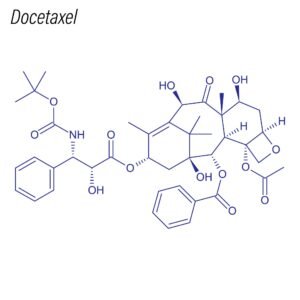
Docetaxel is a semi-synthetic taxane derivative widely used in anticancer research for its potent microtubule-stabilizing activity. It promotes tubulin polymerization, inhibits mitotic spindle disassembly, and induces cell cycle arrest at the G2/M phase, ultimately leading to apoptosis. This compound is utilized extensively in laboratory studies focused on tumor cell proliferation, cytotoxicity, and chemotherapeutic mechanism elucidation.
Description
Contents
hide
Product Description
Docetaxel is a potent chemotherapeutic agent derived from the European yew tree (Taxus baccata) and semi-synthesized to enhance solubility and stability for laboratory use. It exerts its antitumor effects primarily through stabilization of microtubules, thereby preventing their normal dynamic reorganization necessary for mitotic progression. This stabilization leads to G2/M phase cell cycle arrest, inhibition of cell proliferation, and induction of programmed cell death.
Docetaxel has demonstrated activity across multiple tumor models, including breast, lung, prostate, and ovarian cancers. In vitro studies show that it disrupts microtubule dynamics by binding to the β-subunit of tubulin, suppressing microtubule depolymerization. This interference results in mitotic spindle dysfunction, prolonged mitotic arrest, and activation of apoptosis pathways through caspase signaling.
Preclinical research highlights Docetaxel’s ability to enhance tumor cell sensitivity to combination therapies, including radiation and targeted agents. Its biochemical properties also allow investigation of mechanisms of multidrug resistance (MDR) mediated by P-glycoprotein and related transporters. Researchers have explored Docetaxel’s impact on tumor microenvironment, angiogenesis, and signaling pathways such as PI3K/Akt and MAPK/ERK, making it a versatile compound in oncology research.
Additionally, Docetaxel exhibits unique pharmacokinetic features, including high plasma protein binding, slow elimination, and extensive hepatic metabolism predominantly through CYP3A4. These characteristics are critical for experimental design in in vitro and in vivo studies, influencing dose selection, administration schedules, and toxicity evaluation.
Its applications extend beyond cancer cell cytotoxicity, serving as a molecular probe to study microtubule dynamics, spindle checkpoint regulation, and apoptosis mechanisms. Researchers also employ Docetaxel in exploring synergistic effects with novel anticancer compounds, immunotherapies, and gene-targeted approaches.
Product Specifications
| Item | Details |
|---|---|
| Product Name | Docetaxel |
| CAS Number | 148408-61-6 |
| Synonyms | Taxotere, RP 56976 |
| Molecular Formula | C43H53NO14 |
| Molecular Weight | 807.88 g/mol |
| Purity | ≥99% |
| Appearance | White to off-white crystalline powder |
| Solubility | Soluble in DMSO, ethanol, and polysorbate 80 |
| Storage Temperature | 2–8 °C |
| Category | Anticancer agent |
| Applications | Tumor research, microtubule studies, apoptosis research |
| Formulation | Suitable for in vitro cell culture studies and preclinical models |
| Stability | Stable under recommended storage conditions |
| Shelf Life | 24 months |
| Supplier Type | Research chemical supplier |
| Intended Use | For laboratory research use only |
Mechanism of Action
Docetaxel exerts its biological effects primarily through microtubule stabilization. The detailed mechanisms include:
1. Microtubule Stabilization
Docetaxel binds to the β-tubulin subunit, promoting tubulin polymerization and inhibiting microtubule depolymerization. This stabilization impairs normal spindle function during mitosis, causing prolonged mitotic arrest.
2. G2/M Cell Cycle Arrest
Interference with spindle dynamics triggers activation of the spindle assembly checkpoint (SAC). Cells are unable to progress past the G2/M phase, leading to inhibition of cell proliferation and accumulation of cells in mitosis.
3. Apoptosis Induction
Prolonged mitotic arrest activates intrinsic apoptosis pathways, including mitochondrial membrane potential disruption, cytochrome c release, and caspase cascade activation. Docetaxel-mediated apoptosis involves both caspase-dependent and -independent pathways.
4. Anti-Angiogenic Effects
Preclinical studies demonstrate Docetaxel can inhibit tumor-associated angiogenesis by disrupting endothelial cell microtubules, reducing vascular network formation, and suppressing VEGF-mediated signaling.
5. Modulation of Multidrug Resistance
Docetaxel research provides insight into MDR mechanisms, particularly P-glycoprotein-mediated efflux. Experimental models using Docetaxel help explore chemosensitization strategies and MDR reversal approaches.
6. Signaling Pathway Regulation
Docetaxel impacts multiple signaling pathways, including PI3K/Akt, MAPK/ERK, and NF-κB. These interactions influence cell survival, apoptosis, and tumor progression in preclinical studies.
Side Effects
In controlled research settings, Docetaxel may induce cytotoxicity in tumor and normal cells. Observed in vitro and in vivo effects include:
Apoptotic cell death at high concentrations
Microtubule bundle formation disrupting normal cell architecture
Cell cycle perturbations leading to mitotic arrest
Dose-dependent cytotoxicity in non-tumor cell lines
Researchers must carefully titrate concentrations in cell-based assays to balance efficacy and biocompatibility. Protective measures such as proper PPE, biosafety cabinets, and adherence to institutional protocols are mandatory.
Docetaxel is for laboratory research use only and is not intended for human or veterinary administration. Its handling requires awareness of potential cytotoxic effects and environmental precautions.
Keywords
Docetaxel, CAS 148408-61-6, taxane derivative, microtubule stabilizer, tumor research, anticancer agent, apoptosis induction, cell cycle arrest, high-purity chemical, research chemical supplier
Shipping Guarantee
All shipments are handled using validated cold-chain logistics to preserve compound integrity. Each package is sealed in moisture-proof containers with secondary protective wrapping and continuous temperature monitoring. Products are shipped via express international couriers with full tracking and insurance coverage.
Trade Assurance
We ensure product authenticity, verified ≥99% purity, and compliance with analytical standards (HPLC, MS, and NMR). Each batch is supplied with a Certificate of Analysis (CoA). Our trade assurance policy guarantees replacement or refund for any deviation from listed specifications.
Payment Support
We provide flexible and secure global payment options to support international research transactions. Accepted payment methods include PayPal, major credit cards (Visa, MasterCard, American Express), telegraphic transfer (T/T), and cryptocurrencies (USDT, Bitcoin, Ethereum). All transactions are protected by industry-standard encryption and verified payment gateways to ensure confidentiality and fund security.
Disclaimer
All products listed are intended for laboratory research use only and not for human or veterinary use. They are not drugs, medical devices, or diagnostics and should not be administered to humans or animals. Researchers must handle all materials in accordance with institutional biosafety and chemical safety guidelines. The information provided is for scientific reference only and does not imply therapeutic efficacy, safety, or regulatory approval.

Additional information
| Weight | 1.1 kg |
|---|---|
| Dimensions | 18 × 16 × 18 cm |
1. What is Docetaxel used for in research?
Docetaxel is used in oncology research to study microtubule stabilization, cell cycle arrest, apoptosis, and tumor suppression mechanisms.
2. What is the purity of Docetaxel provided?
The Docetaxel supplied is of high purity, ≥99%, verified through HPLC and MS analysis.
3. How should Docetaxel be stored?
Store between 2–8 °C, protected from light and moisture to maintain stability.
4. What is the appearance of Docetaxel?
It appears as a white to off-white crystalline powder.
5. Is Docetaxel soluble in water?
Docetaxel is poorly soluble in water but dissolves readily in DMSO, ethanol, and polysorbate 80 for research applications.
6. Can Docetaxel be used in combination studies?
Yes, it is commonly used in combination with other chemotherapeutic agents, targeted molecules, or experimental treatments in research.
7. Where is Docetaxel manufactured?
Docetaxel is produced by a certified research chemical supplier under controlled laboratory conditions in China.
8. Does Docetaxel come with quality documentation?
Each batch includes a Certificate of Analysis (CoA) confirming ≥99% purity and analytical verification.
9. Can Docetaxel be used in in vivo models?
Yes, it can be used in preclinical animal studies under strict institutional and ethical guidelines.
10. What safety precautions are recommended?
Use appropriate PPE, handle in biosafety cabinets, and follow local chemical safety protocols.
11. Can Docetaxel be purchased in bulk?
Yes, bulk research-grade Docetaxel is available for academic and industrial research use.
12. What is the shelf life of Docetaxel?
The compound remains stable for up to 24 months under recommended storage conditions.
13. Is Docetaxel suitable for formulation studies?
Yes, it is suitable for in vitro studies and preclinical formulations but not for clinical or therapeutic use.
14. What is the mechanism by which Docetaxel induces apoptosis?
Docetaxel stabilizes microtubules, leading to mitotic arrest and subsequent activation of intrinsic and extrinsic apoptosis pathways.
15. Does Docetaxel affect normal cells?
Yes, at higher concentrations, it may induce cytotoxicity in non-tumor cell lines, so careful experimental design is necessary.
Related products
Cetuximab NO1 100 mg/50 mL | High purity | Factory manufactured
Cetuximab NO1 (100 mg/50 mL, Solution) is a high-purity monoclonal antibody solution manufactured under stringent factory-controlled conditions for in vitro laboratory research and molecular mechanism studies. Its solution format facilitates precise dosing, reproducible assay preparation, and integration into receptor-binding and signaling pathway research workflows.
Original price was: $3.00.$2.00Current price is: $2.00.Elranatamab 76mg solution — Laboratory Research Grade Reagent
Elranatamab is a high-purity bispecific monoclonal antibody designed for in vitro studies of target engagement, molecular signaling, and cellular interaction mechanisms. It is intended exclusively for laboratory research, enabling precise mechanistic investigations in controlled experimental systems.
Original price was: $6.00.$3.00Current price is: $3.00.Aprepitant 80mg | 99% High Purity | Laboratory Research Use Only
High-purity Aprepitant, factory-manufactured for in vitro mechanistic studies and molecular pathway research. Supplied as a stable powder for laboratories requiring bulk, wholesale, or customized research-grade supply. $1.00Toremifene Citrate 60mg for scientific research
High-purity Toremifene Citrate Tablets designed exclusively for in vitro molecular mechanism research, receptor-binding analysis, and biochemical pathway modulation studies. Factory-manufactured with consistent batch quality, suitable for bulk and wholesale supply.(For research use only. Not for human or veterinary use.) $1.00


Reviews
There are no reviews yet.