
No products in the cart.
Sale

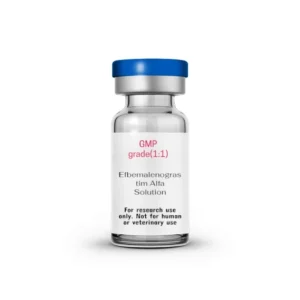
Efbemalenograstim Alfa Solution CAS 2200269‑79‑8 | Research‑Grade Long‑Acting G‑CSF (dimeric)
Original price was: $1,680.00.$1,534.00Current price is: $1,534.00.
High‑purity Efbemalenograstim Alfa Solution (CAS 2200269‑79‑8) is a recombinant, long‑acting G‑CSF fusion protein for mechanistic research. It consists of a dimeric human G‑CSF linked to an IgG2 Fc fragment, offering extended half-life in experimental models.
Description
Contents
hide
Product Description
Efbemalenograstim Alfa Solution (CAS 2200269‑79‑8) is a high-purity, recombinant, long-acting G-CSF fusion protein designed exclusively for laboratory and mechanistic research. Structurally, it consists of a dimer of human G-CSF molecules linked to a human IgG2 Fc fragment, forming a stable dimeric configuration that prolongs protein half-life through Fc-mediated recycling. This extended stability allows sustained receptor engagement, enabling precise studies of granulopoiesis, signal transduction, and progenitor cell proliferation under controlled experimental conditions.
In vitro and ex vivo models benefit from the prolonged G-CSF receptor activation provided by Efbemalenograstim Alfa, as it supports extended JAK/STAT signaling, particularly STAT3 and STAT5 phosphorylation. Researchers can monitor downstream transcriptional responses, anti-apoptotic gene expression, and differentiation kinetics in primary hematopoietic progenitor cells. The sterile solution format eliminates variability associated with lyophilized reconstitution, ensuring reproducible concentrations and reliable mechanistic observations in cell culture systems.
The design of Efbemalenograstim Alfa allows investigators to model long-term granulopoiesis, examine receptor internalization, and study feedback regulation of the G-CSF signaling pathway. It serves as a robust tool to evaluate progenitor cell proliferation, neutrophil survival, and the impact of extended cytokine exposure in experimental settings. By integrating with assays such as phospho-STAT flow cytometry, gene expression profiling, and proliferation measurements (CFU-G, BrdU), researchers can comprehensively assess the mechanistic effects of sustained G-CSF receptor activation without any human-use implications.
Additionally, Efbemalenograstim Alfa facilitates comparative studies with other G-CSF variants, including standard and pegylated forms, to understand differences in signaling kinetics, receptor engagement, and functional outcomes. Its consistent purity (>97%) and fully traceable batch documentation provide reliability in mechanistic research and high reproducibility across experimental runs. The fusion protein also enables integration into multi-omic and computational studies, supporting systems-level analysis of granulopoiesis, receptor dynamics, and cytokine-mediated cellular responses in non-clinical laboratory models.
Overall, Efbemalenograstim Alfa Solution is an indispensable research-grade reagent for laboratories investigating G-CSF biology, progenitor cell expansion, and mechanistic signaling pathways. It offers extended half-life, high reproducibility, and controlled experimental applicability, ensuring that investigators can conduct in-depth mechanistic studies in in vitro and ex vivo systems without introducing human-use variables.
Product Specifications
| Specification | Details |
|---|---|
| Compound Name | Efbemalenograstim Alfa (F‑627) |
| CAS Number | 2200269‑79‑8 |
| Synonyms | F‑627, Bineuta, Benegrastim |
| Molecular Design | Dimeric human G-CSF fused to human IgG2 Fc via a peptide linker |
| Molecular Weight / MW | ~89.5 kDa (non-glycosylated), glycosylated form characterized |
| Purity | >97% (per Certificate of Analysis) |
| Form | Aqueous sterile solution (research grade) |
| Solubility / Buffer | Provided in laboratory-compatible buffer at high concentration |
| Storage Conditions | –80°C for long-term, –20°C short-term; avoid repeated freeze-thaw cycles |
| Shipping | Temperature-controlled, sterile packaging |
| Intended Use | In vitro and ex vivo mechanistic research only |
| Documentation | Batch-specific CoA and traceability included |
Efbemalenograstim Alfa is produced under rigorous quality control to ensure high purity, stability, and reproducibility for mechanistic studies. The sterile solution format allows direct use in experimental assays, eliminating variability associated with reconstitution. Researchers can rely on Efbemalenograstim Alfa for studies of G-CSF receptor signaling, granulopoiesis, STAT activation, progenitor proliferation, and differentiation in controlled laboratory systems. Each batch is fully documented with a Certificate of Analysis, ensuring consistent quality and reliable mechanistic data across in vitro and ex vivo experiments.
Mechanism of Action
Efbemalenograstim Alfa (CAS 2200269‑79‑8) functions as a long-acting, dimeric G-CSF fusion protein, specifically engineered for research purposes to engage the granulocyte colony-stimulating factor receptor (G-CSFR) in controlled experimental systems. By simultaneously presenting two G-CSF moieties, Efbemalenograstim Alfa promotes high-affinity binding to G-CSFR on hematopoietic progenitor cells, activating downstream JAK/STAT signaling pathways, predominantly STAT3 and STAT5. This sustained signaling supports proliferation, differentiation, and survival of granulocytic progenitors in in vitro and ex vivo models.
The inclusion of the IgG2 Fc fragment enhances stability and reduces proteolytic clearance via FcRn-mediated recycling, extending the duration of receptor engagement in experimental assays. This design allows researchers to examine prolonged signaling dynamics, receptor internalization, and feedback mechanisms without introducing clinical administration variables. Efbemalenograstim Alfa provides a reproducible platform to study G-CSF-dependent transcriptional regulation, anti-apoptotic pathways, and granulocyte lineage commitment in mechanistic research.
In experimental contexts, investigators can use Efbemalenograstim Alfa to probe the kinetics of STAT phosphorylation, quantify receptor density and recycling, and measure downstream gene expression changes. Its consistent quality and high purity enable comparative studies with other G-CSF variants, including standard and pegylated forms, allowing mechanistic insights into differences in receptor activation, signal duration, and cellular responses. By maintaining controlled experimental conditions, Efbemalenograstim Alfa facilitates detailed investigation of cytokine-mediated proliferation and survival pathways in primary progenitor cells, bone marrow organoids, and hematopoietic stem cell cultures.
Overall, the mechanism of action of Efbemalenograstim Alfa provides researchers with a highly reliable tool to study G-CSF receptor biology, STAT-dependent signaling, and granulopoietic responses in laboratory models. Its long-acting, dimeric design ensures sustained receptor engagement, reproducibility, and mechanistic clarity for advanced experimental research.
Research Models
Efbemalenograstim Alfa (CAS 2200269‑79‑8) is extensively utilized in diverse laboratory research models to study granulopoiesis, G-CSF receptor signaling, and progenitor cell biology. In vitro systems using primary human or murine hematopoietic stem and progenitor cells allow researchers to examine proliferation, differentiation, and survival under controlled experimental conditions. Efbemalenograstim Alfa provides sustained activation of the G-CSFR, enabling precise evaluation of downstream JAK/STAT signaling, transcriptional responses, and anti-apoptotic mechanisms.
Three-dimensional ex vivo models, including bone marrow organoids and scaffolds, benefit from Efbemalenograstim Alfa’s long-acting properties, supporting extended studies of neutrophil lineage commitment and microenvironment interactions. These models allow investigators to monitor receptor internalization, signal duration, and feedback regulation in a physiologically relevant context while avoiding human-use implications.
Additionally, Efbemalenograstim Alfa is employed in co-culture systems to study interactions between hematopoietic progenitors and stromal cells, immune cell modulation, and niche-dependent granulopoiesis. Its dimeric Fc-fusion design ensures protein stability and reproducibility across experiments, which is critical when integrating multi-omic analyses or computational modeling of G-CSF signaling pathways.
For mechanistic studies, researchers can quantify STAT3/5 phosphorylation, assess gene expression changes, and evaluate proliferation markers such as CFU-G colonies or BrdU incorporation. Efbemalenograstim Alfa also serves as a reference reagent in comparative studies of long-acting G-CSF variants, allowing assessment of receptor kinetics, signaling duration, and cellular response profiles.
Overall, these research models provide a robust framework to study the mechanistic effects of Efbemalenograstim Alfa on hematopoietic progenitors, enabling reproducible, high-fidelity investigations into granulopoiesis, receptor dynamics, and cytokine-mediated cellular responses in laboratory settings.
Experimental Design Considerations
When designing laboratory experiments with Efbemalenograstim Alfa (CAS 2200269‑79‑8), careful planning is essential to maximize mechanistic insight while maintaining reproducibility. Researchers should consider the concentration range, duration of exposure, and timing relative to cell cycle stages to achieve controlled activation of G-CSFR without inducing artificial receptor saturation. Efbemalenograstim Alfa’s long-acting, dimeric Fc-fusion design allows extended receptor engagement, so experimental protocols should account for prolonged signaling when planning sampling intervals and endpoint analyses.
Control conditions are critical for valid mechanistic interpretation. Parallel experiments using standard G-CSF, Fc-only proteins, or vehicle controls help distinguish effects specifically attributable to Efbemalenograstim Alfa. Researchers may implement time-course studies to monitor STAT3/STAT5 phosphorylation, receptor internalization, and downstream transcriptional responses in primary hematopoietic progenitor cultures or ex vivo organoid systems.
Replicates and sample randomization enhance statistical robustness, particularly in high-resolution assays such as phospho-proteomics, flow cytometry, or multi-omic profiling. Consideration of biological variability, including donor-derived progenitor cells or differences between organoid preparations, is essential to ensure reproducible results. Efbemalenograstim Alfa also supports integration with multi-omic and computational modeling studies, allowing researchers to simulate signaling dynamics and predict progenitor cell behavior under varying experimental conditions.
Additional considerations include medium composition, culture density, and potential interactions with co-cultured stromal or immune cells. By accounting for these parameters, investigators can optimize mechanistic studies of G-CSF signaling, progenitor cell proliferation, and differentiation using Efbemalenograstim Alfa. Careful experimental design ensures high reproducibility, reliable mechanistic data, and robust insight into granulopoietic pathways in laboratory research.
Analytical Methods & Assays
Experimental readouts for Efbemalenograstim Alfa include:
Phospho-STAT3/STAT5 analysis by Western blot or flow cytometry.
ELISA or qPCR for downstream gene expression (c-Myc, BCL-XL).
Proliferation assays (CFU-G, BrdU, MTT) in progenitor cells.
Receptor internalization and recycling analysis through imaging or biotinylation assays.
Integration with multi-omic studies to map global signaling changes.
Integration with Multi-Omic & Computational Studies
Efbemalenograstim Alfa (CAS 2200269‑79‑8) serves as a critical tool for integrating laboratory research with multi-omic and computational approaches to dissect G-CSF signaling and granulopoietic mechanisms. Its long-acting, dimeric design provides sustained G-CSFR engagement, enabling precise temporal control over JAK/STAT activation, which is essential for high-resolution multi-omic analyses. Researchers can combine transcriptomics, proteomics, phospho-proteomics, and epigenomics to comprehensively characterize cellular responses to Efbemalenograstim Alfa in hematopoietic progenitors.
In transcriptomic studies, Efbemalenograstim Alfa allows identification of genes regulated by STAT3/STAT5 pathways, including anti-apoptotic, proliferation-related, and differentiation-associated targets. Proteomic and phospho-proteomic profiling further reveals downstream signaling dynamics, post-translational modifications, and feedback regulation under controlled laboratory conditions. The stability and reproducibility of Efbemalenograstim Alfa ensure consistent mechanistic data, critical for computational modeling of G-CSF receptor kinetics, signal transduction networks, and granulopoiesis.
Computational approaches leverage experimental data from Efbemalenograstim Alfa studies to simulate receptor-ligand interactions, intracellular signaling cascades, and progenitor cell population dynamics. These models enable predictive insights into dose-response effects, temporal signaling patterns, and network plasticity, which are invaluable for mechanistic understanding of cytokine-mediated hematopoiesis. Researchers can integrate multi-omic datasets to identify novel regulatory nodes, evaluate pathway crosstalk, and validate experimental hypotheses in silico before laboratory validation.
Overall, Efbemalenograstim Alfa provides a robust and reproducible platform for combining experimental biology with computational and systems-level analyses. Its consistent long-acting activity, dimeric structure, and high purity facilitate detailed mechanistic studies, supporting both experimental and in silico investigations of G-CSF signaling, progenitor cell biology, and granulopoiesis in laboratory research.
Applications
Efbemalenograstim Alfa (CAS 2200269‑79‑8) is widely utilized in laboratory research for mechanistic studies of G-CSF receptor signaling, granulopoiesis, and hematopoietic progenitor cell biology. Its long-acting dimeric Fc-fusion design allows sustained receptor engagement, enabling researchers to investigate downstream JAK/STAT pathways, transcriptional regulation, and anti-apoptotic mechanisms in controlled experimental systems.
In vitro applications include the stimulation of primary hematopoietic stem and progenitor cell cultures to study proliferation, differentiation, and survival. Efbemalenograstim Alfa is particularly valuable for examining extended STAT3/STAT5 phosphorylation kinetics, receptor internalization, and feedback regulation. Its stability and reproducibility make it suitable for quantitative assays, including CFU-G colony formation, BrdU incorporation, and flow cytometry-based differentiation markers.
Ex vivo studies in bone marrow organoids, co-culture systems, or tissue slices benefit from the protein’s prolonged activity, supporting sustained granulopoietic signaling without repeated supplementation. Researchers can model niche-dependent progenitor expansion, immune-stromal interactions, and differentiation trajectories, enabling high-fidelity mechanistic insights.
Efbemalenograstim Alfa also serves as a reference reagent in comparative studies of long-acting G-CSF variants, including standard and pegylated forms. It is applied in multi-omic experiments, systems biology analyses, and computational modeling to explore signaling network dynamics, progenitor cell kinetics, and cytokine-mediated regulatory feedback. Its reproducibility ensures consistent mechanistic data across laboratories, enhancing the reliability of experimental outcomes.
Overall, Efbemalenograstim Alfa provides a robust platform for mechanistic, experimental, and laboratory-based investigations into G-CSF biology, granulopoiesis, and hematopoietic progenitor function, offering controlled, reproducible, and high-resolution insights for research applications.
Side Effects (Research Observations)
In laboratory and mechanistic studies, Efbemalenograstim Alfa (CAS 2200269‑79‑8) has been observed to induce a range of predictable, non-clinical cellular responses that are relevant to in vitro and ex vivo experimentation. The primary observations involve heightened activation of the JAK/STAT signaling pathway, particularly STAT3 and STAT5, leading to increased proliferation of hematopoietic progenitor cells. Sustained exposure to Efbemalenograstim Alfa may result in receptor internalization, downregulation of G-CSFR on the cell surface, and subsequent attenuation of signaling over extended experimental time courses.
Experimental systems also demonstrate elevated anti-apoptotic gene expression and prolonged survival of granulocytic progenitors or neutrophil-lineage cells when treated with Efbemalenograstim Alfa. These responses are mechanistically informative, enabling researchers to examine feedback loops, SOCS protein regulation, and transcriptional modulation associated with long-acting G-CSF signaling. In co-culture or organoid models, prolonged cytokine activity may alter cell-cell interactions, potentially affecting stromal support or niche-mediated differentiation patterns.
Other mechanistic observations include modest shifts in cell cycle distribution, reflecting the proliferative stimulation induced by Efbemalenograstim Alfa, and changes in differentiation kinetics when applied over extended experimental periods. These effects are consistent with the protein’s mechanism as a dimeric G-CSF Fc-fusion, enhancing receptor engagement and providing a controlled model to study prolonged granulopoietic signaling.
It is important to note that all side effects are limited to experimental and laboratory settings. Efbemalenograstim Alfa is strictly a research-grade reagent, and these observations do not imply any clinical adverse events. Researchers can leverage these mechanistic effects to optimize experimental design, assess signaling thresholds, and study feedback regulation in hematopoietic progenitor cultures, organoids, and ex vivo models, providing high reproducibility and mechanistic insight in laboratory research.
Keywords
Efbemalenograstim Alfa, F-627, dimeric G-CSF, G-CSF Fc fusion, long-acting G-CSF, research-grade G-CSF, granulopoiesis, G-CSF signaling, STAT3 activation, hematopoietic progenitor, receptor internalization, in vitro research, ex vivo studies, mechanistic studies, Tumor Research
Shipping Guarantee
All shipments of Efbemalenograstim Alfa (CAS 2200269‑79‑8) are conducted under strict laboratory-grade conditions to maintain protein stability and activity. Temperature-controlled packaging prevents degradation due to heat, cold, or light exposure. Each batch is shipped with full traceability, including a Certificate of Analysis and batch-specific documentation. This ensures that researchers receive high-quality, sterile Efbemalenograstim Alfa suitable for mechanistic studies without compromise.
Trade Assurance
Efbemalenograstim Alfa is manufactured in compliance with rigorous laboratory standards, with factory-controlled quality and batch consistency. Bulk, wholesale, and customized options are available to support diverse experimental requirements. Each lot includes full documentation to facilitate reproducible mechanistic research. Researchers can rely on Efbemalenograstim Alfa for controlled laboratory applications across multiple experimental models.
Payment Support
Multiple secure payment options are supported for laboratory purchases of Efbemalenograstim Alfa, including wire transfers and verified online platforms. Transactions are encrypted and verified to protect laboratory budgets and ensure safe delivery. Flexible payment arrangements are available for bulk orders or long-term research programs. This allows laboratories to maintain continuous access to high-purity Efbemalenograstim Alfa without disruption.
Disclaimer
Efbemalenograstim Alfa is strictly for laboratory and experimental research and is not intended for human or veterinary use. Researchers must adhere to standard laboratory safety protocols and maintain controlled storage conditions. All applications described are limited to in vitro or ex vivo experimental systems. Use of Efbemalenograstim Alfa in mechanistic studies ensures reproducible, high-fidelity data while preventing any clinical or human-use implications.
References
FDA BLA review of Efbemalenograstim (F‑627): accessdata.fda.gov
DrugBank entry for G-CSF analogs: go.drugbank.com
GLP Bio datasheet for F‑627: glpbio.com
Biocat / TargetMol product specification: biocat.com

Additional information
| Weight | 1.1 kg |
|---|---|
| Dimensions | 18 × 18 × 16 cm |
Q1: What is Efbemalenograstim Alfa used for in research?
A1: Efbemalenograstim Alfa (CAS 2200269‑79‑8) is used in laboratory studies to investigate G-CSF receptor signaling, granulopoiesis, and hematopoietic progenitor proliferation. It provides a reproducible platform for in vitro and ex vivo mechanistic experiments.
Q2: How should Efbemalenograstim Alfa be stored?
A2: Efbemalenograstim Alfa should be stored at –80°C for long-term use or –20°C for short-term experiments. Avoid repeated freeze-thaw cycles to maintain protein stability and biological activity.
Q3: Can Efbemalenograstim Alfa be used in vivo?
A3: Efbemalenograstim Alfa is strictly a research-grade reagent and is intended only for laboratory experiments. It is not approved for human or veterinary use.
Q4: What cell types can be used with Efbemalenograstim Alfa?
A4: Researchers commonly apply Efbemalenograstim Alfa to primary hematopoietic stem and progenitor cells, neutrophil precursors, and ex vivo bone marrow organoid models. It facilitates controlled mechanistic studies of granulopoiesis.
Q5: How long does Efbemalenograstim Alfa remain active in culture?
A5: The dimeric Fc-fusion design of Efbemalenograstim Alfa ensures extended receptor engagement, allowing prolonged activation of JAK/STAT signaling in experimental models. Duration should be accounted for when designing time-course assays.
Q6: Can Efbemalenograstim Alfa be used in multi-omic studies?
A6: Yes, Efbemalenograstim Alfa is ideal for integrating transcriptomics, proteomics, phospho-proteomics, and computational modeling. Its reproducibility enables high-quality mechanistic data for systems-level analyses.
Q7: Is Efbemalenograstim Alfa suitable for co-culture experiments?
A7: Efbemalenograstim Alfa can be applied in co-culture systems, including stromal and hematopoietic progenitor cells, to study cell-cell interactions and niche-dependent granulopoiesis.
Q8: How is the purity of Efbemalenograstim Alfa verified?
A8: Each batch of Efbemalenograstim Alfa is analyzed for >97% purity, with full Certificate of Analysis documentation. This ensures reproducible experimental outcomes across laboratories.
Q9: Can Efbemalenograstim Alfa be compared to other G-CSF variants?
A9: Yes, Efbemalenograstim Alfa is frequently used as a reference reagent in comparative studies with standard and pegylated G-CSF to evaluate receptor kinetics, signaling duration, and cellular responses.
Q10: What signaling pathways are primarily activated by Efbemalenograstim Alfa?
A10: Efbemalenograstim Alfa activates the JAK/STAT pathways, particularly STAT3 and STAT5, enabling studies of downstream transcriptional regulation, anti-apoptotic mechanisms, and progenitor cell proliferation.
Q11: Can Efbemalenograstim Alfa be applied to organoid models?
A11: Yes, its long-acting properties make Efbemalenograstim Alfa suitable for ex vivo bone marrow organoids, allowing extended studies of granulopoiesis and niche interactions.
Q12: Is sterile technique required for Efbemalenograstim Alfa experiments?
A12: Absolutely. Efbemalenograstim Alfa must be handled under sterile laboratory conditions to prevent contamination and maintain experimental reproducibility.
Q13: How should Efbemalenograstim Alfa be diluted for in vitro studies?
A13: Researchers should dilute Efbemalenograstim Alfa using laboratory-compatible buffer solutions, ensuring consistent concentrations while avoiding degradation or activity loss.
Related products
Telpegfilgrastim Solution 99% High purity | Factory manufactured
High-purity Telpegfilgrastim Solution, factory-manufactured for in vitro molecular mechanism studies and biochemical pathway research. Supplied as a stable solution, ideal for laboratories requiring bulk, wholesale, or customized research-grade supply. $2.00Elranatamab 76mg solution — Laboratory Research Grade Reagent
Elranatamab is a high-purity bispecific monoclonal antibody designed for in vitro studies of target engagement, molecular signaling, and cellular interaction mechanisms. It is intended exclusively for laboratory research, enabling precise mechanistic investigations in controlled experimental systems.
Original price was: $6.00.$3.00Current price is: $3.00.Fulvestrant (Faslodex) 250mg — Laboratory Research Grade Reagent
Fulvestrant (Faslodex) is a high-purity steroidal compound for in vitro molecular mechanism studies, including nuclear receptor binding, transcriptional modulation, and protein interaction research. It is intended exclusively for laboratory research and mechanistic investigations, enabling controlled experimental analysis in biochemical and cellular assays. Original price was: $6.00.$2.00Current price is: $2.00.Toremifene Citrate 60mg for scientific research
High-purity Toremifene Citrate Tablets designed exclusively for in vitro molecular mechanism research, receptor-binding analysis, and biochemical pathway modulation studies. Factory-manufactured with consistent batch quality, suitable for bulk and wholesale supply.(For research use only. Not for human or veterinary use.) $1.00


Reviews
There are no reviews yet.