
No products in the cart.
Sale
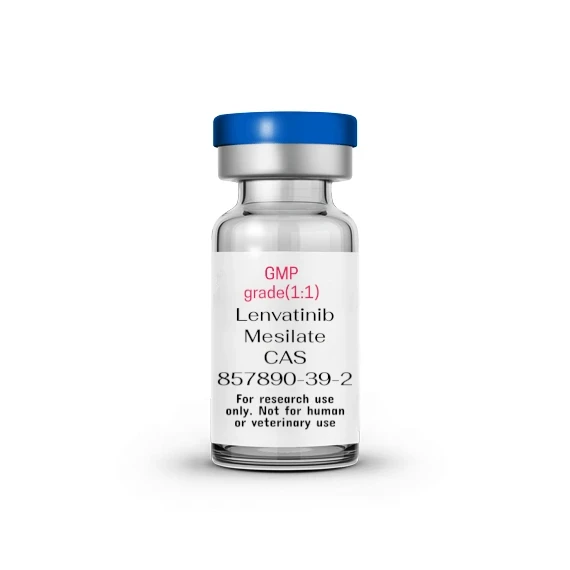

Lenvatinib Mesilate | CAS 857890-39-2 | Multi-Kinase Inhibitor for Preclinical Angiogenesis and Cancer Research
Original price was: $3.00.$2.00Current price is: $2.00.
Lenvatinib Mesilate (CAS 857890-39-2) is a high-purity multi-kinase inhibitor supplied as a solution for preclinical research. It is used to investigate VEGFR, FGFR, PDGFR signaling, tumor angiogenesis, cell proliferation, apoptosis induction, and cytotoxicity mechanisms in cellular and molecular oncology studies.
Description
Product Description
Lenvatinib Mesilate (CAS 857890-39-2) is a highly potent, orally active, multi-targeted tyrosine kinase inhibitor (TKI) that has gained prominence in preclinical oncology research due to its broad-spectrum activity against VEGFR1–3, FGFR1–4, PDGFRα, RET, and KIT. These receptor tyrosine kinases play critical roles in tumor angiogenesis, proliferation, survival, and metastasis. The compound’s solution formulation allows precise dosing in both in vitro and in vivo studies, facilitating mechanistic investigations and pharmacodynamic analyses.
Chemical and Structural Features
Lenvatinib Mesilate is the mesilate salt form of Lenvatinib, a small molecule with a molecular formula of C21H19ClN4O4·CH4O3S and a molecular weight of 426.32 g/mol (free base). The chemical structure consists of a pyrimidine core linked to multiple aromatic and heterocyclic moieties, which confer high affinity for ATP-binding sites on target kinases. This structure allows selective inhibition of VEGFR, FGFR, PDGFR, RET, and KIT kinases, thereby modulating critical signaling pathways in endothelial and tumor cells.
The solution form is typically prepared in DMSO, ethanol, or water-based buffers and can be adjusted between 1–10 mM for experimental needs. Stability studies indicate that the solution is stable under refrigeration (2–8 °C) and should be protected from light to maintain its biological activity. Repeated freeze-thaw cycles should be avoided to prevent degradation.
Pharmacological Significance
Lenvatinib Mesilate demonstrates significant inhibitory activity against key receptor tyrosine kinases involved in angiogenesis and tumor progression:
VEGFR1–3: Lenvatinib blocks VEGF-mediated signaling, preventing endothelial cell proliferation, migration, and tube formation.
FGFR1–4: By inhibiting FGF-driven signaling, it affects tumor microenvironment remodeling, angiogenic sprouting, and contributes to overcoming resistance mechanisms in tumors.
PDGFRα, RET, KIT: These targets are critical in tumor proliferation, survival, and migration. Lenvatinib’s inhibition reduces tumor growth and metastasis potential.
The multi-targeted profile makes Lenvatinib Mesilate a versatile tool for preclinical oncology studies, enabling researchers to dissect the complex signaling networks regulating angiogenesis, proliferation, and apoptosis in cancer models. It has been applied extensively in endothelial cell assays, tumor spheroid models, xenograft studies, and mechanistic in vitro experiments.
Preclinical Applications
Lenvatinib Mesilate solution is particularly suitable for:
Angiogenesis Studies: Investigating VEGFR- and FGFR-mediated pathways in endothelial cells, measuring tube formation, migration, and microvessel density in vitro and in vivo.
Cancer Cell Proliferation Assays: Assessing cell viability, proliferation, and apoptosis in multiple tumor cell lines, including hepatocellular carcinoma, thyroid cancer, and renal cell carcinoma models.
Combination Therapy Research: Evaluating synergistic or antagonistic effects with chemotherapeutics, other kinase inhibitors, immunotherapies, or radiation treatment.
Resistance Mechanism Studies: Studying acquired resistance mechanisms, including upregulation of alternative RTKs, mutations in VEGFR/FGFR, and downstream PI3K/AKT or MAPK/ERK signaling adaptations.
Signal Transduction Investigations: Elucidating downstream pathways modulated by VEGFR/FGFR/PDGFR/RET/KIT, including PI3K/AKT, MAPK/ERK, PLCγ, STAT, and NF-κB pathways.
This extensive utility makes Lenvatinib Mesilate solution an indispensable reagent in oncology research and angiogenesis studies.
Product Specifications
| Parameter | Specification / Data |
|---|---|
| Chemical Name / Synonyms | Lenvatinib Mesilate; E7080 Mesilate; C21H19ClN4O4·CH4O3S |
| CAS Number | 857890-39-2 |
| Molecular Formula | C21H19ClN4O4·CH4O3S |
| Molecular Weight | 426.32 g/mol (free base) |
| Purity / Assay | ≥99% |
| Appearance | Clear to slightly yellow solution |
| Solvent | DMSO, ethanol, water, or laboratory-grade buffers |
| Concentration | Typically 1–10 mM, adjustable per order |
| Storage Temperature | 2–8 °C; protect from light |
| Stability | Stable under refrigeration; avoid repeated freeze-thaw cycles |
| Analytical Methods | HPLC, MS, NMR verified; batch consistency confirmed |
| Mechanistic Target | VEGFR1–3, FGFR1–4, PDGFRα, RET, KIT; apoptosis, angiogenesis inhibition |
| Structural Category | Multi-kinase inhibitor, TKI |
| Applications | Preclinical oncology studies, angiogenesis research, apoptosis assays, combination therapy research, drug resistance modeling |
| Batch Consistency | Verified by HPLC, MS, NMR |
| Regulatory Notes | For laboratory research use only |
| Origin | Factory small-molecule supplier; China chemical manufacturer; OEM & bulk production available |
| Additional Data | SMILES: C1=CC(=C(C=C1)C2=C(C(=O)N(C2=O)C)C3=CC=C(C=C3)Cl)N4C=NC=N4.CS(=O)(=O)O; CoA provided for each batch |
Lenvatinib Mesilate Mechanism of Action
Multi-Kinase Inhibition
Lenvatinib Mesilate acts primarily by binding to the ATP-binding sites of multiple receptor tyrosine kinases: VEGFR1–3, FGFR1–4, PDGFRα, RET, and KIT. By preventing phosphorylation of these kinases, downstream signaling cascades such as PI3K/AKT, MAPK/ERK, PLCγ, STAT, and NF-κB are suppressed, leading to:
Reduced endothelial proliferation and tube formation
Inhibition of tumor cell growth and survival
Induction of apoptotic pathways
Suppression of angiogenesis and metastasis
Apoptosis Induction
Mitochondrial depolarization and cytochrome c release
Activation of caspase-3 and caspase-9, engaging intrinsic apoptotic pathways
ROS generation contributing to oxidative stress
Crosstalk with p53-dependent and independent pathways
Preclinical Research Applications
Angiogenesis Studies: Lenvatinib reduces microvessel density and endothelial cell migration in vitro and in vivo.
Combination Therapy Evaluation: Can be combined with chemotherapeutic agents, immunotherapies, or other TKIs to evaluate synergistic or antagonistic effects.
Resistance Mechanism Research: Used to study VEGFR/FGFR pathway adaptations, compensatory signaling, and kinase mutations in tumor models.
Signal Transduction Analysis: Facilitates mapping of downstream effectors in PI3K/AKT, MAPK/ERK, PLCγ, STAT, and NF-κB pathways.

Lenvatinib Mesilate Side Effects (Preclinical Observations)
Cellular Effects
Reduced endothelial cell proliferation and tube formation
Suppressed tumor cell migration and invasion
Modulation of intracellular calcium signaling and stress-response pathways
ROS-mediated oxidative stress and DNA damage
Apoptotic Effects
Caspase-dependent apoptosis in tumor and endothelial cells
Mitochondrial membrane depolarization and intrinsic pathway activation
p53-dependent and independent apoptotic signaling
Laboratory Handling
Use appropriate PPE and work in a fume hood
Store solution at 2–8 °C and protect from light
Avoid repeated freeze-thaw cycles
Follow institutional biosafety and chemical handling protocols
Keywords
Lenvatinib Mesilate, E7080 Mesilate, multi-kinase inhibitor, VEGFR inhibitor, FGFR inhibitor, PDGFR inhibitor, RET inhibitor, KIT inhibitor, angiogenesis research, apoptosis studies, cytotoxicity assays, preclinical oncology, high-purity research chemical, factory small-molecule supplier, China chemical manufacturer, OEM & bulk production, laboratory research reagent
Shipping Guarantee
All Lenvatinib Mesilate shipments of Lenvatinib Mesilate solution are handled using validated cold-chain logistics to ensure compound integrity. Packages are sealed with secondary protective wrapping and shipped via express international couriers with full tracking and insurance. Shipment conditions are monitored to maintain solution stability and bioactivity during transit.
Trade Assurance
We Lenvatinib Mesilate guarantee the authenticity and quality of all Lenvatinib Mesilate batches. Purity is verified at ≥99% using HPLC, MS, and NMR. Certificates of Analysis (CoA) are provided for each batch. Replacement or refund is assured for any deviation from listed specifications.
Payment Support
Lenvatinib Mesilate Flexible global payment options are available:
PayPal
Major credit cards (Visa, MasterCard, American Express)
Bank transfer (T/T)
Cryptocurrencies (USDT, Bitcoin, Ethereum)
All Lenvatinib Mesilate transactions are encrypted and verified to ensure confidentiality and security.
Disclaimer
Lenvatinib Mesilate is strictly for laboratory research purposes. Not for human or veterinary use. Researchers must adhere to institutional safety and chemical handling protocols. Supplier assumes no liability for misuse.
References
Additional information
| Weight | 1.1 kg |
|---|---|
| Dimensions | 18 × 16 × 18 cm |
What is Lenvatinib Mesilate used for in preclinical research?
Lenvatinib Mesilate is a multi-kinase inhibitor used to study VEGFR, FGFR, PDGFR, RET, and KIT signaling, angiogenesis inhibition, tumor growth suppression, apoptosis, and drug resistance in cellular and animal models.
How does Lenvatinib Mesilate inhibit angiogenesis?
By blocking VEGFR1–3 and FGFR1–4 phosphorylation, Lenvatinib prevents endothelial proliferation, migration, and tube formation, reducing tumor vascularization in preclinical models.
What is the purity of Lenvatinib Mesilate solution?
All batches are verified ≥99% purity using HPLC, MS, and NMR, ensuring consistent experimental results.
How should Lenvatinib Mesilate solution be stored?
Store at 2–8 °C, protected from light, and avoid repeated freeze-thaw cycles to maintain stability.
Which solvents are compatible with Lenvatinib Mesilate?
It is soluble in DMSO, ethanol, water, and laboratory-grade buffers, allowing flexible formulation for in vitro and in vivo studies.
Can Lenvatinib Mesilate be used for combination therapy studies?
Yes, it is frequently combined with chemotherapeutic agents, immunotherapies, or other kinase inhibitors to evaluate synergistic or antagonistic effects.
Does Lenvatinib Mesilate induce apoptosis?
Yes, it triggers caspase-dependent intrinsic apoptosis, mitochondrial depolarization, and ROS-mediated cytotoxic stress in preclinical models.
Can Lenvatinib Mesilate be applied in in vivo studies?
Yes, the solution form allows accurate dosing in xenograft models, tumor angiogenesis assays, and pharmacodynamic evaluations.
Is special laboratory handling required for Lenvatinib Mesilate?
Yes, use PPE and a fume hood. Strictly follow chemical safety protocols due to its cytotoxic properties.
Is bulk ordering of Lenvatinib Mesilate available?
Yes, OEM and bulk production are available from verified chemical manufacturers.
What analytical methods confirm batch quality?
Quality is confirmed using HPLC, MS, and NMR, with each batch accompanied by a Certificate of Analysis (CoA).
How does Lenvatinib Mesilate affect downstream signaling pathways?
It inhibits PI3K/AKT, MAPK/ERK, PLCγ, STAT, and NF-κB pathways downstream of VEGFR/FGFR/PDGFR/RET/KIT inhibition.
Can Lenvatinib Mesilate suppress tumor cell proliferation?
Yes, it inhibits tumor growth and proliferation in multiple preclinical cancer models.
Are high-purity Lenvatinib Mesilate solutions available?
Yes, all batches meet ≥99% purity standards for research use.
What are the recommended preclinical applications?
Angiogenesis research, tumor proliferation studies, apoptosis assays, cytotoxicity testing, combination therapy evaluation, and drug resistance mechanism investigation.
Related products
Irinotecan Hydrochloride Liposome 43mg for scientific research
High-purity Irinotecan Hydrochloride Liposome Solution, factory-manufactured for in vitro molecular mechanism studies and controlled biochemical pathway research. Supplied as a stable liposomal solution suitable for laboratories requiring bulk, wholesale, or customized research-grade supply. Original price was: $2.00.$1.00Current price is: $1.00.Toremifene Citrate 60mg for scientific research
High-purity Toremifene Citrate Tablets designed exclusively for in vitro molecular mechanism research, receptor-binding analysis, and biochemical pathway modulation studies. Factory-manufactured with consistent batch quality, suitable for bulk and wholesale supply.(For research use only. Not for human or veterinary use.) $1.00Temozolomide 100mg — Laboratory Research Grade Chemical
Temozolomide is a high-purity alkylating research compound widely used in in vitro molecular mechanism studies focusing on DNA methylation, damage response pathways, and cell cycle regulation. It is suitable for laboratory-based biochemical and mechanistic research applications only.
Original price was: $6.00.$3.00Current price is: $3.00.Iparomlimab and Tuvonralimab 50 mg/2 mL Solution
Iparomlimab and Tuvonralimab is a high-purity monoclonal antibody solution supplied at 50 mg/2 mL by factory manufacturing with low-price wholesale availability. Designed exclusively for in vitro molecular mechanism studies, protein interaction assays, and signaling pathway research, it provides reproducible and reliable experimental performance. Strictly for laboratory research use. $1.00


Reviews
There are no reviews yet.