
No products in the cart.
Sale
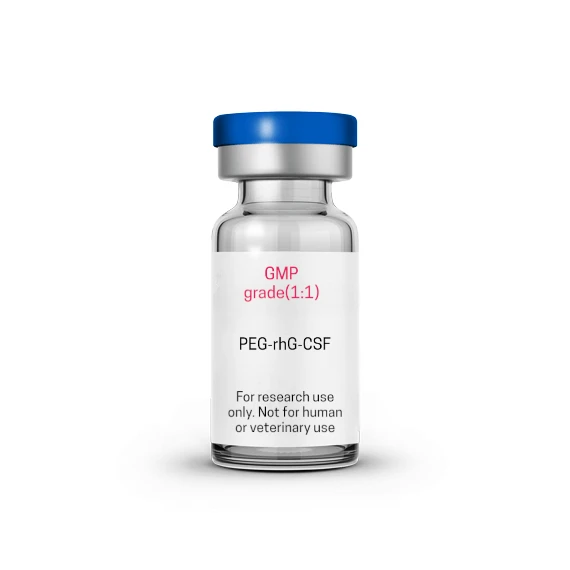

PEG‑rhG‑CSF | PEGylated Recombinant Human G-CSF for Hematopoietic Research
Original price was: $4.00.$2.00Current price is: $2.00.
PEG‑rhG‑CSF is a laboratory-grade PEGylated recombinant human granulocyte colony-stimulating factor (G-CSF) designed for experimental research on hematopoiesis, neutrophil proliferation, and bone marrow stimulation. Its PEGylation enhances molecular stability, prolongs half-life, and supports mechanistic studies in vitro and in vivo.
Description
Product Description
PEG‑rhG‑CSF is a recombinant human granulocyte colony-stimulating factor (rhG‑CSF) that has been covalently conjugated with polyethylene glycol (PEG) to enhance its molecular stability and prolong its half-life for laboratory research. This PEGylated form is designed to maintain full biological activity while offering improved solubility, reduced immunogenicity, and extended circulation in experimental models.
The primary biological function of PEG‑rhG‑CSF is to bind to the G‑CSF receptor (G‑CSFR) on hematopoietic progenitor cells in bone marrow, activating intracellular signaling cascades that stimulate proliferation, differentiation, and maturation of neutrophilic granulocytes. Laboratory studies use PEG‑rhG‑CSF to model hematopoietic recovery, study cytokine-receptor interactions, and investigate signal transduction pathways including JAK/STAT, MAPK, and PI3K/AKT.
In vitro research demonstrates that PEGylation does not significantly alter receptor-binding affinity, but it enhances protein stability against enzymatic degradation, proteolysis, and aggregation. This property allows for more consistent dosing and extended incubation periods in experimental cell cultures.
Experimental applications of PEG‑rhG‑CSF include:
Hematopoietic progenitor assays: Investigating cell proliferation, differentiation, and colony formation in bone marrow cultures.
Immune modulation studies: Examining neutrophil expansion, chemotaxis, and functional activity in vitro and animal models.
Pharmacokinetic modeling: Evaluating the effects of PEGylation on protein half-life, biodistribution, and receptor occupancy.
Signal transduction research: Studying intracellular pathways activated by G‑CSFR engagement.
Combination studies: Exploring synergistic effects with cytokines, growth factors, or experimental therapeutics in laboratory models.
PEG‑rhG‑CSF is supplied as a sterile lyophilized powder or solution, with ≥95% purity, suitable for laboratory preparation and in vitro or in vivo research. Each batch undergoes strict quality control, including protein characterization, PEGylation confirmation, and bioactivity assays. This ensures reproducibility, experimental accuracy, and reliable modeling of neutrophil biology.
Product Specifications
| Item | Details |
|---|---|
| Product Name | PEG‑rhG‑CSF |
| CAS Number | N/A |
| Synonyms | PEGylated recombinant human G-CSF; Pegfilgrastim; PEG-rhG-CSF |
| Molecular Formula | Protein-based, PEG-conjugated |
| Molecular Weight | ~20–40 kDa depending on PEG size |
| Purity | ≥95% |
| Appearance | White to off-white lyophilized powder |
| Solubility | Soluble in sterile water, PBS, and buffer solutions |
| Storage Temperature | −20 °C for long-term; 2–8 °C for short-term use |
| Category | PEGylated recombinant protein, research-grade cytokine |
| Applications | Hematopoietic research, neutrophil proliferation studies, immune modulation assays, preclinical pharmacology |
| Formulation | Lyophilized powder, reconstitutable with sterile buffer; experimental solution preparation |
| Stability | Stable under recommended storage; resistant to proteolytic degradation |
| Shelf Life | 12–24 months depending on formulation |
| Supplier Type | Laboratory research protein supplier |
| Intended Use | For laboratory research use only |
Mechanism of Action
PEG‑rhG‑CSF functions as a potent hematopoietic growth factor by binding to the G-CSF receptor on progenitor cells, initiating intracellular signaling pathways that drive neutrophil production and maturation.
Receptor Binding
PEG‑rhG‑CSF interacts with G-CSFR expressed on hematopoietic stem and progenitor cells. This high-affinity binding triggers receptor dimerization and conformational changes, activating downstream signaling cascades.
Signal Transduction
Activation of G-CSFR initiates JAK/STAT, MAPK, and PI3K/AKT pathways, promoting transcriptional programs that regulate cell proliferation, survival, and differentiation.
PEGylation Advantages
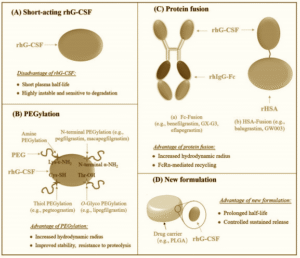
Covalent attachment of PEG chains improves protein solubility, prolongs half-life, reduces immunogenicity, and enhances stability against proteases. This allows extended exposure in experimental systems without significant loss of bioactivity.
In Vitro and In Vivo Research Applications
PEG‑rhG‑CSF is widely used in:
Cell culture models to quantify neutrophil lineage expansion
Hematopoietic colony-forming unit (CFU) assays
Pharmacokinetic and pharmacodynamic modeling in animal studies
Investigating signaling cross-talk and combination effects with other cytokines

Side Effects
In laboratory studies, PEG‑rhG‑CSF demonstrates minimal cytotoxicity at research concentrations. Off-target effects are rare but may include transient changes in cell viability or proliferation at high experimental doses. Researchers should monitor experimental conditions carefully, including protein concentration, incubation time, and culture environment.
PEG‑rhG‑CSF is not intended for human or veterinary administration outside of laboratory research.
Keywords
PEG‑rhG‑CSF, PEGylated recombinant human G-CSF, hematopoietic research, neutrophil proliferation studies, bone marrow stimulation, cytokine research, preclinical pharmacology, laboratory research protein, high-purity recombinant protein, immune modulation assays, factory peptide supplier, peptide wholesale China, cosmetic raw material manufacturer, low-price peptide supplier, China peptide manufacturer, OEM & bulk peptide production
Shipping Guarantee
All shipments of PEG‑rhG‑CSF are handled using validated cold-chain logistics to preserve protein integrity. Each package is sealed in sterile, moisture-proof containers with secondary protective wrapping and continuous temperature monitoring. Products are shipped via express international couriers with full tracking and insurance coverage, ensuring delivery without degradation or loss of bioactivity.
Trade Assurance
We guarantee the authenticity and high purity (≥95%) of PEG‑rhG‑CSF. Each batch undergoes stringent quality control, including protein characterization, PEGylation confirmation, and bioactivity assays. A Certificate of Analysis (CoA) is provided for each batch. Our trade assurance policy ensures replacement or refund for any deviation from listed specifications, including purity, PEGylation integrity, or stability.
Payment Support
We provide secure and flexible payment options for global transactions, supporting PayPal, major credit cards (Visa, MasterCard, American Express), telegraphic transfer (T/T), and cryptocurrencies (USDT, Bitcoin, Ethereum). All transactions are encrypted and verified, ensuring fund security and confidentiality.
Disclaimer
All PEG‑rhG‑CSF products are intended for laboratory research use only. They are not drugs, medical devices, or diagnostics, and should not be administered to humans or animals. Researchers must follow institutional biosafety and chemical safety guidelines. Information provided is for scientific reference only and does not imply therapeutic efficacy, safety, or regulatory approval.

Additional information
| Weight | 1.1 kg |
|---|---|
| Dimensions | 18 × 16 × 18 cm |
Q1: What is PEG‑rhG‑CSF used for?
A1: PEG‑rhG‑CSF is used in research to study hematopoietic progenitor proliferation, neutrophil regulation, and immune cell maturation in preclinical models.
Q2: Is PEG‑rhG‑CSF a high-purity protein?
A2: Yes, it is ≥95% pure, verified by HPLC, SDS-PAGE, and bioactivity assays, ensuring reliable laboratory research outcomes.
Q3: How should PEG‑rhG‑CSF be stored?
A3: For long-term storage, keep at −20 °C; for short-term laboratory use, 2–8 °C is acceptable. Avoid repeated freeze-thaw cycles to preserve activity.
Q4: What is the typical appearance of PEG‑rhG‑CSF?
A4: White to off-white lyophilized powder or solution for laboratory reconstitution.
Q5: Can PEG‑rhG‑CSF be used in combination with other cytokines?
A5: Yes, it is suitable for combination studies to investigate synergistic effects, signal transduction interactions, and hematopoietic modulation.
Q6: Is PEG‑rhG‑CSF stable during storage?
A6: Yes, it is stable under recommended storage conditions, with PEGylation enhancing resistance to proteolysis and aggregation.
Q7: Where is PEG‑rhG‑CSF manufactured?
A7: Produced under research-grade conditions in China, ensuring consistent purity, bioactivity, and PEGylation quality.
Q8: Are OEM or bulk production services available?
A8: Yes, OEM, bulk, and contract manufacturing for research purposes are available from professional suppliers.
Q9: What documentation is provided with PEG‑rhG‑CSF?
A9: Each batch includes a CoA confirming identity, ≥95% purity, PEGylation integrity, and bioactivity validation.
Q10: Is PEG‑rhG‑CSF water-soluble?
A10: Yes, it dissolves readily in sterile water, PBS, and other physiological buffers for in vitro and in vivo research.
Q11: What type of supplier provides PEG‑rhG‑CSF?
A11: Professional laboratory research protein suppliers specializing in high-purity recombinant proteins.
Q12: Does PEG‑rhG‑CSF contain preservatives?
A12: No, it is supplied in pure form without preservatives or stabilizers to maintain laboratory-grade integrity.
Related products
Elranatamab 76mg solution — Laboratory Research Grade Reagent
Elranatamab is a high-purity bispecific monoclonal antibody designed for in vitro studies of target engagement, molecular signaling, and cellular interaction mechanisms. It is intended exclusively for laboratory research, enabling precise mechanistic investigations in controlled experimental systems.
Original price was: $6.00.$3.00Current price is: $3.00.Iparomlimab and Tuvonralimab 50 mg/2 mL Solution
Iparomlimab and Tuvonralimab is a high-purity monoclonal antibody solution supplied at 50 mg/2 mL by factory manufacturing with low-price wholesale availability. Designed exclusively for in vitro molecular mechanism studies, protein interaction assays, and signaling pathway research, it provides reproducible and reliable experimental performance. Strictly for laboratory research use. $1.00Ivodazumab solution (lvonescimab) High Purity | Factory Manufactured
High-purity Ivodazumab Injection (lvonescimab) designed for laboratory research, in vitro mechanistic studies, and receptor-targeted molecular pathway analysis. Factory-manufactured with consistent quality for bulk and wholesale supply, this injectable formulation provides reliable antibody-mediated receptor modulation for mechanistic and multi-omic studies.
Original price was: $3.00.$2.00Current price is: $2.00.Cetuximab NO1 100 mg/50 mL | High purity | Factory manufactured
Cetuximab NO1 (100 mg/50 mL, Solution) is a high-purity monoclonal antibody solution manufactured under stringent factory-controlled conditions for in vitro laboratory research and molecular mechanism studies. Its solution format facilitates precise dosing, reproducible assay preparation, and integration into receptor-binding and signaling pathway research workflows.
Original price was: $3.00.$2.00Current price is: $2.00.


Reviews
There are no reviews yet.