
No products in the cart.
Sale
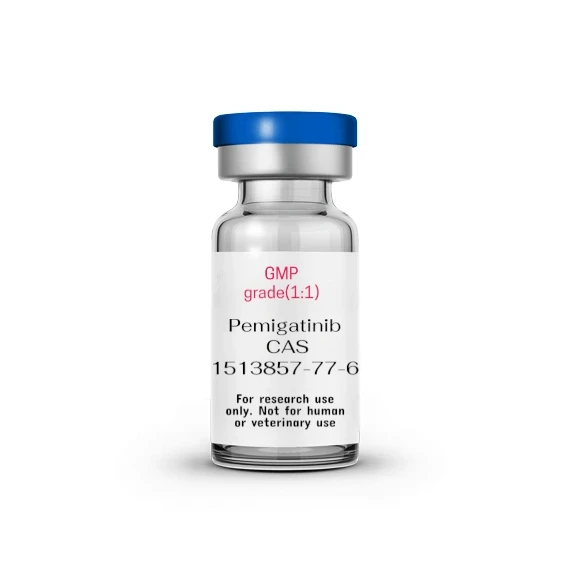

Pemigatinib | CAS 1513857-77-6 | FGFR1/2/3 Inhibitor for Preclinical Oncology and Signal Transduction Research
Original price was: $3.00.$2.00Current price is: $2.00.
Pemigatinib (CAS 1513857-77-6) is a high-purity FGFR1/2/3 inhibitor supplied as tablets for preclinical research, used to investigate FGFR signaling modulation, cell proliferation, apoptosis, and oncogenic pathway studies in cellular and molecular oncology research.
Description
Contents
hide
Product Description
Pemigatinib, CAS 1513857-77-6, is a potent and selective inhibitor of fibroblast growth factor receptors FGFR1, FGFR2, and FGFR3. As a small-molecule kinase inhibitor, it has gained attention in preclinical oncology research for its ability to modulate FGFR-mediated signaling pathways, suppress aberrant cell proliferation, induce apoptosis, and interfere with oncogenic transformation. Pemigatinib’s high specificity enables mechanistic studies of FGFR-driven cancers, including cholangiocarcinoma, bladder carcinoma, and other malignancies with FGFR alterations.
In preclinical models, Pemigatinib binds the ATP-binding pocket of FGFR1–3, preventing autophosphorylation and subsequent downstream signaling through MAPK, PI3K/AKT, and STAT pathways. This leads to reduced proliferation, altered cell-cycle progression, apoptosis induction, and modulation of tumor-relevant gene expression. Its tablet formulation allows precise in vitro dissolution studies, pharmacokinetic investigations, and preclinical in vivo dosing in animal models, providing a reproducible platform for FGFR-targeted oncology research.
Pemigatinib is used extensively to explore mechanisms of FGFR-mediated oncogenic signaling, drug resistance pathways, combination therapy effects, and off-target kinase activity. Its stability as a solid oral dosage form facilitates accurate dosing in cell culture, xenograft models, and pharmacodynamic assays. Researchers can leverage Pemigatinib to dissect FGFR-dependent tumorigenesis, evaluate targeted therapy responses, and understand FGFR pathway modulation in the context of drug development.
Mechanistic studies reveal that Pemigatinib inhibits FGFR autophosphorylation, resulting in downstream blockade of RAS/MAPK, PI3K/AKT, and STAT signaling. This causes G1-phase cell-cycle arrest, suppression of tumor-promoting gene transcription, and induction of intrinsic apoptosis pathways. Its high-purity tablet format ensures reliable experimental outcomes for pharmacological, biochemical, and molecular investigations.
In addition to monotherapy preclinical studies, Pemigatinib is employed in combination assays with chemotherapeutic agents, immune modulators, or other kinase inhibitors to study synergistic or antagonistic effects. Researchers can also examine acquired resistance mechanisms, such as FGFR gatekeeper mutations, receptor amplification, or compensatory pathway activation.
Product Specifications
| Parameter | Specification / Data |
|---|---|
| Chemical Name / Synonyms | Pemigatinib; INCB054828; FGFR1/2/3 inhibitor; C24H23ClFN5O3 |
| CAS Number | 1513857-77-6 |
| Molecular Formula | C24H23ClFN5O3 |
| Molecular Weight | 437.92 g/mol |
| Purity / Assay | ≥99% |
| Appearance | White to off-white tablets |
| Dosage Form | Oral tablets (preclinical research) |
| Strength | Typically 5–25 mg per tablet (adjustable per research needs) |
| Storage Temperature | 2–8 °C; protect from moisture and light |
| Stability | Stable under controlled room temperature; avoid high humidity |
| Analytical Methods | HPLC, MS, NMR verified; batch consistency confirmed |
| Mechanistic Target | FGFR1, FGFR2, FGFR3, MAPK/PI3K/AKT/STAT signaling |
| Structural Category | Small-molecule kinase inhibitor, targeted oncology agent |
| Applications | FGFR signaling research, cell proliferation studies, apoptosis assays, oncogenic pathway investigation, combination therapy modeling, resistance mechanism studies |
| Batch Consistency | Verified by HPLC, MS, NMR |
| Regulatory Notes | For laboratory research use only |
| Origin | Factory small-molecule supplier, China chemical manufacturer, OEM & bulk production available |
| Additional Data | SMILES: CC(C)NC(=O)c1cnc2c(c1)cc(cn2C3CC3)F; CoA provided for each batch |
Mechanism of Action
FGFR Inhibition
Pemigatinib selectively inhibits FGFR1, FGFR2, and FGFR3 by binding the ATP-binding site of the receptor kinases. This prevents autophosphorylation and disrupts downstream signaling cascades responsible for cell proliferation, survival, and differentiation.
Downstream Signaling Modulation
MAPK pathway: Reduced ERK phosphorylation and decreased transcription of proliferation-promoting genes.
PI3K/AKT pathway: Inhibition of survival signaling, promoting apoptosis.
STAT signaling: Impairment of oncogenic transcription factor activation.
Cell-Cycle Arrest and Apoptosis
Induces G1-phase cell-cycle arrest, reducing proliferation.
Activates intrinsic apoptosis pathways via mitochondrial depolarization and caspase activation.
Modulates tumor-relevant gene expression associated with FGFR signaling.
Combination and Resistance Studies
Used in combination assays with chemotherapeutic agents and other kinase inhibitors.
Facilitates study of acquired resistance mechanisms, including FGFR mutations and compensatory signaling.
Enables exploration of FGFR pathway dependency in cancer models.

Side Effects
Cellular Effects:
FGFR pathway inhibition leads to G1-phase arrest
Reduced cell proliferation
Potential induction of ROS in sensitive cell lines
Apoptotic Effects:
Activation of intrinsic apoptosis via mitochondrial pathways
Caspase-dependent cell death
Modulation of p53 and other transcriptional regulators
Laboratory Handling:
Tablets should be handled with PPE
Strictly for laboratory research; cytotoxic and kinase-inhibiting properties require caution
Keywords
Pemigatinib, INCB054828, FGFR inhibitor, FGFR1/2/3 inhibitor, FGFR signaling, targeted oncology research, cell proliferation studies, apoptosis assays, oncogenic pathway studies, combination therapy research, resistance mechanism modeling, high-purity research chemical, factory small-molecule supplier, peptide wholesale China, China chemical manufacturer, OEM & bulk production, laboratory research reagent
Shipping Guarantee
All Pemigatinib shipments of Pemigatinib tablets are handled using validated cold-chain or controlled temperature logistics to maintain compound stability. Packages are sealed with protective wrapping and shipped via express international couriers with tracking and insurance.
Trade Assurance
We Pemigatinib guarantee product authenticity, verified ≥99% purity, and compliance with analytical standards (HPLC, MS, NMR). Each batch is supplied with a Certificate of Analysis (CoA). Replacement or refund is provided for any deviation from listed specifications.
Payment Support
Flexible global payment options: PayPal, major credit cards (Visa, MasterCard, American Express), T/T, USDT, Bitcoin, Ethereum. All transactions are encrypted and verified to ensure confidentiality and security.
Disclaimer
Pemigatinib is supplied strictly for laboratory research. Not for human or veterinary use. Researchers must adhere to institutional safety guidelines. Supplier assumes no liability for misuse.
References
ChEMBL Database: Pemigatinib Bioactivity Summary (CHEMBL4325316)
PubMed ID 30850153: Preclinical studies of Pemigatinib in FGFR-driven cancers

Additional information
| Weight | 1.1 kg |
|---|---|
| Dimensions | 18 × 16 × 18 cm |
What is Pemigatinib used for in laboratory research?
Pemigatinib is a selective FGFR1/2/3 inhibitor used to study FGFR signaling, cell proliferation, apoptosis, and oncogenic pathways.
What is the purity of Pemigatinib supplied?
All batches are verified ≥99% purity using HPLC, MS, and NMR.
How should Pemigatinib tablets be stored?
Store at 2–8 °C, protect from moisture and light.
Can Pemigatinib be used for combination therapy studies?
Yes, it is commonly used with chemotherapeutics or other kinase inhibitors to study synergistic or antagonistic effects.
Does Pemigatinib induce apoptosis in cancer cells?
Yes, through G1-phase arrest and activation of intrinsic apoptosis pathways.
Is Pemigatinib suitable for studying resistance mechanisms?
Yes, it allows exploration of FGFR mutations, receptor amplification, and compensatory pathway activation.
Are high-purity Pemigatinib tablets available for research use?
Yes, all batches meet ≥99% purity standards.
How does Pemigatinib affect FGFR downstream signaling?
Inhibits MAPK, PI3K/AKT, and STAT pathways, reducing proliferation and promoting apoptosis.
Can Pemigatinib support cell-cycle studies?
Yes, it induces G1-phase arrest and checkpoint modulation.
Is Pemigatinib available for bulk preclinical research orders?
Yes, OEM and bulk production services are available.
Does Pemigatinib require special handling in the lab?
Yes, handle with PPE due to kinase-inhibiting and cytotoxic effects.
What applications are suitable for high-purity Pemigatinib tablets?
FGFR signaling research, cell proliferation, apoptosis assays, oncogenic pathway studies, combination therapy modeling, and resistance mechanism studies.
Related products
Irinotecan Hydrochloride Liposome 43mg for scientific research
High-purity Irinotecan Hydrochloride Liposome Solution, factory-manufactured for in vitro molecular mechanism studies and controlled biochemical pathway research. Supplied as a stable liposomal solution suitable for laboratories requiring bulk, wholesale, or customized research-grade supply. Original price was: $2.00.$1.00Current price is: $1.00.Fulzerasib 150mg High Purity | Factory Manufactured
High-purity Fulzerasib (also known as IBI351, GFH925) is a factory-manufactured small-molecule research reagent optimized for in vitro mechanistic studies, KRAS G12C pathway inhibition analysis, and molecular signaling research. Available for bulk and wholesale laboratory use with batch-verified purity and consistent quality. $1.00Toremifene Citrate 60mg for scientific research
High-purity Toremifene Citrate Tablets designed exclusively for in vitro molecular mechanism research, receptor-binding analysis, and biochemical pathway modulation studies. Factory-manufactured with consistent batch quality, suitable for bulk and wholesale supply.(For research use only. Not for human or veterinary use.) $1.00Telpegfilgrastim Solution 99% High purity | Factory manufactured
High-purity Telpegfilgrastim Solution, factory-manufactured for in vitro molecular mechanism studies and biochemical pathway research. Supplied as a stable solution, ideal for laboratories requiring bulk, wholesale, or customized research-grade supply. $2.00


Reviews
There are no reviews yet.