
No products in the cart.
Sale
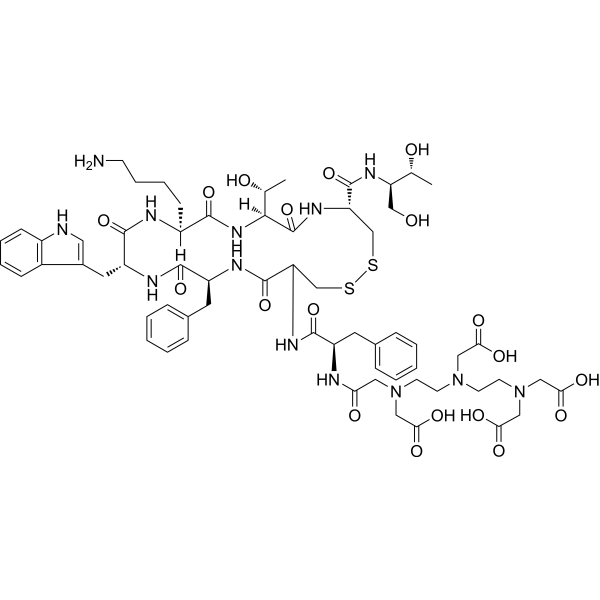
Pentetreotide | CAS 138661-02-6 | Radiolabeled Somatostatin Analog for Neuroendocrine Tumor Imaging
Original price was: $36.00.$32.00Current price is: $32.00.
Pentetreotide (CAS 138661-02-6) is a DTPA-conjugated analog of Octreotide designed for somatostatin receptor imaging. Labeled with indium-111, it enables high-affinity binding to somatostatin receptors on neuroendocrine tumor cells, making it a valuable tool for research in radioligand imaging, tumor localization, and receptor binding dynamics.
Description
Product Description
Pentetreotide is a synthetic peptide conjugated with diethylenetriaminepentaacetic acid (DTPA), engineered to facilitate chelation with radioisotopes such as indium-111 for molecular imaging applications. Functionally, it mimics the pharmacological properties of somatostatin, a natural peptide hormone that inhibits the release of various growth and neuroendocrine factors.
By radiolabeling Pentetreotide with indium, researchers can visualize and quantify somatostatin receptor expression in vivo through single-photon emission computed tomography (SPECT). This technique provides critical insights into tumor localization, receptor density, and metastatic spread, particularly in neuroendocrine tumors (NETs) such as carcinoid tumors, gastrinomas, and insulinomas.
The peptide’s high affinity for somatostatin receptor subtypes 2 and 5 (SSTR2 and SSTR5) underpins its imaging precision. This receptor selectivity allows researchers to map receptor distribution in various tissues, evaluate receptor internalization kinetics, and assess the biological behavior of receptor-positive malignancies.
Structurally, Pentetreotide retains the cyclic octapeptide backbone of Octreotide but incorporates a DTPA moiety at its N-terminus. This chelating group stably binds metallic radioisotopes, enabling controlled synthesis of radiopharmaceutical derivatives. The molecule’s physicochemical stability and receptor affinity make it an ideal candidate for studying peptide-based radiotracers and somatostatin receptor pharmacology.
In addition to its use in nuclear imaging, Pentetreotide serves as a valuable biochemical probe for receptor-binding assays and ligand competition studies. It has facilitated key discoveries regarding receptor trafficking, endocytosis, and ligand-dependent desensitization processes within neuroendocrine cell lines.
Pentetreotide’s robust in vivo binding characteristics and minimal non-specific uptake enhance imaging clarity and quantification accuracy. It also provides a foundation for developing newer radioligands and somatostatin-based diagnostic tracers with improved pharmacokinetics and imaging contrast.
Through its reproducible binding affinity and radiochemical stability, Pentetreotide continues to be indispensable for preclinical and translational research into receptor-targeted imaging strategies.
Product Specifications
| Property | Description |
|---|---|
| Product Name | Pentetreotide |
| CAS Number | 138661-02-6 |
| Synonyms | DTPA-Octreotide; [111In]-Pentetreotide; OctreoScan analog |
| Molecular Formula | C₆₄H₈₂N₁₄O₁₉S₂ |
| Purity | ≥99% |
| Form | Lyophilized peptide powder |
| Storage | −20°C, protected from light and moisture |
| Solubility | Soluble in water, PBS, or DMSO |
| Stability | Stable for ≥12 months under recommended conditions |
| Category | Radiolabeled peptide; Somatostatin analog |
| Applications | Nuclear medicine imaging, receptor binding assays, tumor visualization research |
| Research Area | Radiobiology, Oncology, Molecular Imaging, Pharmacology |
| Intended Use | For laboratory research use only |
Mechanism of Action
Pentetreotide functions as a receptor-specific imaging probe through its high-affinity binding to somatostatin receptors (SSTRs). Upon administration, the radiolabeled peptide selectively binds to SSTR-positive cells, particularly those overexpressing SSTR2 and SSTR5, which are prevalent in neuroendocrine tumors.
Following receptor engagement, the peptide–receptor complex undergoes internalization into the tumor cell, concentrating the radiolabeled signal and allowing for clear imaging via SPECT or planar scintigraphy. This internalization enhances image resolution and enables quantitative receptor mapping.
The DTPA moiety in Pentetreotide acts as a versatile chelating agent, forming stable coordination complexes with trivalent metal ions such as indium (In³⁺). The resulting [¹¹¹In]-Pentetreotide complex exhibits excellent in vivo stability, ensuring that the radiolabel remains intact during biodistribution and imaging.
By exploiting somatostatin receptor overexpression, Pentetreotide provides a receptor-mediated imaging approach distinct from non-specific tracers. This specificity allows precise detection of primary tumors and metastatic lesions, especially in tissues such as the pancreas, gastrointestinal tract, and lungs.
In mechanistic studies, Pentetreotide also aids in understanding receptor-ligand kinetics, receptor recycling, and signal modulation. It reveals how somatostatin analogs inhibit adenylate cyclase activity, reduce calcium influx, and suppress secretion of neuroendocrine hormones—all crucial to tumor cell regulation.
Overall, Pentetreotide’s mechanism combines receptor-specific binding, stable radionuclide chelation, and efficient intracellular trafficking, making it a key molecule for advanced imaging and receptor research.
Side Effects
In preclinical and translational research settings, Pentetreotide has shown favorable tolerability and minimal cytotoxicity when used at experimental concentrations.
Potential observed side effects in model systems include transient receptor desensitization, mild gastrointestinal activity modulation, and minor metabolic alterations due to somatostatin receptor interactions. These effects are generally reversible upon compound clearance.
At supra-physiological doses, Pentetreotide may transiently alter calcium-dependent signaling or hormone secretion in neuroendocrine cell lines. However, these phenomena are rare under typical research dosages and are well-characterized within receptor pharmacology frameworks.
No genotoxic or mutagenic effects have been reported. When properly handled and stored, Pentetreotide maintains high chemical stability without degradation byproducts that could interfere with assay integrity.
As with all research peptides, appropriate handling, shielding from radiation exposure (for radiolabeled forms), and compliance with laboratory safety standards are mandatory.
Disclaimer
is supplied strictly for laboratory research use only. It is not intended for human or veterinary applications, clinical diagnostics, or therapeutic use.
Keywords
CAS 138661-02-6, DTPA-Octreotide, radiolabeled somatostatin analog, neuroendocrine tumor imaging, somatostatin receptor tracer, nuclear medicine research, SSTR imaging compound, indium-111 conjugate, receptor binding peptide
Shipping Guarantee
All peptides are packaged in temperature-controlled containers and shipped under validated cold-chain logistics to ensure chemical stability and purity upon arrival.
Trade Assurance
Each batch of Pentetreotide is verified by HPLC and mass spectrometry. Certificates of Analysis (CoA) are available upon request to confirm identity, purity, and peptide integrity.

Additional information
| Weight | 0.8 kg |
|---|---|
| Dimensions | 65 × 43 × 65 cm |
What is Pentetreotide?
Pentetreotide is a DTPA-conjugated somatostatin analog used as a receptor-targeted radioligand in imaging research.
What is the CAS number of Pentetreotide?
The CAS number is 138661-02-6.
How does Pentetreotide function in imaging?
It binds to somatostatin receptors on tumor cells and, when radiolabeled, enables visualization of receptor-positive tissues through scintigraphy.
What isotope is commonly used with Pentetreotide?
Indium-111 is the standard isotope chelated to Pentetreotide for imaging applications.
What are its key receptor targets?
SSTR2 and SSTR5, both highly expressed in neuroendocrine tumor cells.
Is Pentetreotide stable after labeling?
Yes, the DTPA chelate ensures excellent in vivo stability of the radiolabeled complex.
Can Pentetreotide be used for receptor binding assays?
Yes. It is widely used for in vitro receptor binding and internalization studies.
What is the recommended storage condition?
Store at −20°C, protected from light and moisture.
Is it toxic to cells?
No significant cytotoxicity has been observed under standard laboratory concentrations.
What research areas use Pentetreotide?
It is applied in radiobiology, oncology, receptor imaging, and pharmacological modeling.
Is Pentetreotide for clinical use?
No. It is strictly intended for laboratory research use only.
Related products
Top Quality Peptides Lyophilized Powder – Reta Trutide Fitness and Weight Loss Peptide in Stock | Factory Wholesale
Peptides Function Weight Loss Peptides Moq:10 vials per box Original price was: $38.00.$22.00Current price is: $22.00.Retatrutide cost with insurance
Retatrutide cost with insurance Original price was: $38.00.$26.00Current price is: $26.00.USA-Peptide-Janoshik Lyophilized Peptide Raw Powder for Muscle Building & Weight Loss
Lyophilized peptide raw powder Moq:10 vials per box Appearance:Lyophilized powder Original price was: $32.00.$24.00Current price is: $24.00.Semaglutide finished product (lyophilized powder) wholesale Supplier
Semaglutide finished product (lyophilized powder) wholesale $1.00
Reviews
There are no reviews yet.