
No products in the cart.
Sale

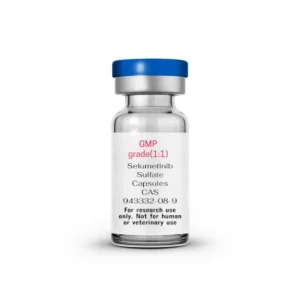
Selumetinib Sulfate Capsules CAS 943332-08-9 – High Purity | Factory Manufactured | Wholesale Supply
Original price was: $3.00.$2.00Current price is: $2.00.
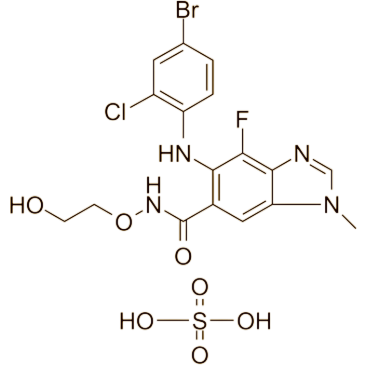
Selumetinib Sulfate Capsules (CAS 943332-08-9) are high-purity, research-grade MEK1/2 pathway modulators designed for controlled in-vitro and in-vivo experimental systems. Manufactured under strict laboratory-grade quality standards, these capsules provide consistent performance for studies investigating MAPK signaling, RAS pathway modulation, cellular stress response, and molecular mechanism discovery.
Description
Contents
hide
Product Description
The research-grade Selumetinib Sulfate Capsules (CAS 943332-08-9) are highly selective allosteric inhibitors of MEK1/2, specifically designed for laboratory mechanistic studies. By reproducibly suppressing ERK1/2 phosphorylation in controlled in-vitro and ex-vivo experimental models, these capsules enable researchers to investigate the RAF–MEK–ERK signaling cascade, feedback mechanisms, and adaptive cellular responses. Their precise activity facilitates detailed mechanistic exploration of MAPK network dynamics, allowing scientists to assess how specific nodes within the signaling pathway influence cellular behavior, transcriptional regulation, and phosphorylation-dependent feedback loops.
In experimental systems, Selumetinib Sulfate allows modulation of ERK-dependent transcriptional networks, protein-protein interactions, and post-translational modifications. Researchers can utilize these capsules to evaluate pathway-specific responses, identify compensatory signaling events, and map regulatory circuits in both established cell lines and primary tissue models. The high selectivity of Selumetinib Sulfate ensures minimal off-target interference, providing reproducible mechanistic insights for multi-omic analyses, computational modeling, and synthetic biology research. This makes it an invaluable tool for dissecting complex signal transduction networks and understanding the molecular underpinnings of pathway regulation in a laboratory context.
Additionally, the capsules serve as a robust reference standard for benchmarking experimental MEK inhibitors and validating laboratory protocols. They are widely employed in studies exploring ERK-mediated transcriptional outputs, feedback control loops, and adaptive signaling in diverse experimental conditions. Integration of Selumetinib Sulfate into controlled experimental designs enables quantitative assessment of pathway inhibition, temporal signaling dynamics, and network perturbation effects. By providing a reliable and reproducible reagent, these capsules support rigorous laboratory research aimed at elucidating molecular mechanisms, pathway interdependencies, and cellular responses without introducing variables associated with human or clinical applications.
Product Specifications
| Specification | Details |
|---|---|
| Compound Name | Selumetinib Sulfate |
| CAS Number | 943332-08-9 |
| Molecular Formula | C24H29FN4O5S•C4H6O6 |
| Molecular Weight | 615.65 g/mol |
| Purity | ≥ 99% by HPLC |
| Form | Capsules |
| Appearance | White to off-white powder encapsulated |
| Solubility | Soluble in DMSO and other laboratory-grade solvents |
| Storage | 2–8°C, dark and dry conditions |
| Shelf Life | ≥ 12 months under recommended storage |
| Batch Documentation | Certificate of Analysis included for each batch |
| Laboratory Use | Mechanistic studies, in-vitro and ex-vivo research only |
Mechanism of Action
Selumetinib Sulfate Capsules (CAS 943332-08-9) act as selective allosteric inhibitors of MEK1/2, blocking the phosphorylation and activation of ERK1/2 within the MAPK signaling pathway in experimental models. This selective inhibition allows researchers to dissect the intricacies of the RAF–MEK–ERK cascade, investigate feedback control mechanisms, and explore adaptive signaling responses in controlled laboratory conditions. By modulating MEK1/2 activity, scientists can examine how downstream ERK signaling governs transcriptional regulation, protein phosphorylation networks, and cellular functional outputs in various in-vitro and ex-vivo systems.
Selumetinib In mechanistic studies, Selumetinib Sulfate provides a reproducible tool to quantify pathway-specific responses, monitor compensatory network activation, and evaluate the dynamic interplay between signaling nodes. It enables detailed characterization of temporal signaling events, dose-dependent effects in laboratory models, and perturbation-induced alterations in MAPK-associated transcriptional and post-translational modifications. The high specificity of the compound ensures minimal off-target activity, making it suitable for mechanistic assays that require precise modulation of MEK1/2 without confounding variables.
Furthermore, Selumetinib Sulfate serves as a reference compound in multi-omic investigations, computational modeling, and synthetic biology experiments. Researchers can employ it to validate experimental MEK inhibitors, simulate adaptive pathway behaviors, and integrate mechanistic data into quantitative signaling models. Its stability and reproducibility provide consistent experimental conditions, ensuring that insights derived from pathway modulation, network dynamics, and feedback analyses remain robust and comparable across laboratory studies.
The Selumetinib compound is also instrumental in exploring cross-talk between the MAPK pathway and other signaling networks. By selectively inhibiting MEK1/2, researchers can investigate how ERK activity influences upstream or parallel pathways, assess regulatory nodes, and map network dependencies. This facilitates a comprehensive understanding of signaling architecture, molecular regulation, and the consequences of targeted pathway modulation in diverse experimental frameworks.

Research Models
Selumetinib Sulfate Capsules (CAS 943332-08-9) are applied across diverse experimental models to investigate MEK1/2-dependent signaling. In 2D cell culture systems, researchers examine phosphorylation dynamics, ERK-dependent transcriptional regulation, and adaptive cellular responses. In 3D spheroid and organoid models, the capsules facilitate study of tissue-level signal propagation and network feedback mechanisms. Ex-vivo tissue slices allow mechanistic analysis in physiologically relevant microenvironments, enabling quantitative assessment of pathway perturbations under controlled laboratory conditions. These models collectively provide robust platforms for pathway mapping, network plasticity evaluation, and mechanistic assay validation.
Experimental Design Considerations
To maximize reproducibility and scientific rigor, experimental design with Selumetinib Sulfate requires careful consideration of model type, exposure duration, and pathway-specific readouts. Researchers implement parallel controls, temporal sampling, and pathway-specific assays to monitor MEK1/2 inhibition. Integration with phospho-protein quantification, transcription factor activity measurement, and network feedback analysis allows comprehensive mechanistic understanding of ERK/MAPK modulation. Consistent laboratory practices, including replicate experiments and standard reagent handling, ensure robust and reproducible results across different experimental setups.
Analytical Methods & Assays
Mechanistic studies with Selumetinib Sulfate Capsules often incorporate a variety of analytical approaches. Western blotting, ELISA, and mass spectrometry quantify ERK1/2 phosphorylation and downstream signaling components. Phospho-protein arrays and imaging-based assays allow spatial and temporal mapping of pathway activity. Multi-omic readouts, including transcriptomics and proteomics, can be integrated to assess network-wide effects of MEK1/2 inhibition. These analytical strategies enable researchers to generate high-resolution mechanistic data while maintaining strict laboratory safety and reproducibility standards.
Integration with Multi-Omic & Computational Studies
The reproducible effects of Selumetinib Sulfate on the RAF–MEK–ERK cascade make it ideal for integration with multi-omic and computational research. Transcriptomic, proteomic, and phosphoproteomic datasets can be combined to model pathway dynamics and network feedback. Computational simulations allow prediction of adaptive signaling, identification of regulatory nodes, and hypothesis generation for experimental validation. By leveraging mechanistic data from Selumetinib Sulfate studies, researchers can develop quantitative models that bridge laboratory findings with broader signaling network analyses in controlled experimental contexts.
Applications
Selumetinib Sulfate Capsules are extensively applied in laboratory research to investigate ERK/MAPK signaling mechanisms. They support in-vitro and ex-vivo studies focused on pathway mapping, signal transduction analysis, and functional network interrogation. Researchers use these capsules to elucidate the impact of MEK1/2 inhibition on phosphorylation cascades, transcription factor activity, and downstream cellular signaling events, enabling mechanistic insights into MAPK pathway regulation.
In multi-omic experimental designs, Selumetinib Sulfate facilitates integration of transcriptomic, proteomic, and phospho-proteomic analyses to study dynamic signaling responses and adaptive mechanisms. The compound enables controlled perturbation of the MAPK network, supporting computational modeling, systems biology simulations, and synthetic biology assays. By providing reproducible MEK inhibition, it serves as a benchmark for comparative studies, validation of experimental inhibitors, and evaluation of network robustness under selective pathway modulation.
Selumetinib Sulfate is also valuable for mechanistic research into signaling cross-talk and compensatory pathways. In controlled laboratory conditions, researchers can examine how ERK suppression influences upstream regulators, feedback loops, and parallel signaling cascades. This enables detailed investigation of molecular interdependencies, regulatory networks, and adaptive responses in both cell line and tissue-based experimental models.
Additionally, the capsules support the development and validation of novel mechanistic assays, high-throughput screening workflows, and pathway-specific laboratory protocols. Their reproducible performance ensures consistent experimental outcomes across multiple studies, providing researchers with a reliable tool for mechanistic exploration, network mapping, and quantitative evaluation of signaling dynamics in a strictly non-clinical research context.
Laboratory Safety & Handling Guidelines
Handling Selumetinib Sulfate Capsules requires adherence to standard laboratory safety protocols. Protective gloves, lab coats, and eye protection are recommended. Experiments should be conducted within fume hoods or designated laboratory workspaces to avoid contamination. Proper storage at 2–8°C in a dark, dry environment preserves compound stability and reproducibility. Waste and residual materials must be disposed of according to institutional laboratory safety regulations. These precautions ensure that laboratory investigations remain safe, controlled, and aligned with the non-clinical research designation of the compound.
Side Effects
As a research-grade compound, Selumetinib Sulfate Capsules are strictly intended for laboratory use. Suppression of MEK1/2 activity in in-vitro and ex-vivo models can lead to measurable alterations in ERK phosphorylation, downstream transcription factor activation, and adaptive signaling responses. These laboratory-observed effects provide valuable mechanistic insights into the regulation of the RAF–MEK–ERK pathway without implying clinical relevance.
In experimental systems, modulation of ERK-dependent signaling may result in altered phosphorylation kinetics, changes in protein-protein interactions, and adjustments in cellular network dynamics. Researchers can quantify these responses using phospho-protein assays, imaging-based readouts, and multi-omic analyses. These laboratory effects enable the study of pathway-specific consequences, compensatory signaling, and the robustness of network perturbations under controlled research conditions.
Handling requires standard laboratory safety protocols to maintain researcher safety and compound integrity. Proper storage conditions preserve stability and consistent experimental outcomes. Understanding these laboratory-observed effects allows researchers to design mechanistic experiments, validate new assay protocols, and interpret signaling perturbation data with high reproducibility.
Keywords
Selumetinib Sulfate, MEK1/2 inhibitor, research-grade, laboratory MEK inhibitor, ERK pathway modulation, MAPK signaling, mechanistic study, experimental pathway analysis, non-clinical research, in-vitro signaling, ex-vivo pathway modeling, laboratory pharmacology, adaptive signaling, cellular network analysis, multi-omic research, synthetic biology inhibitor, RAF-MEK-ERK cascade, pathway perturbation, signaling dynamics
Shipping Guarantee
Secure, traceable shipping of Selumetinib Sulfate Capsules under controlled laboratory conditions. Capsules are packaged to protect against moisture, light, and temperature fluctuations. Tracking information and batch documentation ensure integrity and reproducibility of experimental research applications.
Trade Assurance
Factory-manufactured capsules come with full Certificates of Analysis (CoA) for each batch. Wholesale and bulk supply options are available, guaranteeing consistent quality and reproducibility for mechanistic studies and pathway research.
Payment Support
Selumetinib Multiple secure payment options are provided, including international credit cards, wire transfers, and verified online platforms. All transactions are processed securely to ensure timely delivery of research-grade compounds for controlled laboratory studies.
Disclaimer
Selumetinib Sulfate Capsules are strictly intended for laboratory and experimental research. Not for human, veterinary, or clinical use. Researchers must follow standard safety protocols and controlled storage. This product is provided exclusively for mechanistic, pathway, and signal transduction studies in experimental models.
References
Nature Reviews Molecular Cell Biology: MEK inhibitors in research
Journal of Biological Chemistry: Selumetinib Mechanistic Studies

Additional information
| Weight | 1.1 kg |
|---|---|
| Dimensions | 18 × 16 × 18 cm |
Can Selumetinib Sulfate Capsules be used in human studies?
No. These capsules are strictly for in-vitro and ex-vivo laboratory research only.
What storage conditions are required?
Store in a dark, dry environment at 2–8°C to maintain stability for up to 12 months.
How is the purity of Selumetinib Sulfate verified?
Purity is confirmed using HPLC, NMR, and mass spectrometry.
Is a Certificate of Analysis provided?
Yes, each batch includes a CoA detailing purity, identity, and content uniformity.
Can it be used for pathway mapping studies?
Yes, it is designed for mechanistic studies of ERK/MAPK signaling pathways.
Is it suitable for multi-omic experiments?
Yes, it supports integrated multi-omic laboratory research.
Are there any precautions during handling?
Use gloves, lab coats, eye protection, and handle under a fume hood.
Can it be used in ex-vivo models?
Yes, it is suitable for controlled ex-vivo experimental models.
Does it interfere with other cellular pathways?
Selumetinib Sulfate is highly selective for MEK1/2, minimizing off-target effects in laboratory studies.
Is there a recommended solvent for lab use?
Use appropriate laboratory-grade solvents; follow standard handling protocols.
Can it be used in synthetic biology research?
Yes, it is commonly used in synthetic biology pathway modeling and analysis.
What is the expected stability under lab conditions?
Stable for at least 12 months when stored properly.
Related products
Lenalidomide 25mg High Purity | Factory Manufactured
High-purity Lenalidomide Tablets designed for laboratory research, in vitro mechanistic studies, and multi-omic pathway analysis. Factory-manufactured with consistent quality for bulk and wholesale supply, these tablets provide reliable receptor-modulation and molecular mechanism research capabilities. Original price was: $3.00.$2.00Current price is: $2.00.Fulvestrant (Faslodex) 250mg — Laboratory Research Grade Reagent
Fulvestrant (Faslodex) is a high-purity steroidal compound for in vitro molecular mechanism studies, including nuclear receptor binding, transcriptional modulation, and protein interaction research. It is intended exclusively for laboratory research and mechanistic investigations, enabling controlled experimental analysis in biochemical and cellular assays. Original price was: $6.00.$2.00Current price is: $2.00.Regorafenib 40mg | High Purity | Factory Manufactured | Laboratory Research Use Only
High-purity Regorafenib, factory-manufactured for in vitro mechanistic studies and molecular pathway research. Supplied as a stable solution or powder for laboratories requiring bulk, wholesale, or customized research-grade supply. Original price was: $3.00.$2.00Current price is: $2.00.Granisetron Hydrochloride Dispersible 1mg
High-purity Granisetron Hydrochloride Dispersible is a factory-manufactured research reagent optimized for in vitro receptor binding studies, 5-HT3 receptor mechanistic analysis, and molecular signaling research. Available for bulk and wholesale laboratory use with batch-verified purity and reproducible performance. $1.00


Reviews
There are no reviews yet.