
No products in the cart.
Sale

Sunitinib Malate Capsules | CAS 341031-54-7 | Multi-Target Tyrosine Kinase Inhibitor for Oncology Research
Original price was: $3.00.$2.00Current price is: $2.00.
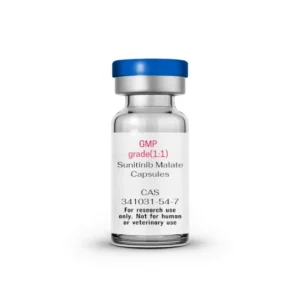
Sunitinib Malate Capsules (CAS 341031-54-7) are multi-target tyrosine kinase inhibitors widely applied in preclinical oncology research to investigate receptor-mediated angiogenesis, tumor proliferation, and metastatic pathways.
Description
Product Description
Sunitinib Malate is a synthetic multi-targeted tyrosine kinase inhibitor primarily designed to block receptor tyrosine kinases such as VEGFR, PDGFR, FLT3, and KIT. It is supplied in capsule form for laboratory research, allowing controlled dosing and easy administration in preclinical models. With high receptor affinity and broad kinase inhibition, Sunitinib Malate is widely used in research studying angiogenesis, tumor growth regulation, and resistance mechanisms in oncology.
In cellular and in vivo studies, Sunitinib Malate suppresses endothelial proliferation, migration, and survival by blocking VEGFR and PDGFR autophosphorylation. These pathways are essential in tumor vascular development and maintenance. By inhibiting multiple kinases, it provides researchers with a model compound to investigate tumor angiogenesis suppression, apoptosis induction, and cell cycle arrest mechanisms.
Product Specifications
| Item | Details |
|---|---|
| Product Name | Sunitinib Malate Capsules |
| CAS Number | 341031-54-7 |
| Molecular Formula | C22H27FN4O2 · C4H6O5 |
| Molecular Weight | 532.6 g/mol |
| Purity | ≥99% |
| Appearance | Yellow to orange powder (encapsulated form) |
| Solubility | Soluble in DMSO, ethanol; slightly soluble in water |
| Storage Temperature | 2–8 °C |
| Category | Multi-target tyrosine kinase inhibitor |
| Applications | Tumor angiogenesis, VEGFR inhibition, oncology pathway research |
| Stability | Stable under recommended storage conditions |
| Formulation | Capsule (research use only) |
| Shelf Life | 24 months |
| Supplier Type | Research chemical manufacturer |
| Intended Use | For laboratory research use only |
Mechanism of Action
Sunitinib Malate acts by competitively inhibiting ATP binding at the catalytic sites of receptor tyrosine kinases, including VEGFR, PDGFR, and c-KIT. This inhibition halts receptor phosphorylation and downstream signal transduction involved in angiogenesis and cell proliferation.
The compound effectively disrupts signaling through the MAPK and PI3K/AKT pathways, leading to growth inhibition, apoptosis induction, and reduced endothelial migration. Its ability to target multiple kinases simultaneously makes it an ideal model to study cross-talk between angiogenic and proliferative pathways in tumor biology.
Preclinical research often focuses on its dual inhibition of tumor vasculature and cancer cell signaling, exploring Sunitinib Malate as a reference molecule for multi-pathway blockade mechanisms.
Side Effects
In preclinical assays, Sunitinib Malate induces expected VEGFR/PDGFR-related effects such as:
- Inhibition of endothelial proliferation and vessel formation.
- Induction of apoptotic signaling in tumor-associated cells.
- Cell cycle arrest in G1 phase.
- Reduced tumor perfusion and altered oxygenation levels.
- Gene modulation involving VEGF-A, HIF-1α, and BCL-2.
All experimental handling should follow institutional chemical safety protocols.
Keywords
Sunitinib Malate, CAS 341031-54-7, tyrosine kinase inhibitor, VEGFR inhibitor, PDGFR inhibitor, multi-target inhibitor, oncology research chemical, antiangiogenic compound, small molecule inhibitor, research-grade kinase blocker.
Shipping Guarantee
All shipments are transported via validated cold-chain logistics to maintain Sunitinib Malate stability. Packages are sealed with moisture-proof, insulated materials and temperature monitoring. Each delivery is fully insured and traceable through international couriers.
Trade Assurance
Our trade assurance guarantees verified product purity (≥99%) and analytical validation via HPLC, MS, and NMR. Every batch includes a Certificate of Analysis (CoA). Refund or replacement is provided if analytical parameters differ from listed specifications.
Payment Support
We accept flexible and secure payment methods: PayPal, Visa, MasterCard, American Express, bank transfer (T/T), and cryptocurrency (USDT, BTC, ETH). All transactions are protected by encryption and verified payment gateways to ensure confidentiality.
Disclaimer
All products are intended for laboratory research only and not for human or veterinary use. They are not drugs, diagnostics, or medical devices. Researchers must follow institutional biosafety and chemical handling standards.

Additional information
| Weight | 1.8 kg |
|---|---|
| Dimensions | 53 × 46 × 53 cm |
What is Sunitinib Malate used for?
It is used in preclinical oncology research to study RTK signaling, tumor angiogenesis inhibition, and tumor proliferation suppression.
Is Sunitinib Malate a peptide?
No, it is a small-molecule multi-target tyrosine kinase inhibitor.
What is the purity of Sunitinib Malate?
≥99%, verified via HPLC and MS.
How should Sunitinib Malate Capsules be stored?
Store at 2–8 °C, protected from light and moisture.
What solvents can Sunitinib Malate dissolve in?
Soluble in DMSO; slightly soluble in ethanol and water.
Can Sunitinib Malate be used in in vivo studies?
Yes, under approved preclinical experimental conditions.
Does the product include documentation?
Yes, each batch comes with a Certificate of Analysis (CoA).
Is bulk purchase or OEM available?
Yes, OEM and bulk production services are offered by research chemical suppliers in China.
Is Sunitinib Malate stable during storage?
Yes, stable for up to 24 months under recommended conditions.
Which research areas utilize Sunitinib Malate?
Angiogenesis studies, tumor proliferation assays, tumor microenvironment research, and receptor tyrosine kinase signaling studies.
Can it be combined with other therapies?
Yes, commonly used with chemotherapeutic agents, targeted therapies, or immunotherapies in research.
What safety precautions are recommended?
Use gloves, lab coat, and fume hood; avoid skin contact and inhalation.
Is it available from peptide wholesale China suppliers?
Yes, supplied by international laboratory chemical distributors.
Can analogues of Sunitinib Malate be synthesized?
Yes, OEM services for analogues and derivatives are available.
Why is Sunitinib Malate valuable for research?
Its selective multi-target RTK inhibition and ≥99% purity allow precise mechanistic studies of angiogenesis, tumor growth, and preclinical oncology pathways.
Related products
Palbociclib 125 mg capsule
Palbociclib is a high-purity small-molecule CDK4/6 inhibitor supplied at 125 mg per vial, specifically formulated for laboratory research and in vitro mechanistic studies. Produced via factory-controlled processes, it ensures high reproducibility and consistent performance for protein interaction assays, signaling pathway analysis, and molecular mechanism research. Strictly for research use only.
$2.00Limertinib (ASK120067) 80mg — Laboratory Research Grade Chemical
Limertinib is a high-purity, irreversible small-molecule inhibitor that selectively targets mutant EGFR in vitro. Designed specifically for laboratory research, it is ideal for investigating signal transduction, kinase activity, and receptor molecular mechanisms in cell-free or in vitro systems. This compound is suitable for mechanistic studies, target validation, and enzymatic assays. Original price was: $3.00.$2.00Current price is: $2.00.Doxorubicin Liposome Solution for scientific research
High-purity Doxorubicin Liposome Solution, factory-manufactured for in vitro molecular mechanism studies and biochemical pathway research. Supplied as a stable liposomal solution, ideal for laboratories requiring bulk, wholesale, or customized research-grade supply. Original price was: $10.00.$8.00Current price is: $8.00.Rilertinib Mesylate 100mg – High Purity | Factory Manufactured | For laboratory use only
High-purity Rilertinib Mesylate, manufactured under controlled factory conditions for in vitro pathway analysis, receptor-binding studies, and molecular mechanism research. Available in bulk and wholesale quantities with consistent batch quality and secure global shipping. $1.00



Reviews
There are no reviews yet.