
No products in the cart.
Sale
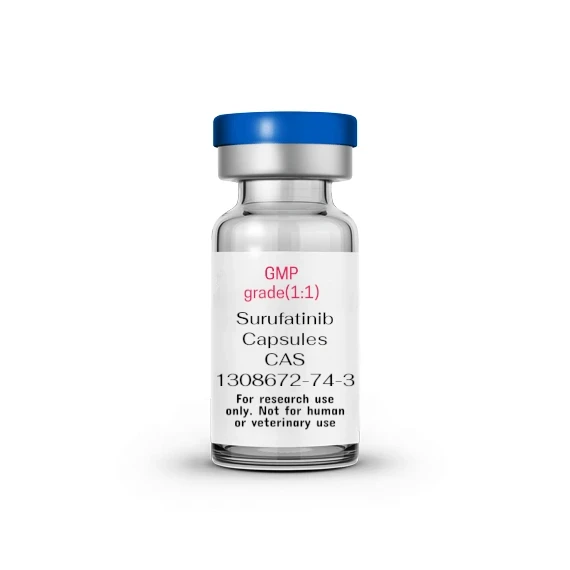
Surufatinib Capsules| CAS 1308672-74-3 | Multi-Kinase Inhibitor for Oncology Research
Original price was: $4.00.$2.00Current price is: $2.00.
Surufatinib (CAS 1308672-74-3) is a selective small-molecule multi-kinase inhibitor that targets VEGFR, FGFR1, and CSF-1R. It is widely used in preclinical oncology research to investigate anti-angiogenic mechanisms, tumor proliferation control, and tumor microenvironment modulation.
Description
Product Description
Surufatinib is a chemically synthesized, orally bioavailable, small-molecule inhibitor designed to target multiple kinases implicated in tumor growth and angiogenesis. Its primary targets are VEGFR1–3, FGFR1, and CSF-1R, making it a versatile research tool for exploring cancer biology, angiogenic signaling, and tumor-immune interactions.
Structurally, Surufatinib contains fluorinated aromatic rings and heterocyclic scaffolds that improve metabolic stability, selectivity, and oral bioavailability. These chemical modifications reduce rapid degradation, allowing sustained intracellular concentrations in experimental assays and preclinical models.
In cellular studies, Surufatinib inhibits VEGFR-mediated endothelial proliferation, migration, and tube formation, suppressing angiogenesis. FGFR1 inhibition disrupts fibroblast growth factor signaling, affecting tumor proliferation and stromal interactions. CSF-1R inhibition modulates tumor-associated macrophage (TAM) activity, allowing research on tumor immune microenvironment interactions.
Preclinical models reveal that Surufatinib reduces phosphorylation of target kinases, decreasing downstream MAPK/ERK and PI3K/AKT signaling, inducing cell cycle arrest, and promoting apoptosis. These effects are useful for exploring tumor growth control, evaluating combination therapies, and studying mechanisms of resistance.
Experimental applications include:
Signal transduction research: Mapping kinase-dependent signaling networks in tumor and endothelial cells.
Angiogenesis studies: Assessing endothelial tube formation, migration, and microvessel density.
Tumor microenvironment modeling: Investigating CSF-1R-mediated macrophage modulation.
Combination therapy evaluation: Studying synergistic effects with chemotherapeutics, immunomodulators, or other targeted inhibitors.
Resistance modeling: Monitoring compensatory pathway activation under chronic kinase inhibition.
Its physicochemical properties, including solubility in DMSO and ethanol, stability, and ≥99% purity, ensure reproducibility in mechanistic studies, high-throughput screening, and preclinical oncology research. Surufatinib provides a robust platform for investigating angiogenesis, tumor-stroma interactions, and immune modulation.
Product Specifications
| Item | Details |
|---|---|
| Product Name | Surufatinib |
| CAS Number | 1308672-74-3 |
| Synonyms | Sulfatinib; HMPL-012; SANOFI-1308672-74-3 |
| Molecular Formula | C22H23FN4O5 |
| Molecular Weight | 434.44 g/mol |
| Purity | ≥99% |
| Appearance | White to off-white crystalline powder |
| Solubility | Soluble in DMSO, ethanol; slightly soluble in water |
| Storage Temperature | 2–8 °C, protected from light and moisture |
| Category | Small-molecule multi-kinase inhibitor |
| Applications | Oncology research, anti-angiogenic studies, tumor proliferation assays, tumor microenvironment research |
| Formulation | Suitable for in vitro kinase assays, cell culture studies, and preclinical in vivo models |
| Stability | Stable under recommended storage conditions for up to 24 months |
| Shelf Life | 24 months |
| Supplier Type | Research chemical supplier |
| Intended Use | For laboratory research use only |
| Packaging Options | 10 mg – 1 kg sealed powder in moisture-proof containers |
| Delivery Mode | Cold-chain logistics with tracking and insurance |
Mechanism of Action
Surufatinib selectively inhibits VEGFR1–3, FGFR1, and CSF-1R, blocking phosphorylation and downstream signaling.
VEGFR Inhibition: Reduces endothelial proliferation, migration, and tube formation, suppressing angiogenesis and tumor vascularization.
FGFR1 Inhibition: Disrupts fibroblast growth factor signaling, affecting tumor cell proliferation and stromal interactions.
CSF-1R Modulation: Reduces tumor-associated macrophage activity, allowing studies on immune microenvironment and tumor-immune interactions.
Downstream Signaling: Suppression of MAPK/ERK, PI3K/AKT, and STAT3 pathways induces cell cycle arrest and apoptosis in tumor cells.
Experimental applications include combination therapy, angiogenesis assays, tumor microenvironment modeling, and resistance mechanism studies.

Side Effects
In preclinical studies, Surufatinib shows:
Cell cycle arrest: Typically G1 phase in tumor cells.
Apoptosis induction: Activation of caspase-dependent and mitochondrial pathways.
Angiogenesis suppression: Inhibition of endothelial tube formation, proliferation, and migration.
Immune modulation: Reduced TAM-mediated effects.
Gene expression modulation: Downregulation of VEGF-A, c-Myc, and cyclin D1.
Laboratory Safety:
Wear gloves, lab coat, eye protection.
Handle in fume hood; avoid inhalation and skin contact.
Store at 2–8 °C, sealed and protected from light and moisture.
Dispose of residues per institutional hazardous chemical guidelines.
Keywords
Surufatinib, CAS 1308672-74-3, multi-kinase inhibitor, VEGFR inhibitor, FGFR1 inhibitor, CSF-1R inhibitor, anti-angiogenic research, tumor microenvironment, oncology preclinical research, lab-grade small molecule, high-purity research chemical, peptide & chemical supplier China, OEM & bulk production, research compound ≥99% purity.
Shipping Guarantee
All Surufatinib shipments use validated cold-chain logistics to preserve compound integrity. Packages are sealed in moisture-proof containers with secondary protection and continuous temperature monitoring, shipped via express international couriers with full tracking and insurance.
Trade Assurance
We Surufatinib ensure authenticity, verified ≥99% purity, and compliance with HPLC, MS, and NMR standards. Each batch includes a Certificate of Analysis (CoA). Our policy guarantees replacement or refund for any specification deviation.
Payment Support
Flexible global payment options: PayPal, Visa, MasterCard, American Express, T/T, USDT, Bitcoin, Ethereum. All transactions are encrypted and verified.
Disclaimer
All Surufatinib products are for laboratory research only, not for human or veterinary use. They are not drugs, medical devices, or diagnostics. Researchers must follow institutional biosafety and chemical safety guidelines. Information is for scientific reference only.
Additional information
| Weight | 1.1 kg |
|---|---|
| Dimensions | 18 × 16 × 18 cm |
What is Surufatinib used for?
Preclinical oncology research, angiogenesis studies, tumor proliferation control, and immune microenvironment modeling.
Is Surufatinib a peptide?
No, it is a small-molecule multi-kinase inhibitor.
What is the purity of Surufatinib?
≥99%, verified by HPLC and MS.
How should Surufatinib be stored?
2–8 °C, protected from light and moisture.
What solvents can Surufatinib be dissolved in?
DMSO and ethanol; slightly soluble in water.
Can Surufatinib be used in in vivo studies?
Yes, under approved preclinical conditions.
Does Surufatinib come with documentation?
Yes, each batch includes CoA and analytical verification.
Can Surufatinib be purchased in bulk?
Yes, OEM & bulk production is available via China-based suppliers.
Is Surufatinib stable during storage?
Yes, up to 24 months under recommended conditions.
What research areas use Surufatinib?
Angiogenesis, tumor microenvironment, signal transduction, oncology preclinical studies.
Is Surufatinib available from peptide wholesale China suppliers?
Yes, accessible from international lab suppliers and China chemical manufacturers.
Can Surufatinib be used in combination studies?
Yes, it is commonly combined with chemotherapeutics or other inhibitors.
Are there safety precautions for handling Surufatinib?
Use gloves, lab coat, and fume hood; avoid skin contact and inhalation.
Can analogues of Surufatinib be synthesized?
Yes, OEM services are available for analogues and derivatives.
Why is Surufatinib important for preclinical research?
Its dual inhibition of VEGFR, FGFR1, and CSF-1R with ≥99% purity provides reliable insights for mechanistic oncology studies.
Related products
Toremifene Citrate 60mg for scientific research
High-purity Toremifene Citrate Tablets designed exclusively for in vitro molecular mechanism research, receptor-binding analysis, and biochemical pathway modulation studies. Factory-manufactured with consistent batch quality, suitable for bulk and wholesale supply.(For research use only. Not for human or veterinary use.) $1.00Fulzerasib 150mg High Purity | Factory Manufactured
High-purity Fulzerasib (also known as IBI351, GFH925) is a factory-manufactured small-molecule research reagent optimized for in vitro mechanistic studies, KRAS G12C pathway inhibition analysis, and molecular signaling research. Available for bulk and wholesale laboratory use with batch-verified purity and consistent quality. $1.00Iparomlimab and Tuvonralimab 50 mg/2 mL Solution
Iparomlimab and Tuvonralimab is a high-purity monoclonal antibody solution supplied at 50 mg/2 mL by factory manufacturing with low-price wholesale availability. Designed exclusively for in vitro molecular mechanism studies, protein interaction assays, and signaling pathway research, it provides reproducible and reliable experimental performance. Strictly for laboratory research use. $1.00Irinotecan Hydrochloride Liposome 43mg for scientific research
High-purity Irinotecan Hydrochloride Liposome Solution, factory-manufactured for in vitro molecular mechanism studies and controlled biochemical pathway research. Supplied as a stable liposomal solution suitable for laboratories requiring bulk, wholesale, or customized research-grade supply. Original price was: $2.00.$1.00Current price is: $1.00.


Reviews
There are no reviews yet.