
No products in the cart.
5-Amino-1MQ: NNMT Inhibition, Molecular Mechanisms, Metabolic Research and Future Perspectives
Contents
hide
Abstract
5-Amino-1MQ, also known as 5-amino-1-methylquinolinium, is a membrane-permeable small-molecule inhibitor of nicotinamide N-methyltransferase (NNMT). Although frequently discussed alongside research peptides and metabolic compounds, 5-Amino-1MQ is chemically distinct from peptides and belongs to the methylquinolinium class of small molecules.
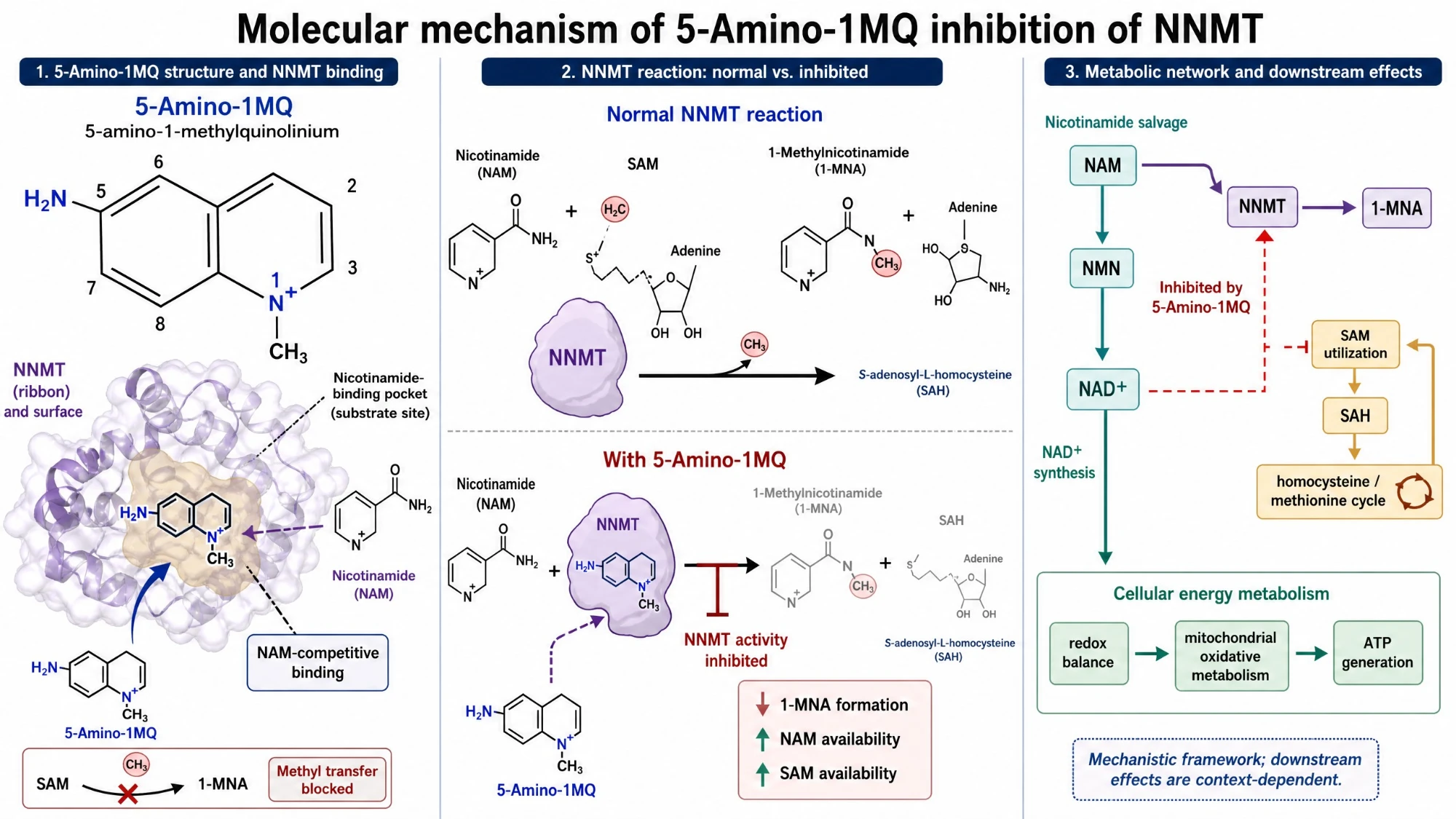
NNMT is an intracellular methyltransferase that uses S-adenosyl-L-methionine (SAM) to methylate nicotinamide, generating 1-methylnicotinamide (1-MNA). Because this reaction influences both methyl-donor metabolism and the availability of nicotinamide for NAD⁺ salvage, NNMT has emerged as a potential metabolic regulatory target. Experimental inhibition of NNMT has therefore attracted interest in obesity, adipocyte biology, insulin sensitivity, hepatic metabolism, skeletal muscle function, and cellular energy homeostasis.
Studies using 5-Amino-1MQ have demonstrated inhibition of NNMT activity in biochemical and cellular models, accompanied by changes in intracellular 1-MNA, NAD⁺, and SAM levels. In diet-induced obese mice, experimental NNMT inhibition has also been associated with reduced body-weight gain, reduced adipose tissue mass, improved glucose handling, and attenuation of hepatic steatosis. However, these findings remain predominantly preclinical and cannot be directly extrapolated to human therapeutic outcomes.
This review examines the molecular characteristics, biochemical mechanism, experimental evidence, metabolic implications, limitations, and future research directions surrounding 5-Amino-1MQ and NNMT inhibition.
Keywords: 5-Amino-1MQ; 5-amino-1-methylquinolinium; NNMT; nicotinamide N-methyltransferase; NAD⁺; SAM; 1-MNA; metabolic research; adipose tissue; small-molecule inhibitor
1. Introduction
Metabolic regulation depends on interconnected networks involving energy metabolism, redox balance, methyl-group transfer, mitochondrial function, and cellular signaling.
Nicotinamide metabolism is particularly important because nicotinamide serves as a precursor for NAD⁺, a central cofactor involved in oxidative metabolism, DNA repair, redox reactions, and multiple signaling processes.
Nicotinamide N-methyltransferase (NNMT) occupies an important position within this metabolic network. The enzyme catalyzes the transfer of a methyl group from SAM to nicotinamide, producing 1-MNA and S-adenosyl-L-homocysteine.
This reaction creates a biochemical connection between:
Nicotinamide metabolism
and
SAM-dependent methylation metabolism.
Interest in NNMT increased following studies showing that modulation of NNMT expression could influence adipose tissue metabolism and susceptibility to diet-induced obesity in experimental animals.
5-Amino-1MQ subsequently became an important chemical tool for investigating whether pharmacological NNMT inhibition could reproduce some of these metabolic effects. Research has demonstrated biological activity in cultured adipocytes and mouse models, including changes in lipid accumulation, NAD⁺ metabolism, body composition, glucose handling, and hepatic lipid accumulation.
However, an important scientific distinction must be maintained:
Evidence for NNMT as a biological target is not equivalent to evidence establishing 5-Amino-1MQ as a human therapeutic agent.
2. Molecular Characteristics of 5-Amino-1MQ
2.1 Chemical Classification
5-Amino-1MQ is short for 5-amino-1-methylquinolinium.
It is a small organic cation belonging to the methylquinolinium chemical class.
Unlike peptide-based research compounds, it does not contain a peptide backbone or a sequence of amino acids.
Its scientific importance therefore derives from small-molecule enzyme inhibition, rather than peptide-receptor pharmacology.
2.2 NNMT as the Molecular Target
NNMT is a cytosolic methyltransferase that catalyzes:
Nicotinamide + SAM → 1-MNA + SAH
This reaction consumes both:
- Nicotinamide;
- S-adenosylmethionine.
The resulting changes can influence cellular metabolic flux.
5-Amino-1MQ was identified as a membrane-permeable NNMT inhibitor with substantially improved inhibitory activity compared with earlier methylquinolinium analogues. A review of NNMT inhibitor development reports an inhibitory concentration around the low-micromolar range for 5-Amino-1MQ.
3. NNMT and Cellular Metabolic Regulation
3.1 The NAD⁺ Salvage Pathway
NAD⁺ is essential for numerous cellular processes.
It participates in:
- Oxidative phosphorylation;
- Redox reactions;
- DNA repair;
- Sirtuin signaling;
- Cellular stress responses;
- Energy metabolism.
Nicotinamide can be recycled through NAD⁺ salvage pathways.
Because NNMT consumes nicotinamide, inhibition of NNMT may alter the availability of this metabolite for alternative metabolic pathways.
Experimental work with 5-Amino-1MQ has shown concentration-dependent increases in intracellular NAD⁺ in differentiated adipocytes under specific experimental conditions.
This provides a mechanistic basis for investigating NNMT inhibition as a metabolic intervention.
3.2 SAM Metabolism
SAM is the principal methyl donor for numerous methyltransferase reactions.
NNMT consumes SAM during nicotinamide methylation.
Therefore:
NNMT inhibition → reduced nicotinamide methylation → altered SAM utilization
Experimental studies using 5-Amino-1MQ have reported increases in intracellular SAM under selected treatment conditions.
This suggests that NNMT may function not only as a regulator of nicotinamide metabolism but also as a modulator of broader cellular methylation metabolism.
4. Potential Biological Mechanisms
4.1 Reduction of 1-MNA Production
One of the most direct experimental indicators of NNMT inhibition is reduced production of 1-MNA.
In differentiated adipocytes, 5-Amino-1MQ produced concentration-dependent reductions in intracellular 1-MNA, demonstrating effective inhibition of the targeted metabolic pathway.
This makes 1-MNA a potentially useful pharmacodynamic biomarker for NNMT activity.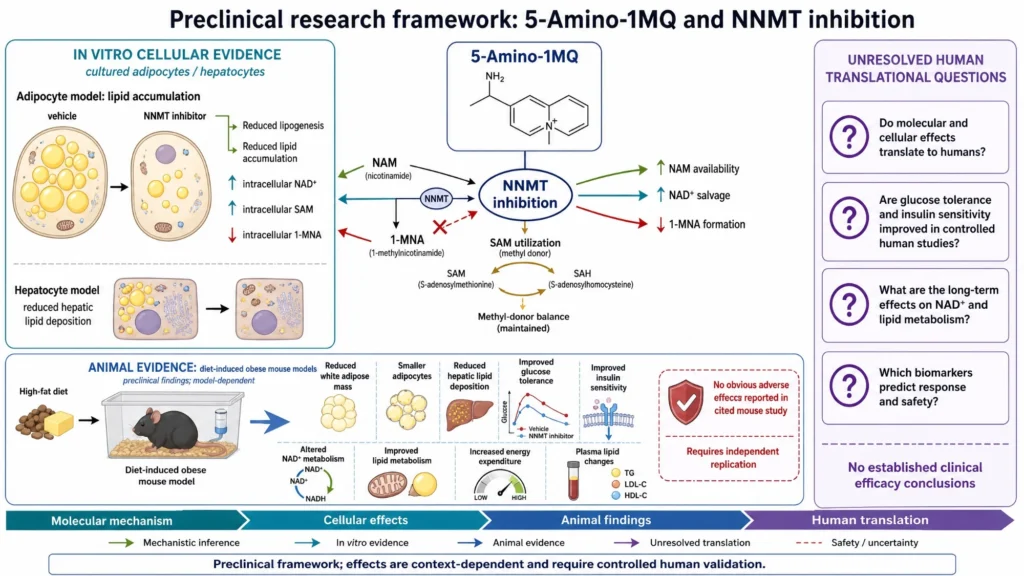
4.2 Effects on Adipocyte Lipid Metabolism
NNMT expression is particularly relevant to adipose tissue biology.
Experimental treatment of differentiating 3T3-L1 adipocytes with 5-Amino-1MQ reduced lipid accumulation in a concentration-dependent manner.
The original study reported approximately 50% and 70% reductions in lipid accumulation at selected experimental concentrations, although these results were obtained in a specific cell culture system and should not be interpreted as evidence of equivalent effects in humans.
These findings support further investigation into the role of NNMT in:
- Adipocyte differentiation;
- Lipogenesis;
- Lipid storage;
- Cellular energy metabolism.
4.3 Body Composition in Animal Models
The metabolic hypothesis was subsequently investigated in diet-induced obese mice.
In one study, 5-Amino-1MQ treatment was associated with progressive body-weight reduction during an 11-day experimental period, together with reduced epididymal adipose tissue mass.
A later 28-day mouse study reported dose-dependent limitation of body-weight and fat-mass gain, together with improvements in glucose tolerance and insulin sensitivity. The study also reported reduced hepatic steatosis and hepatic triglyceride accumulation.
These findings are scientifically significant because they suggest that NNMT inhibition may affect several interconnected metabolic phenotypes.
However, the evidence remains animal-based.
5. Experimental Evidence
5.1 Cellular Evidence
Cellular research provides evidence that 5-Amino-1MQ can directly modulate NNMT-associated metabolic pathways.
Important observations include:
- Reduced intracellular 1-MNA;
- Increased NAD⁺ under selected conditions;
- Changes in SAM;
- Reduced lipid accumulation;
- Effects on adipocyte differentiation.
These findings support a mechanistic relationship between NNMT inhibition and cellular metabolic regulation.
5.2 Animal Evidence
Diet-induced obesity models provide a second level of evidence.
Experimental NNMT inhibition has been associated with:
- Reduced body-weight gain;
- Reduced adipose tissue mass;
- Improved glucose tolerance;
- Improved insulin sensitivity;
- Reduced hyperinsulinemia;
- Reduced hepatic lipid accumulation;
- Reduced hepatic inflammatory changes.
The consistency of these findings across experimental endpoints has contributed to increasing interest in NNMT as a metabolic research target.
Nevertheless, mouse metabolic physiology differs substantially from human metabolism.
Therefore:
Mouse efficacy ≠ demonstrated human efficacy.
6. NNMT, Obesity, and Metabolic Research
The relationship between NNMT and obesity has become one of the major areas of interest surrounding 5-Amino-1MQ.
Adipose tissue can exhibit substantial changes in NNMT expression under metabolic stress.
The hypothesis is that excessive NNMT activity may alter methyl-donor availability and nicotinamide metabolism in ways that influence adipocyte function.
Pharmacological NNMT inhibition therefore provides a tool for testing whether these metabolic changes are causally important.
Experimental results have provided preliminary support for this model.
However, several questions remain unresolved:
- What level of NNMT inhibition is biologically optimal?
- Which tissues are most important?
- Are metabolic effects dependent on adipose NNMT?
- How much of the phenotype is mediated through NAD⁺ metabolism?
- Are there NNMT-independent effects of the inhibitor?
- Will the same metabolic phenotype occur in humans?
These questions require direct experimental investigation.
7. Hepatic Metabolism and Insulin Sensitivity
The effects of NNMT inhibition may extend beyond adipose tissue.
A 2024 study using diet-induced obese mice reported that 5A1MQ treatment improved oral glucose tolerance and insulin sensitivity and reduced hepatic steatosis, liver weight, and hepatic triglyceride levels.
These findings are important because they suggest that NNMT inhibition may influence several interconnected metabolic compartments.
Potential areas of interest include:
Adipose tissue → liver → glucose metabolism → systemic metabolic signaling
Nevertheless, the precise contribution of each tissue remains unclear.
Future studies using tissue-specific NNMT deletion or selective pharmacological approaches could help distinguish primary from secondary effects.
8. Experimental Evidence Level
A useful way to interpret the current evidence is to separate different levels of research.
Molecular evidence — relatively strong
The enzymatic reaction catalyzed by NNMT and its relationship to nicotinamide and SAM metabolism are well characterized.
Cellular evidence — substantial but model-dependent
5-Amino-1MQ has demonstrated NNMT inhibition and metabolic effects in cultured cells, particularly adipocyte models.
Animal evidence — promising but preclinical
Multiple mouse studies have reported changes in body composition and metabolic parameters following NNMT inhibition.
Human efficacy evidence — insufficient
No reliable published human clinical evidence currently establishes that 5-Amino-1MQ produces weight loss, improves metabolic disease, or provides a clinically meaningful therapeutic benefit. Current evidence assessments describe the compound as preclinical.
Human pharmacokinetic evidence — insufficient
Human pharmacokinetic characteristics and long-term exposure-response relationships remain inadequately characterized.
9. Safety and Translational Challenges
9.1 Lack of Human Safety Data
One of the most important limitations is the absence of an established human safety profile.
Preclinical observations cannot establish:
- Appropriate human exposure;
- Long-term toxicity;
- Drug interactions;
- Organ-specific safety;
- Reproductive safety;
- Cardiovascular safety.
Therefore, any interpretation of 5-Amino-1MQ should remain within the boundaries of experimental research.
9.2 Target Selectivity
A major challenge in small-molecule inhibitor development is demonstrating that observed biological effects arise from the intended molecular target.
Although 5-Amino-1MQ demonstrates NNMT inhibitory activity, future studies should systematically evaluate:
- NNMT selectivity;
- Related methyltransferases;
- Off-target enzyme interactions;
- Receptor interactions;
- Cellular toxicity.
This is particularly important because metabolic enzymes frequently participate in interconnected biochemical pathways.
9.3 Pharmacokinetic Characterization
Translation requires reliable pharmacokinetic data.
Important parameters include:
- Absorption;
- Plasma exposure;
- Tissue distribution;
- Metabolic stability;
- Clearance;
- Bioavailability;
- Relationship between exposure and NNMT inhibition.
Published work has included non-human pharmacokinetic investigations, but human pharmacokinetic characterization remains an important evidence gap.
10. Future Research Directions
10.1 Tissue-Specific NNMT Biology
Future studies should determine whether NNMT inhibition in:
- Adipose tissue;
- Liver;
- Skeletal muscle;
- Immune cells;
produces distinct metabolic effects.
This could clarify which tissues represent the most relevant therapeutic or experimental targets.
10.2 NAD⁺ Metabolic Flux
Rather than measuring only total NAD⁺ concentrations, future studies could examine metabolic flux through the NAD⁺ salvage pathway.
This may provide a more precise understanding of how NNMT inhibition modifies cellular metabolism.
10.3 Skeletal Muscle Research
Recent NNMT research has expanded beyond adipose tissue into skeletal muscle biology, including studies of muscle regeneration and age-associated muscle dysfunction. The broader literature therefore suggests that NNMT may have tissue-specific functions that cannot be reduced to obesity biology alone.
Future studies should determine whether these effects are directly caused by NNMT inhibition or reflect secondary metabolic changes.
10.4 Next-Generation NNMT Inhibitors
5-Amino-1MQ is better viewed as an experimental chemical tool within a broader NNMT inhibitor-development program.
Medicinal chemistry efforts are investigating compounds with:
- Greater potency;
- Improved selectivity;
- Better pharmacokinetic properties;
- Greater tissue specificity;
- Reduced off-target activity.
The long-term research objective is not necessarily to establish 5-Amino-1MQ itself as a therapeutic agent, but to determine whether NNMT is a sufficiently robust target for future metabolic drug development.
11. Translational Perspective
The most important scientific question surrounding 5-Amino-1MQ is no longer simply whether NNMT can be inhibited.
Instead, researchers need to determine:
Does pharmacological NNMT inhibition produce a reproducible and clinically meaningful metabolic phenotype in humans?
Answering this requires several stages:
Biochemical validation
↓
Cellular mechanism
↓
Animal pharmacology
↓
Pharmacokinetic characterization
↓
Toxicology
↓
Human pharmacodynamic studies
↓
Controlled clinical investigation
The existing literature is concentrated in the first three stages.
Consequently, the current evidence should be described as preclinical and hypothesis-generating, rather than clinically validated.
12. Conclusion
5-Amino-1MQ is a small-molecule inhibitor of nicotinamide N-methyltransferase and an important experimental tool for investigating the relationship between NNMT activity, nicotinamide metabolism, NAD⁺ salvage, SAM utilization, and metabolic physiology.
Cellular studies demonstrate that 5-Amino-1MQ can inhibit NNMT-associated production of 1-MNA and alter intracellular metabolic parameters. Animal studies have further reported reductions in adiposity and improvements in glucose handling and hepatic metabolic phenotypes under specific experimental conditions.
These observations provide a compelling scientific rationale for continued investigation of NNMT biology.
However, the current evidence remains predominantly preclinical. There is insufficient human evidence to establish 5-Amino-1MQ as an effective or safe metabolic intervention. The distinction between experimental NNMT inhibition and demonstrated human therapeutic benefit is therefore essential.
From a translational research perspective, the future of 5-Amino-1MQ research will depend on rigorous characterization of target selectivity, pharmacokinetics, tissue-specific mechanisms, metabolic flux, toxicity, and ultimately human pharmacology.
Rather than viewing 5-Amino-1MQ simply as a “weight-loss compound,” it is more scientifically accurate to regard it as a research tool for interrogating NNMT-dependent metabolic regulation and the broader relationship between methylation metabolism and cellular energy homeostasis.
Selected References
- Neelakantan H, et al. Selective and membrane-permeable small molecule inhibitors of nicotinamide N-methyltransferase reverse high fat diet-induced obesity in mice. Biochemical Pharmacology / related primary literature. The study demonstrated cellular NNMT inhibition and metabolic effects of 5-Amino-1MQ in adipocytes and diet-induced obese mice.
- Nicotinamide N-methyltransferase inhibition mitigates obesity-related metabolic dysfunction. The study evaluated 5A1MQ in diet-induced obese mice and reported effects on body composition, glucose tolerance, insulin sensitivity, and hepatic steatosis.
- Mechanisms and inhibitors of nicotinamide N-methyltransferase. Review of NNMT biology, inhibitor development, and structure–activity relationships involving 5-amino-1MQ.
