
No products in the cart.
Tesamorelin 13 mg + Ipamorelin 3 mg: Scientific Mechanisms, GH Axis Research and Translational Perspectives
Contents
hide
Abstract
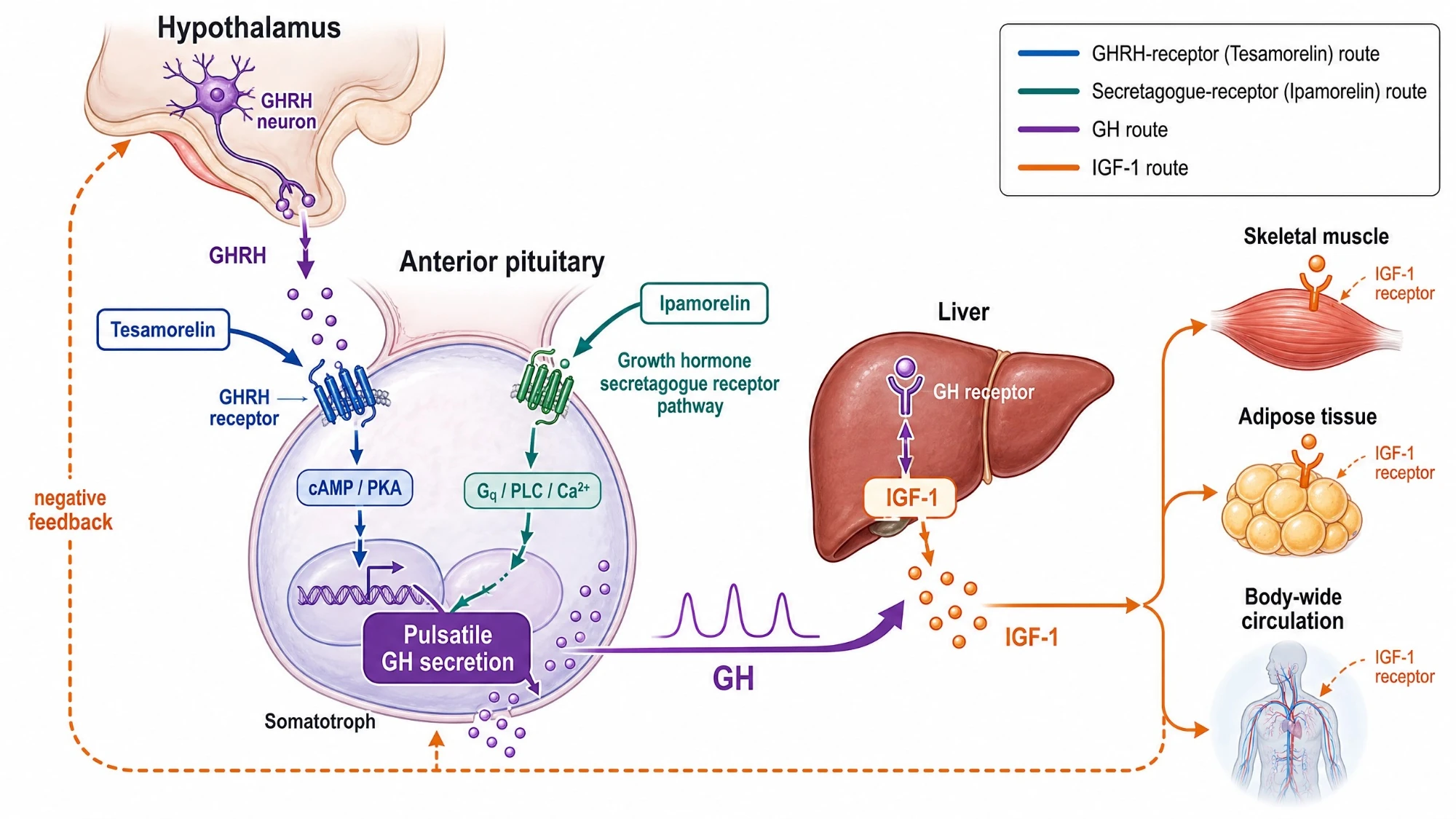
Tesamorelin and Ipamorelin are two structurally distinct peptide-based modulators of the growth hormone (GH) axis that act through complementary endocrine signaling pathways. Tesamorelin is a synthetic growth hormone-releasing factor (GHRF/GHRH) analogue that stimulates the pituitary GHRH receptor, whereas Ipamorelin is a synthetic growth hormone secretagogue that activates a GHRP-like receptor pathway. Their pharmacological distinction provides a scientific rationale for investigating their combined effects on pulsatile GH secretion and downstream endocrine signaling.
The combination of Tesamorelin 13 mg and Ipamorelin 3 mg represents a research formulation rather than a combination with an established clinical evidence base. Tesamorelin has been extensively investigated as an individual molecule, particularly in HIV-associated lipodystrophy, where randomized clinical trials demonstrated reductions in visceral adipose tissue and increases in circulating IGF-1. Ipamorelin, in contrast, has primarily been characterized through pharmacological and preclinical research, with early studies demonstrating selective stimulation of GH secretion.
The theoretical interest in combining these peptides arises from their distinct points of interaction with the GH regulatory system. However, direct evidence demonstrating that a fixed Tesamorelin–Ipamorelin combination produces clinically meaningful synergistic effects remains limited. This distinction is essential when interpreting potential applications in body-composition research, endocrine physiology, muscle biology, and metabolic research.
This review examines the molecular characteristics, proposed mechanisms, experimental evidence, safety considerations, and translational challenges associated with Tesamorelin and Ipamorelin combination research.
Keywords: Tesamorelin; Ipamorelin; GHRH; growth hormone secretagogue; growth hormone axis; IGF-1; visceral adipose tissue; peptide research; endocrine signaling
1. Introduction
The growth hormone axis represents a highly regulated endocrine network involving the hypothalamus, pituitary gland, liver, peripheral tissues, and multiple feedback mechanisms.
Growth hormone secretion is primarily regulated by the interaction between two hypothalamic signals:
- Growth hormone-releasing hormone (GHRH), which stimulates GH secretion;
- Somatostatin, which suppresses GH secretion.
Additional endocrine signals can modulate this system through the growth hormone secretagogue receptor pathway.
From a peptide pharmacology perspective, Tesamorelin and Ipamorelin are particularly interesting because they interact with different components of this regulatory network.
Tesamorelin is a synthetic analogue of human GHRH/GRF and stimulates the GHRH receptor on pituitary somatotroph cells. The FDA prescribing information describes tesamorelin as a GHRF analogue that stimulates endogenous GH secretion and subsequently increases circulating IGF-1 and IGFBP-3.
Ipamorelin belongs to a different pharmacological class. It is a pentapeptide growth hormone secretagogue that acts through a GHRP-like receptor pathway. Experimental studies demonstrated potent GH release in pituitary cells and animal models, while showing comparatively limited stimulation of ACTH and cortisol relative to some earlier secretagogues.
The combination therefore raises an important research question:
Can simultaneous modulation of the GHRH receptor pathway and the growth hormone secretagogue pathway produce a distinct or amplified pattern of GH-axis activation?
This question is biologically plausible but remains different from demonstrating clinical synergy.
2. Molecular Characteristics
2.1 Tesamorelin
Tesamorelin is a synthetic analogue of growth hormone-releasing factor.
Its molecular design was intended to preserve the biological activity of endogenous GHRH while providing a pharmacologically useful peptide analogue.
At the molecular level, Tesamorelin interacts with the human GHRH receptor expressed on pituitary somatotroph cells.
Following receptor activation, intracellular signaling promotes:
GHRH receptor activation → GH synthesis and secretion → increased IGF-1 signaling
The FDA describes tesamorelin as binding and stimulating human GHRF receptors with potency comparable to endogenous GRF in vitro.
2.2 Ipamorelin
Ipamorelin is a synthetic pentapeptide with the sequence:
Aib–His–D-2-Nal–D-Phe–Lys–NH₂
Its development resulted from structure–activity investigations of growth hormone secretagogues. The original pharmacological characterization demonstrated strong GH-releasing activity in pituitary cell systems and animal models.
Unlike GHRH analogues, Ipamorelin belongs to the growth hormone secretagogue class and acts through a GHRP-like receptor pathway.
This mechanistic distinction is central to understanding why combining Ipamorelin with a GHRH analogue may be of scientific interest.
3. Complementary Modulation of the Growth Hormone Axis
3.1 Two Distinct Signaling Inputs
The principal scientific rationale for the combination can be represented conceptually as:
Tesamorelin → GHRH receptor pathway
and
Ipamorelin → GHRP-like secretagogue pathway
Both pathways converge functionally on pituitary GH secretion but originate from different receptor systems.
This creates a theoretical opportunity for coordinated modulation of GH release.
However, the existence of two pathways does not automatically demonstrate pharmacological synergy.
Synergy requires experimental evidence showing that the combined response is greater than would be expected from the individual effects of each component.
3.2 GH and IGF-1 Signaling
Growth hormone acts through both direct and indirect mechanisms.
One of its major downstream mediators is insulin-like growth factor-1 (IGF-1), which is produced predominantly by the liver but also in peripheral tissues.
The simplified pathway is:
GHRH / secretagogue signaling
↓
Pituitary GH secretion
↓
Hepatic and peripheral IGF-1 signaling
↓
Effects on metabolism, tissue growth, and cellular physiology
Tesamorelin research provides particularly strong evidence for this endocrine relationship. Clinical studies have demonstrated increased circulating IGF-1 following treatment.
However, higher GH or IGF-1 concentrations should not automatically be interpreted as improved physical performance or superior body composition.
The physiological response depends on receptor sensitivity, exposure pattern, baseline endocrine status, age, metabolic condition, and tissue-specific signaling.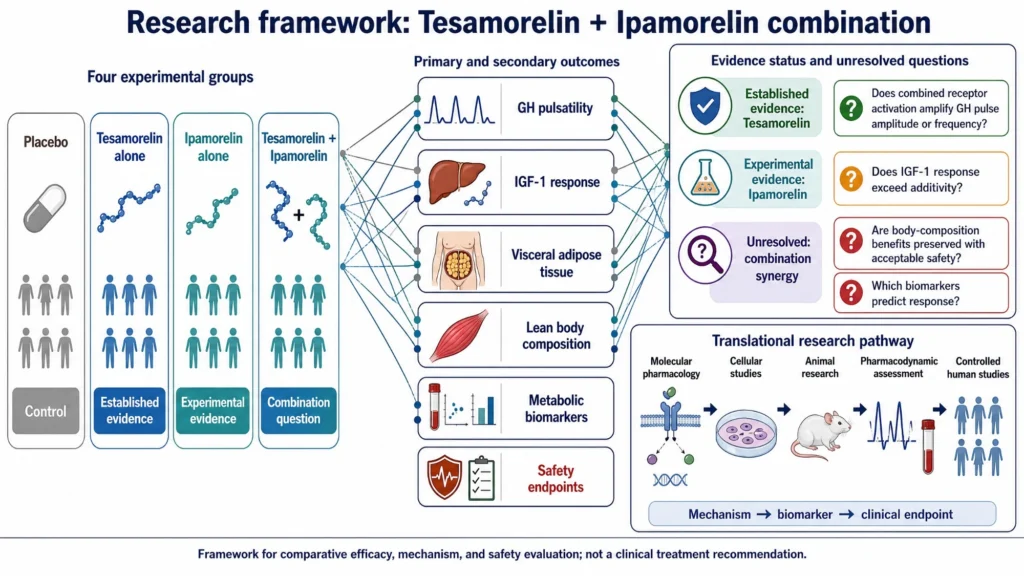
4. Potential Biological Mechanisms
4.1 Regulation of Pulsatile GH Secretion
Physiological GH secretion occurs in pulses rather than as a constant concentration.
This pulsatile pattern is influenced by:
- GHRH;
- Somatostatin;
- Secretagogue signaling;
- Sleep;
- Age;
- Nutritional status;
- Metabolic state.
Tesamorelin and Ipamorelin may influence this system through different upstream mechanisms.
From a research perspective, an important question is whether their combination alters:
- GH pulse amplitude;
- Pulse frequency;
- Interpulse GH concentration;
- Total GH exposure;
- IGF-1 response.
These parameters provide more useful information than measuring a single GH concentration.
4.2 Visceral Adipose Tissue Biology
Tesamorelin has substantial evidence supporting its effects on visceral adipose tissue in specific populations.
In a randomized controlled study involving abdominally obese subjects with reduced GH secretion, Tesamorelin significantly reduced visceral adipose tissue compared with placebo and increased IGF-1.
In HIV-associated abdominal adiposity, randomized studies similarly demonstrated reductions in visceral adipose tissue. One major study reported a 15.2% reduction in visceral adipose tissue with Tesamorelin compared with an increase in the placebo group over 26 weeks.
These findings are important but highly specific.
They should not be generalized to the claim that a Tesamorelin–Ipamorelin combination has been proven to reduce body fat in healthy populations.
There is currently insufficient direct evidence establishing such an effect for the combination.
4.3 Body Composition
Changes in GH and IGF-1 signaling can influence multiple aspects of body composition.
Tesamorelin studies have reported changes involving:
- Visceral adipose tissue;
- Trunk fat;
- Lean body mass;
- Adipose tissue characteristics.
Research has also demonstrated changes in skeletal muscle area and density among Tesamorelin responders in HIV-associated abdominal adiposity.
However, the interpretation of lean mass changes requires caution.
An increase in lean body mass does not necessarily indicate an equivalent increase in contractile muscle tissue or physical performance.
Future studies should therefore distinguish:
Lean mass → muscle mass → muscle quality → muscle function
rather than treating these endpoints as interchangeable.
5. Experimental Evidence for Ipamorelin
5.1 Cellular Evidence
The original pharmacological characterization of Ipamorelin demonstrated potent stimulation of GH release from primary rat pituitary cells.
The reported activity was comparable to GHRP-6 in the experimental system.
These findings established Ipamorelin as a potent GH secretagogue and provided the foundation for subsequent pharmacological research.
5.2 Animal Evidence
In experimental animals, Ipamorelin stimulated GH release with substantial potency.
Studies in rats and pigs demonstrated measurable increases in circulating GH following exposure. Importantly, the original research also examined the selectivity of Ipamorelin with respect to other pituitary hormones.
The researchers reported that Ipamorelin did not produce significant ACTH or cortisol responses comparable to those observed with certain other secretagogues.
This property contributed to its characterization as a relatively selective GH secretagogue.
Nevertheless, animal endocrine responses cannot be assumed to reproduce human pharmacology.
6. Clinical Evidence: Tesamorelin Versus the Combination
6.1 Evidence for Tesamorelin Alone
Tesamorelin has substantially more clinical evidence than Ipamorelin.
Randomized trials have demonstrated reductions in visceral adipose tissue in adults with HIV-associated lipodystrophy.
A systematic review of randomized controlled trials published in 2026 also reported significant reductions in visceral adipose tissue, trunk fat, hepatic fat, and waist circumference in the studied HIV population, together with increased lean body mass.
These findings demonstrate that Tesamorelin has a clinically characterized biological effect in a specific patient population.
6.2 Evidence for Ipamorelin
Ipamorelin has a much smaller human evidence base.
Its principal scientific foundation comes from pharmacological characterization and preclinical studies demonstrating GH secretagogue activity.
Consequently, evidence supporting Ipamorelin should be classified differently from evidence supporting Tesamorelin.
6.3 Evidence for the Fixed Tesamorelin + Ipamorelin Combination
This distinction is particularly important for a Tesamorelin 13 mg + Ipamorelin 3 mg research formulation.
The clinical evidence supporting Tesamorelin as an individual molecule does not establish efficacy for this specific combination.
Likewise, evidence demonstrating that Ipamorelin stimulates GH secretion does not prove that combining the two peptides produces clinically meaningful synergy.
At present, the combination should therefore be considered a research formulation based on complementary GH-axis pharmacology, rather than a clinically validated fixed combination.
Future studies should directly compare:
- Tesamorelin alone;
- Ipamorelin alone;
- Tesamorelin + Ipamorelin;
- Placebo.
This four-arm design would be particularly valuable for determining whether a true interaction exists.
7. Safety and Biological Limitations
7.1 IGF-1 Elevation
Because Tesamorelin stimulates GH secretion, it also increases IGF-1.
The FDA labeling specifically warns about elevated IGF-1 and notes that the consequences of prolonged elevations are not fully established.
This is particularly relevant when considering combinations intended to stimulate the GH axis through more than one mechanism.
A combination producing greater endocrine stimulation could potentially produce a different safety profile from either peptide alone.
This hypothesis requires direct experimental validation.
7.2 Glucose Metabolism
GH and IGF-1 signaling interact with glucose metabolism in complex ways.
Tesamorelin clinical studies have generally not demonstrated major deterioration in glucose parameters in the populations studied, but this should not be interpreted as evidence that all individuals will have identical metabolic responses.
Future combination studies should systematically monitor:
- Fasting glucose;
- Insulin;
- HbA1c;
- Insulin sensitivity;
- IGF-1;
- GH exposure.
7.3 Fluid Retention and Musculoskeletal Effects
Growth hormone pathway activation can affect fluid balance and connective tissues.
The current FDA label for Tesamorelin identifies fluid retention-related adverse effects including edema, arthralgia, and carpal tunnel syndrome.
This is important when evaluating GH-axis peptide combinations because increasing pathway stimulation may theoretically alter the magnitude of such effects.
Again, this is a research hypothesis rather than established evidence for the specific 13 mg + 3 mg formulation.
7.4 Long-Term Safety
Long-term safety is one of the major unresolved questions in GH-axis peptide research.
Potential areas requiring further investigation include:
- Persistent IGF-1 elevation;
- Metabolic effects;
- Cardiovascular outcomes;
- Tissue-specific growth signaling;
- Effects in individuals with pre-existing malignancy;
- Endocrine feedback adaptation.
The FDA label for Tesamorelin specifically contains warnings concerning malignancy and elevated IGF-1.
These considerations reinforce the importance of treating combination formulations as research subjects rather than assuming that the established safety profile of one component automatically applies to the combination.
8. Translational Research Challenges
8.1 Establishing True Pharmacological Synergy
The central unanswered question is whether Tesamorelin and Ipamorelin actually produce synergistic rather than merely additive effects.
A rigorous study should calculate:
Observed combination effect
versus
Expected additive effect
using appropriate pharmacodynamic and statistical models.
Without such analysis, the term “synergy” should be avoided.
8.2 Characterizing GH Pulsatility
Single-point GH measurements are insufficient to fully characterize endocrine responses.
Future research should use serial sampling to determine:
- GH pulse amplitude;
- Frequency;
- Area under the concentration–time curve;
- IGF-1 response;
- Temporal relationship between GH and IGF-1.
This would provide a much more precise understanding of the combination.
8.3 Product Characterization
For a research formulation containing Tesamorelin and Ipamorelin, analytical characterization should include:
- Peptide identity;
- Sequence confirmation;
- Purity;
- Molecular mass;
- Aggregation profile;
- Residual impurities;
- Stability;
- Batch-to-batch consistency.
This is particularly important for combination peptide preparations because the presence of one component should not obscure the analytical characterization of the other.
9. Future Research Directions
9.1 Direct Combination Studies
The most important next step is controlled comparative research directly evaluating the combination.
A scientifically robust design should compare:
Placebo
vs.
Tesamorelin
vs.
Ipamorelin
vs.
Tesamorelin + Ipamorelin
The primary endpoints should focus on GH-axis pharmacodynamics rather than assuming improvements in body composition.
9.2 Tissue-Specific Effects
Future studies should determine whether combined GH-axis stimulation produces differential effects in:
- Adipose tissue;
- Skeletal muscle;
- Liver;
- Bone;
- Cardiovascular tissue.
This may help distinguish endocrine biomarkers from meaningful tissue-level outcomes.
9.3 Metabolic Phenotyping
Comprehensive metabolic profiling could include:
- Visceral adipose tissue;
- Hepatic fat;
- Insulin sensitivity;
- Lipid metabolism;
- Lean mass;
- Muscle quality.
Tesamorelin studies already provide evidence that visceral adiposity and some metabolic parameters can change in selected populations.
The key research question is whether adding Ipamorelin provides additional benefit beyond Tesamorelin alone.
9.4 Precision Endocrinology
Responses to GH-axis modulation may differ according to:
- Age;
- Baseline GH secretion;
- Baseline IGF-1;
- Body composition;
- Metabolic status;
- Sex;
- Genetic background.
Future research could therefore investigate biomarker-guided selection of study populations.
10. Conclusion
Tesamorelin and Ipamorelin represent two mechanistically distinct approaches to modulation of the growth hormone axis.
Tesamorelin is a GHRH/GHRF analogue that activates the pituitary GHRH receptor and has substantial clinical evidence in the specific setting of HIV-associated lipodystrophy. Its effects include stimulation of GH secretion, increased IGF-1, and reduction of visceral adipose tissue in appropriately studied populations.
Ipamorelin is a synthetic pentapeptide growth hormone secretagogue that acts through a different receptor pathway and has demonstrated potent GH-releasing activity in experimental systems.
The scientific rationale for combining these peptides lies in their complementary interaction with the GH regulatory network. Nevertheless, the available evidence for Tesamorelin and Ipamorelin individually should not be interpreted as direct evidence for the efficacy or safety of a fixed Tesamorelin 13 mg + Ipamorelin 3 mg formulation.
The combination should currently be regarded as a research formulation requiring direct pharmacodynamic, pharmacokinetic, safety, and comparative efficacy investigation.
Future studies should prioritize direct head-to-head comparisons, quantitative assessment of GH pulsatility, IGF-1 dynamics, metabolic phenotyping, tissue-specific effects, and rigorous long-term safety assessment.
From a peptide research perspective, the principal scientific question is not simply whether two GH-axis peptides can increase endocrine signaling, but whether their combined modulation produces a reproducible and clinically meaningful biological advantage that exceeds the effects of either component alone.
Selected References
- Raun K, Hansen BS, Johansen NL, et al. Ipamorelin, the first selective growth hormone secretagogue. European Journal of Endocrinology. 1998;139(5):552–561.
- Falutz J, Allas S, Mamputu JC, et al. Long-term safety and effects of tesamorelin, a growth hormone-releasing factor analogue, in HIV patients with abdominal fat accumulation. AIDS. 2008.
- Stanley TL, et al. Metabolic effects of a growth hormone-releasing factor in patients with HIV. Journal of Clinical Endocrinology & Metabolism.
- Falutz J, et al. Effects of tesamorelin, a growth hormone-releasing factor, in HIV-infected patients with abdominal fat accumulation.
- Stanley TL, et al. Reduction in visceral adiposity is associated with an improved metabolic profile in HIV-infected patients receiving tesamorelin. Clinical Infectious Diseases.
- U.S. Food and Drug Administration. EGRIFTA WR (tesamorelin) Prescribing Information.
