
No products in the cart.
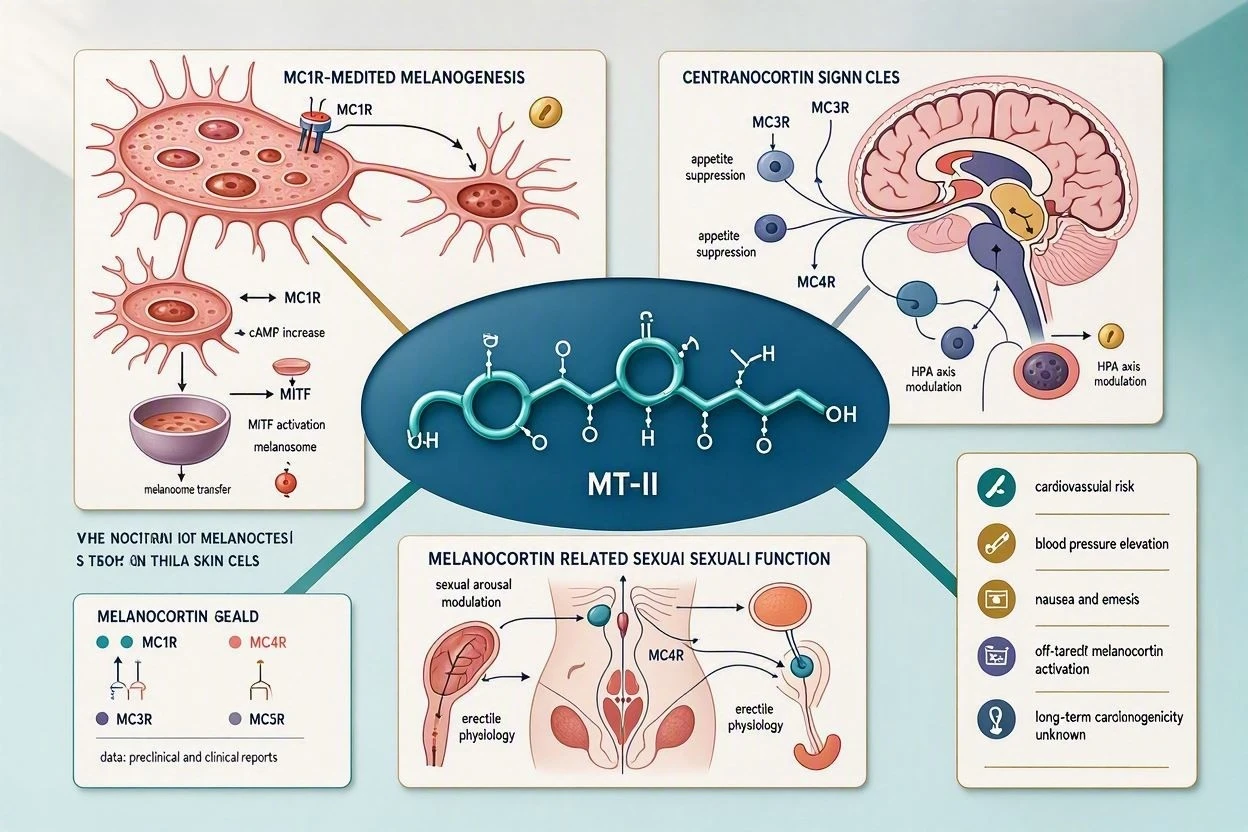
Melanotan II: Molecular Characteristics, Melanocortin Signaling, Experimental Evidence, and Translational Challenges
Abstract
Melanotan II (MT-II) is a synthetic cyclic peptide analogue of α-melanocyte-stimulating hormone (α-MSH) and a pharmacologically active ligand of the melanocortin receptor system. Originally developed from structure–activity studies of melanocortin peptides, MT-II has attracted scientific interest because of its potent activity at melanocortin receptors and its ability to influence biological processes involving pigmentation, sexual function, energy balance, and other melanocortin-mediated pathways.
Unlike endogenous α-MSH, MT-II incorporates structural modifications designed to increase receptor activity and biological stability. Its cyclic heptapeptide architecture contains the pharmacophoric region of α-MSH, while conformational restriction contributes to its high melanotropic potency. Early human studies demonstrated changes in skin pigmentation and unexpected effects on erectile responses, providing important pharmacological evidence for melanocortin receptor involvement in human physiology.
However, the translational position of MT-II requires careful interpretation. Although experimental and early clinical studies demonstrate biological activity, MT-II has not established a broad clinical role for tanning, sexual enhancement, or general health applications. Unregulated use has also generated safety concerns, particularly regarding product quality, melanocytic changes, and uncertain long-term risks.
This review examines the molecular characteristics, receptor pharmacology, experimental evidence, potential biological mechanisms, safety considerations, and future research directions of Melanotan II from a peptide research perspective.
Keywords: Melanotan II; MT-II; α-MSH; melanocortin receptor; MC1R; MC3R; MC4R; melanogenesis; cyclic peptide; peptide pharmacology
1. Introduction
Melanocortins constitute a family of peptide hormones and related analogues derived from the proopiomelanocortin (POMC) precursor. These peptides participate in diverse physiological processes, including melanogenesis, energy homeostasis, sexual behavior, and neuroendocrine regulation.
Among synthetic melanocortin analogues, Melanotan II occupies a distinctive position in peptide pharmacology. It was designed as a cyclic analogue of the biologically active region of α-MSH and exhibits substantially greater melanotropic potency than the endogenous peptide in experimental systems.
The development of MT-II illustrates an important principle in peptide drug discovery: relatively small modifications to peptide sequence and conformation can produce major changes in receptor affinity, biological potency, and pharmacological selectivity.
Early human studies provided evidence that MT-II could increase pigmentation and also revealed effects on sexual function. In a small phase I study, investigators observed increased pigmentation together with nausea, fatigue, yawning, and spontaneous erections in some participants.
Subsequent controlled studies further investigated its effects on erectile responses, demonstrating that melanocortin receptor activation could influence sexual physiology in humans.
Nevertheless, these early findings should not be interpreted as evidence for broad therapeutic utility. MT-II remains an investigational melanocortin analogue with significant unanswered questions regarding receptor selectivity, long-term safety, product quality, and clinical applicability.
2. Molecular Characteristics of Melanotan II
2.1 Classification
Melanotan II is a synthetic cyclic melanotropic peptide and structural analogue of α-MSH.
The original human study described MT-II as a cyclic heptapeptide analogue containing the sequence:
Ac-Nle⁴-Asp⁵-His⁶-D-Phe⁷-Arg⁸-Trp⁹-Lys¹⁰-α-MSH⁴⁻¹⁰-NH₂
with a lactam bridge producing a conformationally constrained cyclic structure.
This structural design was intended to preserve the pharmacophoric features of α-MSH while increasing conformational stability and melanocortin receptor activity.
2.2 Relationship to α-MSH
α-MSH is an endogenous melanocortin peptide involved in the regulation of melanogenesis through melanocortin receptors, particularly MC1R in melanocytes.
The biological activity of α-MSH depends strongly on a conserved central pharmacophore. Structural modification of this region can significantly alter receptor affinity and biological potency.
MT-II represents an example of rational peptide modification in which:
- Non-natural amino acid substitution;
- Stereochemical modification;
- C-terminal modification;
- Conformational restriction
are combined to generate a synthetic analogue with enhanced receptor activity.
2.3 Cyclic Peptide Architecture
The cyclic structure is particularly important from a medicinal chemistry perspective.
Cyclization can influence:
- Conformational rigidity;
- Receptor-binding affinity;
- Proteolytic stability;
- Biological half-life;
- Selectivity among receptor subtypes.
However, increased potency does not necessarily translate into improved therapeutic value.
A highly potent receptor agonist may also produce stronger off-target or dose-dependent physiological effects.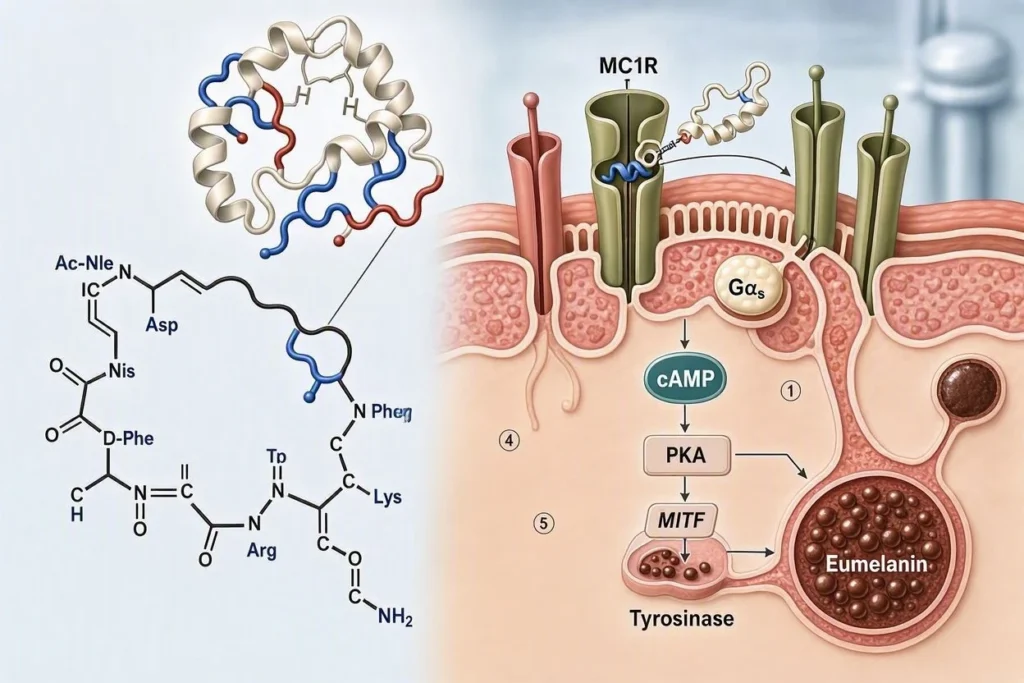
3. Melanocortin Receptor Pharmacology
3.1 The Melanocortin Receptor Family
The melanocortin receptor system consists of five known G protein-coupled receptors:
- MC1R;
- MC2R;
- MC3R;
- MC4R;
- MC5R.
These receptors exhibit different tissue distributions and physiological functions.
MC1R is particularly important in melanocytes, where activation promotes eumelanin synthesis and contributes to pigmentation.
MC3R and MC4R are strongly associated with central regulation of energy balance and neuroendocrine signaling.
Therefore, a non-selective melanocortin agonist such as MT-II can potentially generate biological effects across multiple physiological systems.
4. Potential Biological Mechanisms
4.1 MC1R Activation and Melanogenesis
The best-characterized biological pathway associated with melanocortin signaling involves MC1R activation in melanocytes.
Activation of MC1R increases intracellular cyclic AMP signaling and influences transcriptional pathways involved in melanogenesis.
A simplified pathway can be represented as:
MT-II → MC1R → cAMP signaling → melanogenic pathways → increased eumelanin synthesis
The resulting increase in melanin production provides a mechanistic explanation for the pigmentation observed in early human studies.
However, increased pigmentation should not automatically be equated with complete photoprotection. Melanin biology is complex, and pharmacologically induced pigmentation does not eliminate the biological effects of ultraviolet radiation.
4.2 Melanocortin Signaling and Sexual Function
One of the most notable discoveries associated with MT-II was its effect on sexual physiology.
Early human experiments unexpectedly demonstrated spontaneous penile erections following MT-II exposure. Subsequent placebo-controlled studies investigated this phenomenon directly.
In one controlled study involving men with erectile dysfunction, MT-II produced measurable erectile responses compared with placebo. Nausea, yawning, and appetite-related effects were also observed.
These findings provided important evidence that melanocortin signaling participates in sexual function.
However, the studies were small and primarily designed as pharmacological investigations rather than definitive therapeutic trials.
Consequently, the scientific conclusion should be framed as:
MT-II provides experimental evidence that melanocortin receptor activation can influence sexual physiology.
This is different from concluding that MT-II is an established treatment for erectile dysfunction or sexual disorders.
4.3 Central Melanocortin Signaling
Melanocortin receptors are expressed in multiple regions of the central nervous system.
MC3R and MC4R signaling participates in pathways related to:
- Energy homeostasis;
- Appetite;
- Sexual behavior;
- Autonomic regulation;
- Neuroendocrine signaling.
Because MT-II interacts with multiple melanocortin receptor subtypes, its biological effects may extend beyond pigmentation.
This broad receptor activity is scientifically interesting but also represents a major challenge for therapeutic development.
Receptor selectivity is often essential when developing peptide agonists for clinical use.
5. Experimental and Clinical Evidence
5.1 Early Phase I Human Research
The first published human study was a small phase I investigation involving three healthy male volunteers.
The study demonstrated:
- Increased skin pigmentation;
- Nausea;
- Fatigue and somnolence at higher exposure;
- Yawning and stretching;
- Spontaneous erections.
The researchers concluded that MT-II demonstrated strong melanotropic activity in humans.
However, the sample size was extremely small.
Therefore, the study provides proof-of-pharmacological-activity, rather than robust evidence of clinical efficacy or long-term safety.
5.2 Studies of Erectile Function
Subsequent controlled studies investigated MT-II in men with erectile dysfunction.
One placebo-controlled crossover study enrolled ten men with erectile dysfunction and observed erectile responses following MT-II exposure. Nausea and yawning occurred more frequently than with placebo.
Another study involving men with psychogenic and organic erectile dysfunction reported erectile responses in a substantial proportion of participants following MT-II exposure. The investigators also observed increased sexual desire in some subjects.
These studies are scientifically important because they established a connection between melanocortin receptor activation and human sexual physiology.
Nevertheless, the small sample sizes, short observation periods, and experimental design limit their ability to establish long-term therapeutic efficacy.
6. Safety and Scientific Limitations
6.1 Acute Pharmacological Effects
Early human studies reported several transient effects, including:
- Nausea;
- Yawning;
- Stretching;
- Fatigue;
- Somnolence;
- Appetite reduction;
- Changes in pigmentation.
The frequency and intensity of these effects varied with exposure.
These observations illustrate an important principle of melanocortin pharmacology: receptor activation can affect multiple physiological systems simultaneously.
6.2 Pigmentary Changes
Because MT-II stimulates melanocortin pathways involved in melanogenesis, changes in existing nevi and the appearance of new pigmented lesions have attracted dermatological attention.
A review of unregulated α-MSH analogue use reported increasing concern regarding melanocytic changes and highlighted case reports involving atypical nevi and melanoma occurring during or after melanotan use. The authors emphasized that causal relationships remained unproven but that the safety uncertainties warranted caution.
A separate case report described melanoma occurring in temporal association with MT-II use and emphasized the uncertainty surrounding unlicensed exposure.
These reports do not establish that MT-II causes melanoma.
However, they provide a scientifically relevant safety signal because melanocortin signaling directly influences melanocyte biology.
6.3 Product Quality and Peptide Characterization
An additional concern is that MT-II obtained outside controlled pharmaceutical research environments may differ substantially in:
- Chemical purity;
- Peptide identity;
- Aggregation state;
- Residual synthesis impurities;
- Microbiological quality;
- Concentration accuracy.
The U.S. FDA has specifically identified potential immunogenicity concerns for compounded Melanotan II preparations, including risks associated with aggregation and peptide-related impurities.
For peptide research, this is particularly important.
Biological activity observed with analytically characterized MT-II cannot automatically be extrapolated to an inadequately characterized commercial or research preparation.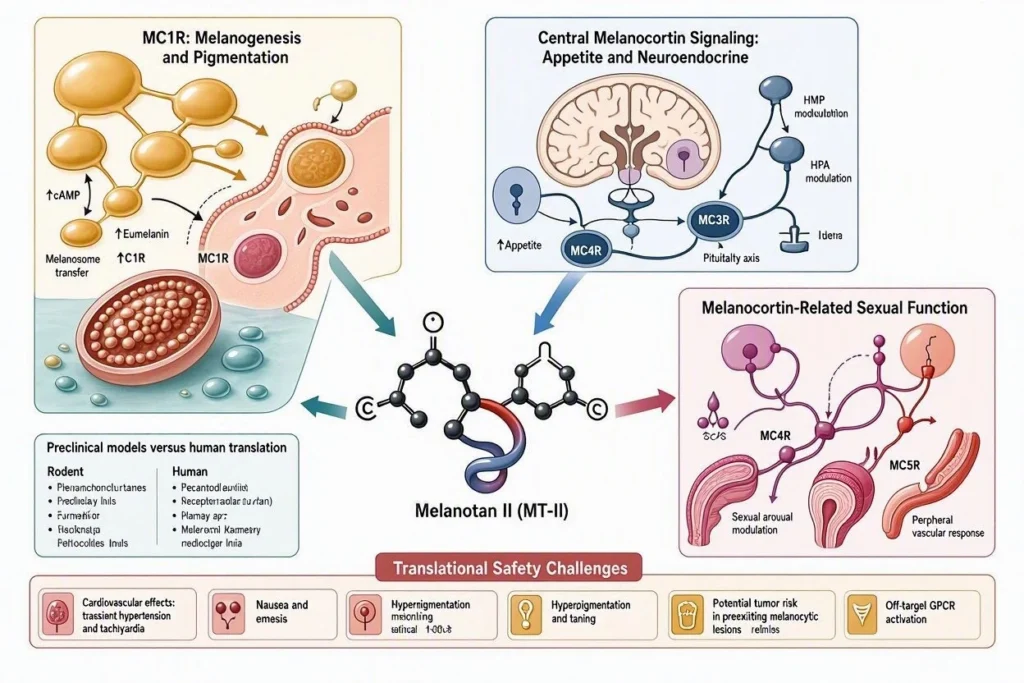
7. Evidence-Level Assessment
The current evidence can be divided into several levels.
Molecular evidence — relatively strong
The relationship between melanocortin receptor signaling and melanogenesis is well established, and MT-II has a clearly defined relationship to α-MSH pharmacology.
Cellular evidence — substantial
Experimental studies support melanocortin receptor-mediated cellular responses, particularly involving pigmentation-related pathways.
Early human pharmacological evidence — established but limited
Small controlled human studies demonstrate biological activity involving pigmentation and sexual physiology.
Long-term clinical evidence — insufficient
There is insufficient high-quality evidence to establish the long-term safety or therapeutic efficacy of MT-II for broad clinical applications.
Evidence regarding melanoma risk — unresolved
Case reports and reviews justify safety concerns, but they do not establish a definitive causal relationship between MT-II and melanoma.
8. Translational Research Challenges
8.1 Receptor Selectivity
One of the central challenges is separating desirable melanocortin receptor effects from unwanted systemic effects.
Future peptide engineering could focus on:
- MC1R-selective agonists;
- MC4R-selective agonists;
- Tissue-selective receptor activation;
- Biased agonism;
- Controlled pharmacokinetics.
This could potentially produce compounds with narrower biological profiles than MT-II.
8.2 Pharmacokinetic Optimization
A successful peptide therapeutic requires predictable:
- Absorption;
- Distribution;
- Metabolism;
- Elimination;
- Receptor exposure.
MT-II research would benefit from detailed pharmacokinetic studies correlating plasma exposure with receptor activation and physiological outcomes.
8.3 Structure–Activity Relationships
MT-II provides a valuable model for investigating how peptide structure influences melanocortin receptor activity.
Future research can systematically modify:
- Ring size;
- Amino acid substitutions;
- Side-chain chemistry;
- Backbone conformation;
- Terminal groups.
Such structure–activity relationship studies may help identify compounds with improved receptor selectivity and reduced off-target activity.
9. Future Research Directions
9.1 Development of Receptor-Selective Melanocortin Peptides
Future melanocortin research is likely to move away from broadly active agonists toward receptor-selective molecules.
Particular attention may be directed toward separating:
MC1R-mediated pigmentation effects
from
MC3R/MC4R-mediated central physiological effects.
This distinction could improve both experimental interpretation and therapeutic design.
9.2 Melanocortin Signaling in Dermatology
MC1R remains an important research target in pigmentation biology and photobiology.
Future research may investigate:
- Melanocyte signaling;
- Eumelanin synthesis;
- Photoprotection;
- Oxidative stress;
- Melanoma biology;
- MC1R genetic variation.
However, pharmacological pigmentation should not be interpreted as a substitute for established photoprotection strategies.
9.3 Neuroendocrine Research
Because melanocortin receptors are involved in central physiological regulation, MT-II and related analogues may remain useful experimental tools for studying:
- Appetite regulation;
- Sexual behavior;
- Autonomic signaling;
- Neuroendocrine pathways.
The value of MT-II in these settings may therefore extend beyond its potential therapeutic applications.
9.4 Safer Next-Generation Peptide Analogues
Rather than focusing exclusively on MT-II itself, future research may use its molecular architecture as a starting point for developing next-generation melanocortin receptor ligands with:
- Greater receptor selectivity;
- Improved pharmacokinetics;
- Reduced off-target effects;
- Better manufacturing consistency;
- More predictable biological activity.
10. Conclusion
Melanotan II is a scientifically important synthetic cyclic analogue of α-MSH and an influential tool in melanocortin peptide research.
Its molecular architecture demonstrates how conformational restriction and sequence modification can produce a highly active melanocortin receptor ligand. Experimental and early human studies have established that MT-II can influence melanogenesis and can also affect sexual physiology through melanocortin signaling.
At the same time, MT-II should not be characterized simply as a “tanning peptide” or generalized as a clinically established therapeutic agent. Its activity across multiple melanocortin receptor pathways creates both scientific opportunities and safety challenges.
The current evidence is strongest at the level of molecular pharmacology and early human proof-of-concept research. Long-term clinical safety, therapeutic specificity, and the clinical significance of pigmentary effects remain incompletely defined.
From a peptide research perspective, the greatest value of Melanotan II may ultimately lie in what it has revealed about melanocortin receptor biology and structure–activity relationships. Continued research should focus on receptor selectivity, molecular characterization, pharmacokinetics, safety, and the development of next-generation melanocortin ligands with more predictable biological profiles.
