
No products in the cart.
Sale
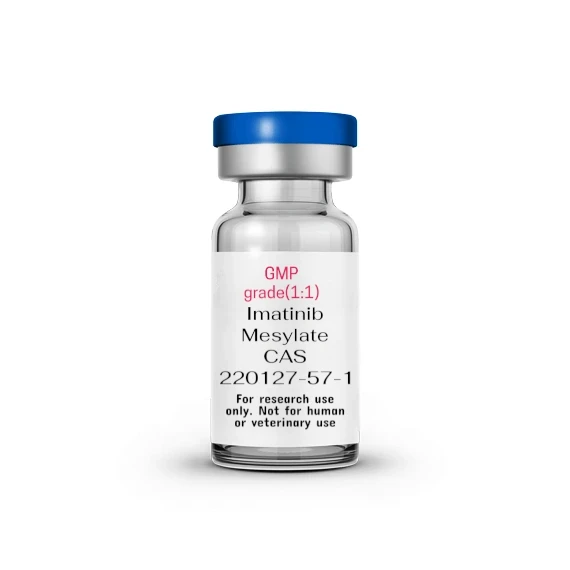
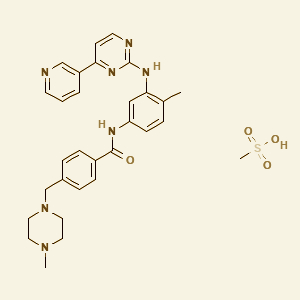
Imatinib Mesylate | CAS 220127-57-1 | High-Purity Bulk Wholesale and GMP Factory Customization
Original price was: $3.00.$2.00Current price is: $2.00.
Imatinib Mesylate (CAS 220127-57-1) is a high-purity tyrosine kinase inhibitor available for bulk wholesale and GMP factory customization. Ideal for oncology, signal-transduction, and kinase-pathway research requiring consistent, reproducible, research-grade powder.

Description
Product Description
Imatinib Mesylate (CAS 220127-57-1) is a high-purity lyophilized powder widely utilized as a selective tyrosine kinase inhibitor, primarily targeting BCR-ABL, c-KIT, and PDGFR. As a first-generation small-molecule kinase inhibitor, Imatinib Mesylate has transformed research into chronic myeloid leukemia (CML) and gastrointestinal stromal tumors (GISTs). Its high specificity and reproducibility make it an indispensable tool for laboratory research, ranging from in vitro kinase profiling to in vivo translational studies.
Molecular Background and Scientific Significance
The discovery of Imatinib Mesylate revolutionized the understanding of tyrosine kinase-driven oncogenesis. BCR-ABL, generated by the t(9;22) chromosomal translocation, exhibits constitutive kinase activity, driving uncontrolled proliferation and survival of leukemic cells. Imatinib Mesylate binds the ATP-binding pocket of BCR-ABL in its inactive conformation, preventing autophosphorylation and downstream signaling. Beyond BCR-ABL, Imatinib Mesylate inhibits c-KIT and PDGFR, receptors critical in stem cell biology, hematopoiesis, and tumor angiogenesis.
Its utility in research extends to the study of apoptosis, cell cycle regulation, and mechanisms of drug resistance. By selectively inhibiting kinase activity, Imatinib Mesylate enables scientists to dissect signaling pathways with high precision, modeling disease progression and therapeutic interventions.
Research Applications
1. Kinase Profiling and Enzyme Kinetics
Imatinib Mesylate is a benchmark inhibitor in ATP-competitive kinase assays. Its lyophilized form allows long-term storage and reproducible performance. Researchers use Imatinib Mesylate to characterize enzyme kinetics, determine IC50 values, and compare inhibition across kinase families. This facilitates the validation of novel compounds and drug candidates in both academic and industrial settings.
2. Oncology Research
In leukemia and GIST models, Imatinib Mesylate is applied to investigate oncogenic signaling, proliferation, and apoptosis. Researchers assess the compound’s impact on leukemic stem cell survival, clonal expansion, and apoptotic induction. In GIST models, c-KIT inhibition by Imatinib Mesylate elucidates tumor dependency on receptor tyrosine kinases, supporting therapeutic modeling and resistance mechanism studies.
3. Signal Transduction Studies
By inhibiting downstream pathways such as MAPK/ERK, PI3K/AKT, and JAK/STAT, Imatinib Mesylate serves as a chemical probe for dissecting signal transduction cascades. It allows analysis of pathway crosstalk, feedback regulation, and compensatory mechanisms in kinase-driven cells. Researchers can explore gene expression changes, protein phosphorylation dynamics, and cellular responses in both normal and diseased cell lines.
4. Structural Biology and Computational Modeling
Imatinib Mesylate is widely used as a ligand in protein crystallography to understand kinase-ligand interactions. Computational modeling and molecular docking studies utilize Imatinib Mesylate to explore binding energy, conformational changes, and structure-activity relationships (SAR), providing insights for next-generation kinase inhibitor development.
5. Drug Resistance Mechanism Investigation
Resistance to kinase inhibitors often arises from point mutations in BCR-ABL or overactivation of compensatory pathways. Imatinib Mesylate facilitates the study of such mutations, supporting development of alternative strategies and combination therapies. Its consistent inhibitory profile makes it a valuable reference compound in evaluating secondary resistance mechanisms in vitro and in vivo.
6. Preclinical and Translational Models
In organoids, spheroids, and xenograft models, Imatinib Mesylate is used to assess tumor growth inhibition, angiogenesis suppression, and pathway modulation. Its application in pharmacokinetic/pharmacodynamic studies helps optimize dosage regimens and validate molecular targets for translational oncology research.
7. Cell Cycle and Apoptosis Research
Imatinib Mesylate induces cell cycle arrest and promotes apoptosis in kinase-dependent cells. Researchers employ flow cytometry, caspase assays, and western blotting to monitor effects of Imatinib Mesylate on cyclins, CDKs, and apoptotic markers. This provides mechanistic insights into therapeutic action and cellular responses to tyrosine kinase inhibition.
8. High-Throughput Screening (HTS) Applications
The compound is suitable for automated HTS platforms to evaluate combinatorial drug effects or to screen kinase inhibitors. Imatinib Mesylate provides a reference standard for assay calibration, quality control, and comparative analysis across multiple targets.
9. Translational and Personalized Medicine Research
Imatinib Mesylate is used to model patient-derived cells and evaluate individualized therapy responses. It allows scientists to investigate differential kinase dependence, resistance patterns, and the efficacy of experimental combinational treatments.
10. Toxicology and Safety Studies
Although not for clinical use, Imatinib Mesylate assists in studying cytotoxicity, off-target effects, and cellular stress responses, informing safer design of novel therapeutics.
Lyophilized Powder Advantages
Enhanced stability for long-term storage
Reduced degradation compared to solution forms
Soluble in DMSO and compatible buffers
Consistent batch-to-batch performance
Optimal for high-throughput and long-term in vitro studies
Manufacturing and Quality Assurance
Produced in GMP-certified facilities, each batch of Imatinib Mesylate undergoes stringent quality control. Analytical verification includes HPLC, LC-MS, HRMS, and NMR. Certificates of Analysis (CoA) and safety data sheets (MSDS) accompany all shipments. Bulk production and factory customization ensure consistent quality and scalability for industrial and academic research purposes.
Product Specifications
| Parameter | Specification |
|---|---|
| Chemical Name / Synonyms | Imatinib Mesylate; STI-571; CGP57148; Gleevec |
| CAS Number | 220127-57-1 |
| Molecular Formula | C₃₀H₃₅N₇O · CH₄O₃S |
| Molecular Weight | 589.71 g/mol |
| Purity | ≥99% (HPLC) |
| Appearance | White to off-white lyophilized powder |
| Dosage Form | Lyophilized powder |
| Solubility | Soluble in DMSO; slightly soluble in methanol and aqueous buffers |
| Concentration | Customizable upon reconstitution |
| Storage Temperature | 2–8°C |
| Stability | 24 months under proper storage |
| Analytical Methods | HPLC, LC-MS, HRMS, NMR |
| Mechanistic Target | BCR-ABL, c-KIT, PDGFR-α/β |
| Structural Category | Small-molecule tyrosine kinase inhibitor |
| Applications | Oncology research, kinase biology, drug-resistance models |
| Batch Consistency | Each batch tested for reproducibility |
| Regulatory Notes | For laboratory research use only |
| Origin | China, factory direct supply |
| Additional Data | CoA, MSDS, spectral data |
Mechanism of Action
Imatinib Mesylate selectively inhibits ATP-binding sites of BCR-ABL, c-KIT, and PDGFR, stabilizing kinases in inactive conformations. This prevents phosphorylation of substrates, blocking downstream signal transduction and altering transcriptional programs.
BCR-ABL Inhibition
Blocks autophosphorylation and substrate phosphorylation
Suppresses MAPK/ERK, PI3K/AKT, and STAT5 pathways
Induces apoptosis via mitochondrial pathways
c-KIT and PDGFR Inhibition
Interferes with stem cell proliferation and differentiation
Inhibits angiogenesis through VEGF and PDGF signaling
Reduces tumor growth in GIST models
ATP-Competitive Mechanism
Imatinib Mesylate occupies the ATP-binding cleft, forming hydrogen bonds and hydrophobic interactions. Structural studies confirm that it locks kinases in inactive conformations, preventing substrate engagement.
Impact on Downstream Pathways
Modulates transcription factors controlling cell cycle and apoptosis
Alters expression of anti-apoptotic proteins (BCL-2, MCL-1)
Activates caspases and promotes DNA fragmentation
Drug Resistance Studies
Facilitates modeling of BCR-ABL mutations (T315I, E255K)
Evaluates compensatory pathway activation
Supports testing of second-generation inhibitors
Applications in Cell Biology
Flow cytometry to monitor apoptosis and cell cycle
Western blot and ELISA to assess protein phosphorylation
Kinase profiling assays to determine selectivity
Preclinical Models
Organoids, xenografts, and spheroids
Pharmacokinetics and pharmacodynamics modeling
Combined therapy evaluation
High-Throughput Screening
Standard reference in automated kinase assays
Assists in assay calibration and validation
Supports structure-activity relationship studies

Side Effects
Cellular Effects
Apoptosis induction in BCR-ABL, c-KIT, PDGFR-dependent cells
Growth inhibition in sensitive cell lines
Off-target modulation of alternative pathways
Molecular Effects
Caspase activation and mitochondrial depolarization
Alteration of cyclin/CDK expression
DNA fragmentation in apoptosis assays
Experimental Handling Considerations
Use gloves, lab coat, and fume hood
Avoid ingestion and inhalation
Proper disposal according to institutional guidelines
Storage and Stability
Lyophilized powder maintains activity at 2–8°C
Protect from light and moisture
Reconstitution in DMSO or compatible buffers for immediate use
Safety Precautions
Follow local and national safety protocols
Do not use in humans or animals
Ensure training for laboratory personnel
Keywords
high-purity Imatinib Mesylate, kinase inhibitor bulk powder, BCR-ABL inhibitor research chemical, tyrosine kinase assay compound, PDGFR inhibitor, cancer signaling pathway inhibitor, small-molecule reference standard, pharmaceutical research chemical, China chemical manufacturer, oncology research reagent, factory direct supply, high-purity small-molecule supplier, bulk chemical customization, GMP customization service, wholesale kinase inhibitor, drug resistance modeling, translational cancer research, signal transduction probe
Shipping Guarantee
Our Imatinib Mesylate is shipped worldwide using cold-chain logistics to ensure product stability and bioactivity. Packaging includes insulated, moisture-proof containers with temperature monitoring. All shipments include tracking, insurance, and customs documentation for secure delivery. Bulk orders are packaged with reinforced insulation to maintain integrity throughout transit. Lyophilized Imatinib Mesylate maintains consistent activity and purity during shipping, enabling researchers to receive reliable, high-quality kinase inhibitor powder for large-scale laboratory and preclinical applications.
Trade Assurance
Each batch of Imatinib Mesylate undergoes stringent quality control to ensure ≥99% purity, verified via HPLC, LC-MS, HRMS, and NMR. Certificates of Analysis (CoA) and MSDS accompany all shipments. Factory-direct supply, GMP-grade customization, and bulk production are available for research laboratories and industrial clients. Our trade assurance guarantees replacement or refund in case of inconsistencies, providing confidence in purchasing high-purity Imatinib Mesylate for kinase profiling, oncology research, and preclinical studies.
Payment Support
We accept PayPal, credit cards, T/T bank transfers, USDT, Bitcoin, and Ethereum for all Imatinib Mesylate orders. Transactions are secure, encrypted, and verified for global clients. Flexible payment supports both small-scale research and bulk purchases. International customers can procure Imatinib Mesylate conveniently, ensuring timely access to high-purity kinase inhibitors for academic and industrial research applications, including large-scale preclinical studies and translational oncology projects.
Disclaimer
Imatinib Mesylate is intended strictly for laboratory research purposes. It is not for human, veterinary, or clinical use. Researchers must adhere to institutional, local, and national safety regulations. Personal protective equipment (PPE) such as gloves, lab coats, and safety goggles is mandatory. Avoid ingestion, inhalation, or direct skin contact. Follow proper storage, handling, and disposal protocols. Imatinib Mesylate should only be used by trained personnel in appropriate laboratory facilities to ensure experimental integrity and safety.
References

Additional information
| Weight | 1.1 kg |
|---|---|
| Dimensions | 18 × 16 × 18 cm |
1. What is Imatinib Mesylate used for in research?
Used to study BCR-ABL, c-KIT, PDGFR signaling, apoptosis, proliferation, and drug-resistance mechanisms.
2. Can I purchase bulk Imatinib Mesylate?
Yes, bulk and GMP-grade customization are available from the factory.
3. What purity does this product meet?
≥99%, confirmed via HPLC, MS, and NMR for all batches.
4. How should Imatinib Mesylate be stored?
Store at 2–8°C, protected from light and moisture.
5. Is it suitable for in vitro kinase assays?
Yes, widely used as a reference inhibitor for enzymology and high-throughput assays.
6. How is the lyophilized powder reconstituted?
Dissolve in DMSO or compatible aqueous buffers prior to use.
7. Can this product be used in vivo?
No, strictly for laboratory research only.
8. Are Certificates of Analysis provided?
Yes, each shipment includes CoA and spectral data.
9. Is GMP-grade Imatinib Mesylate available?
Yes, GMP customization is offered for industrial and research applications.
10. Which analytical methods confirm quality?
HPLC, LC-MS, HRMS, and NMR verify all batches.
11. Can this product be shipped internationally?
Yes, with cold-chain logistics, tracking, and insurance.
12. What is the shelf life?
Lyophilized powder remains stable for up to 24 months under recommended storage.
13. What are common research applications?
Oncology, kinase profiling, resistance modeling, structural biology, and assay development.
14. Are small-scale samples available?
Yes, pilot research quantities can be provided.
15. Is MSDS provided?
Yes, included with every shipment.
Related products
Lenalidomide 25mg High Purity | Factory Manufactured
High-purity Lenalidomide Tablets designed for laboratory research, in vitro mechanistic studies, and multi-omic pathway analysis. Factory-manufactured with consistent quality for bulk and wholesale supply, these tablets provide reliable receptor-modulation and molecular mechanism research capabilities. Original price was: $3.00.$2.00Current price is: $2.00.Iparomlimab and Tuvonralimab 50 mg/2 mL Solution
Iparomlimab and Tuvonralimab is a high-purity monoclonal antibody solution supplied at 50 mg/2 mL by factory manufacturing with low-price wholesale availability. Designed exclusively for in vitro molecular mechanism studies, protein interaction assays, and signaling pathway research, it provides reproducible and reliable experimental performance. Strictly for laboratory research use. $1.00Temozolomide 100mg — Laboratory Research Grade Chemical
Temozolomide is a high-purity alkylating research compound widely used in in vitro molecular mechanism studies focusing on DNA methylation, damage response pathways, and cell cycle regulation. It is suitable for laboratory-based biochemical and mechanistic research applications only.
Original price was: $6.00.$3.00Current price is: $3.00.Cetuximab NO1 100 mg/50 mL | High purity | Factory manufactured
Cetuximab NO1 (100 mg/50 mL, Solution) is a high-purity monoclonal antibody solution manufactured under stringent factory-controlled conditions for in vitro laboratory research and molecular mechanism studies. Its solution format facilitates precise dosing, reproducible assay preparation, and integration into receptor-binding and signaling pathway research workflows.
Original price was: $3.00.$2.00Current price is: $2.00.


Reviews
There are no reviews yet.