
No products in the cart.
Sale
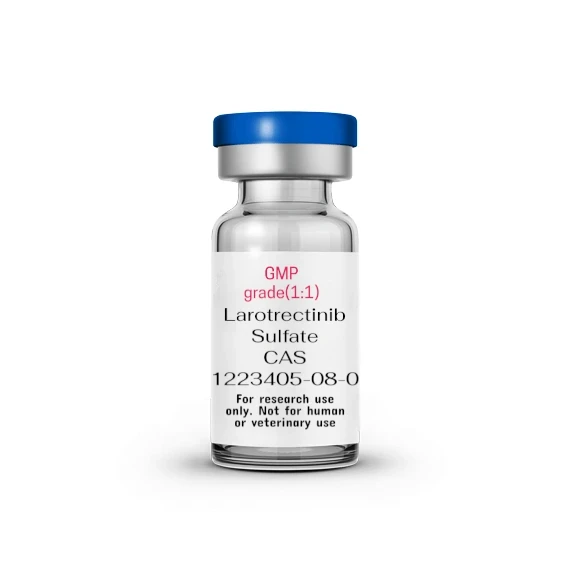

Larotrectinib Sulfate | CAS 1223405-08-0 | TRK Inhibitor for Preclinical Oncology and Precision Medicine Research
Original price was: $5.00.$2.00Current price is: $2.00.
Larotrectinib Sulfate (CAS 1223405-08-0) is a high-purity TRK inhibitor supplied as a solution for preclinical research. It is used to study NTRK gene fusion-driven cancers, TRK signaling, cell proliferation, apoptosis induction, and cytotoxicity mechanisms in cellular and molecular oncology models.

Description
Product Description
Larotrectinib Sulfate (CAS 1223405-08-0) is a highly selective, orally bioavailable small-molecule inhibitor of tropomyosin receptor kinases TRKA, TRKB, and TRKC. These kinases, encoded by the NTRK1, NTRK2, and NTRK3 genes, are key oncogenic drivers in tumors harboring NTRK gene fusions. Larotrectinib has demonstrated profound anti-proliferative effects in preclinical models by blocking TRK-mediated signaling cascades, including MAPK/ERK, PI3K/AKT, and PLCγ pathways.
The solution formulation allows precise dosing for in vitro assays, xenograft models, and pharmacodynamic studies. This high-purity solution is particularly suitable for preclinical cancer research focused on NTRK fusion-positive cell lines, including solid tumors, sarcomas, and rare pediatric malignancies.
Chemical and Structural Features
Larotrectinib Sulfate is the sulfate salt form of Larotrectinib, enhancing aqueous solubility and stability. The molecular formula is C29H30ClN7O3S·H2SO4, with a molecular weight of 584.1 g/mol (sulfate salt). Structurally, it contains a pyrrolopyrimidine core linked to aromatic and heterocyclic groups, allowing high-affinity binding to the ATP-binding site of TRK kinases. This selectivity is crucial for minimizing off-target effects and maintaining potent inhibition of NTRK fusion-driven oncogenic pathways.
Pharmacological Significance
Larotrectinib Sulfate acts as a pan-TRK inhibitor with IC50 values in the low nanomolar range for TRKA, TRKB, and TRKC. By suppressing kinase activity, it prevents phosphorylation of downstream effectors such as MEK, ERK, PI3K, and AKT, ultimately leading to:
Inhibition of cell proliferation and survival in NTRK fusion-positive cancer cells
Induction of cell-cycle arrest, predominantly at G1/S phase
Activation of intrinsic apoptotic pathways
Suppression of tumor growth and angiogenesis in xenograft models
The Larotrectinib Sulfate compound has been extensively validated in vitro using NTRK fusion-positive cancer cell lines and in vivo using mouse xenograft models, demonstrating dose-dependent tumor regression, high selectivity, and manageable preclinical toxicity profiles.
Preclinical Applications
Larotrectinib Sulfate solution is particularly useful for:
TRK Signaling Studies: Investigating TRKA/B/C kinase activity, downstream MAPK/ERK and PI3K/AKT pathways.
NTRK Fusion Cancer Research: Exploring tumor dependency on NTRK fusions in solid tumors and sarcomas.
Apoptosis and Cytotoxicity Studies: Evaluating intrinsic and extrinsic apoptotic pathways via caspase activation, mitochondrial depolarization, and ROS generation.
Combination Therapy Studies: Testing synergy or antagonism with chemotherapy, targeted inhibitors, or immunotherapy in preclinical models.
Resistance Mechanism Investigations: Studying acquired resistance through TRK kinase domain mutations, alternative signaling activation, or drug efflux modulation.
Pharmacokinetic and Pharmacodynamic Evaluations: Using solution formulation for dose titration in in vivo studies and PK/PD modeling.

Larotrectinib-Sulfate
Product Specifications
| Parameter | Specification / Data |
|---|---|
| Chemical Name / Synonyms | Larotrectinib Sulfate; LOXO-101 Sulfate; C29H30ClN7O3S·H2SO4 |
| CAS Number | 1223405-08-0 |
| Molecular Formula | C29H30ClN7O3S·H2SO4 |
| Molecular Weight | 584.1 g/mol (sulfate salt) |
| Purity / Assay | ≥99% |
| Appearance | Clear to slightly yellow solution |
| Solvent | DMSO, ethanol, water, or laboratory-grade buffers |
| Concentration | Typically 1–10 mM, adjustable per order |
| Storage Temperature | 2–8 °C; protect from light |
| Stability | Stable under refrigeration; avoid repeated freeze-thaw cycles |
| Analytical Methods | HPLC, MS, NMR verified; batch consistency confirmed |
| Mechanistic Target | TRKA, TRKB, TRKC; NTRK fusion-positive cell lines; apoptosis induction |
| Structural Category | TRK inhibitor, targeted oncology small molecule |
| Applications | Preclinical oncology studies, TRK signaling research, apoptosis assays, combination therapy research, drug resistance modeling |
| Batch Consistency | Verified by HPLC, MS, NMR |
| Regulatory Notes | For laboratory research use only |
| Origin | Factory small-molecule supplier; China chemical manufacturer; OEM & bulk production available |
| Additional Data | SMILES: CC1=C(C=C(C=C1)C2=NC3=CC=CC=C3N2)NC4=CC=CC=C4Cl.NH3SO4; CoA provided for each batch |
Larotrectinib Sulfate Mechanism of Action
TRK Kinase Inhibition
Larotrectinib Sulfate selectively binds to the ATP-binding pocket of TRKA, TRKB, and TRKC kinases, preventing autophosphorylation and downstream signaling. Inhibition of TRK kinases blocks:
MAPK/ERK pathway: Reduces proliferation and survival signals in tumor cells
PI3K/AKT pathway: Promotes apoptosis and decreases cell viability
PLCγ signaling: Modulates calcium-dependent signaling and cytoskeletal dynamics
Apoptosis Induction
Mitochondrial depolarization and cytochrome c release
Caspase-3 and caspase-9 activation
ROS generation and oxidative stress contributing to cell death
G1/S cell-cycle arrest in NTRK fusion-positive cells
Preclinical Research Applications
Mechanistic studies in TRK fusion-positive cell lines
Evaluation of tumor regression in xenograft models
Combination therapy assays with chemotherapeutics or kinase inhibitors
Resistance mechanism analysis, including kinase domain mutations and bypass pathway activation
Side Effects (Preclinical Observations)
Cellular Effects
Reduced proliferation of TRK-driven cancer cells
G1/S phase cell-cycle arrest
ROS-mediated stress responses
Modulation of intracellular signaling networks
Apoptotic Effects
Activation of caspase-dependent intrinsic apoptotic pathways
Mitochondrial depolarization
p53-dependent and independent apoptosis
Laboratory Handling
Handle with appropriate PPE in a fume hood
Store at 2–8 °C, protect from light
Avoid repeated freeze-thaw cycles
Larotrectinib Sulfate Follow institutional biosafety guidelines due to cytotoxic properties
Keywords
Larotrectinib Sulfate, LOXO-101 Sulfate, TRK inhibitor, TRKA inhibitor, TRKB inhibitor, TRKC inhibitor, NTRK fusion cancer research, angiogenesis studies, apoptosis research, cytotoxicity assays, preclinical oncology, high-purity research chemical, factory small-molecule supplier, China chemical manufacturer, OEM & bulk production, laboratory research reagent
Shipping Guarantee
All Larotrectinib Sulfate shipments of Larotrectinib Sulfate solution are handled with validated cold-chain logistics to ensure compound stability. Packages are sealed with secondary protective wrapping and shipped via express international couriers with tracking and insurance. Conditions are monitored to maintain solution integrity during transit.
Trade Assurance
We Larotrectinib Sulfate guarantee the authenticity and quality of all Larotrectinib Sulfate batches. Purity is verified at ≥99% via HPLC, MS, and NMR. Certificates of Analysis (CoA) are provided for each batch. Replacement or refund is assured for any deviation from listed specifications.
Payment Support
Larotrectinib Sulfate Flexible global payment options include:
PayPal
Major credit cards (Visa, MasterCard, American Express)
Bank transfer (T/T)
Cryptocurrencies (USDT, Bitcoin, Ethereum)
All Larotrectinib Sulfate transactions are encrypted to ensure security and confidentiality.
Disclaimer
Larotrectinib Sulfate is supplied strictly for laboratory research purposes. Not for human or veterinary use. Researchers must follow institutional safety and chemical handling protocols. Supplier assumes no liability for misuse.
References
Additional information
| Weight | 1.1 kg |
|---|---|
| Dimensions | 18 × 16 × 18 cm |
What is Larotrectinib Sulfate used for in preclinical research?
Larotrectinib Sulfate is a selective TRK inhibitor used to study NTRK fusion-driven cancers, TRK signaling pathways, apoptosis, and cytotoxicity in preclinical models.
Which TRK kinases does Larotrectinib inhibit?
It selectively inhibits TRKA, TRKB, and TRKC kinases, blocking downstream MAPK/ERK, PI3K/AKT, and PLCγ pathways.
What is the purity of Larotrectinib Sulfate solution?
All batches are verified at ≥99% purity using HPLC, MS, and NMR.
How should Larotrectinib Sulfate be stored?
Store at 2–8 °C, protected from light, and avoid repeated freeze-thaw cycles.
Which solvents are compatible with Larotrectinib Sulfate?
It is soluble in DMSO, ethanol, water, and laboratory-grade buffers.
Can Larotrectinib Sulfate be used in combination therapy studies?
Yes, it is often combined with chemotherapeutics, other kinase inhibitors, or immunotherapies to evaluate synergistic or antagonistic effects.
How does Larotrectinib Sulfate induce apoptosis?
It triggers intrinsic apoptosis via mitochondrial depolarization, caspase-3/-9 activation, and ROS generation.
Can Larotrectinib Sulfate be used for in vivo studies?
Yes, the solution formulation allows precise dosing in xenograft and pharmacodynamic studies.
Is special laboratory handling required?
Yes, use PPE and a fume hood; strictly for research use due to cytotoxic properties.
Is bulk ordering of Larotrectinib Sulfate available?
Yes, OEM and bulk production are available from verified chemical manufacturers.
Which analytical methods confirm batch quality?
HPLC, MS, and NMR are used, with each batch supplied with a Certificate of Analysis (CoA).
Does Larotrectinib affect cell-cycle checkpoints?
Yes, it induces G1/S phase arrest in NTRK fusion-positive cells.
Can Larotrectinib Sulfate be used to study resistance mechanisms?
Yes, it is applied in preclinical studies to investigate acquired resistance via TRK kinase domain mutations or bypass signaling.
Are high-purity Larotrectinib Sulfate solutions available for research?
Yes, all batches meet ≥99% purity standards.
What preclinical applications are suitable for Larotrectinib Sulfate?
NTRK fusion cancer research, TRK signaling studies, apoptosis and cytotoxicity assays, combination therapy evaluation, and resistance mechanism investigation.
Related products
Telpegfilgrastim Solution 99% High purity | Factory manufactured
High-purity Telpegfilgrastim Solution, factory-manufactured for in vitro molecular mechanism studies and biochemical pathway research. Supplied as a stable solution, ideal for laboratories requiring bulk, wholesale, or customized research-grade supply. $2.00Fulvestrant (Faslodex) 250mg — Laboratory Research Grade Reagent
Fulvestrant (Faslodex) is a high-purity steroidal compound for in vitro molecular mechanism studies, including nuclear receptor binding, transcriptional modulation, and protein interaction research. It is intended exclusively for laboratory research and mechanistic investigations, enabling controlled experimental analysis in biochemical and cellular assays. Original price was: $6.00.$2.00Current price is: $2.00.Fulzerasib 150mg High Purity | Factory Manufactured
High-purity Fulzerasib (also known as IBI351, GFH925) is a factory-manufactured small-molecule research reagent optimized for in vitro mechanistic studies, KRAS G12C pathway inhibition analysis, and molecular signaling research. Available for bulk and wholesale laboratory use with batch-verified purity and consistent quality. $1.00Cetuximab NO1 100 mg/50 mL | High purity | Factory manufactured
Cetuximab NO1 (100 mg/50 mL, Solution) is a high-purity monoclonal antibody solution manufactured under stringent factory-controlled conditions for in vitro laboratory research and molecular mechanism studies. Its solution format facilitates precise dosing, reproducible assay preparation, and integration into receptor-binding and signaling pathway research workflows.
Original price was: $3.00.$2.00Current price is: $2.00.


Reviews
There are no reviews yet.