
No products in the cart.
Sale
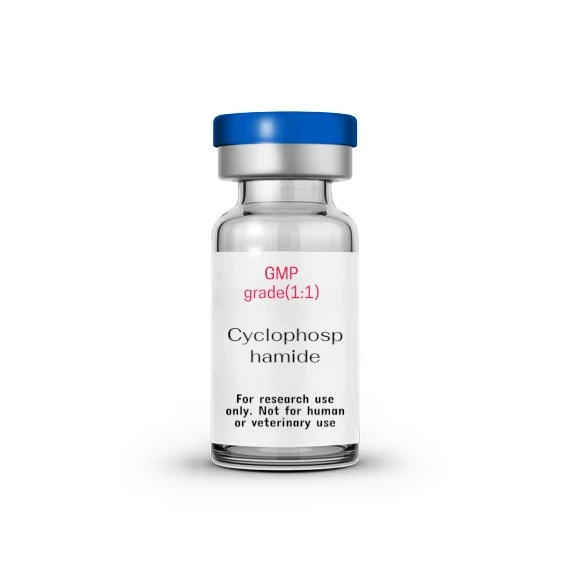

Cyclophosphamide | CAS 50-18-0 | Alkylating Agent for Laboratory Research
Original price was: $3.00.$2.00Current price is: $2.00.
Cyclophosphamide is a synthetic small-molecule alkylating agent widely used in laboratory research to study DNA crosslinking, cytotoxic mechanisms, and preclinical models of cell proliferation and apoptosis. It serves as a model compound for chemotherapeutic research, oxidative stress studies, and mechanistic investigations in vitro and in vivo.

Description
Contents
hide
Product Description
Cyclophosphamide is a synthetic nitrogen mustard derivative designed for experimental research in cytotoxic pharmacology. It functions as an alkylating agent that forms DNA crosslinks, thereby inhibiting cell proliferation and inducing apoptosis in actively dividing cells. Laboratory studies utilize cyclophosphamide to model chemotherapeutic effects, study DNA damage responses, and explore mechanisms of drug-induced cytotoxicity.
Experimental Applications
DNA crosslinking studies: Investigating covalent modification of DNA and effects on replication fidelity.
Cytotoxicity and apoptosis research: Examining cell death pathways, ROS generation, and DNA damage responses in preclinical models.
Oxidative stress and detoxification studies: Assessing the role of reactive metabolites and cellular antioxidant defenses.
Mechanistic pharmacology: Modeling dose-dependent effects, pharmacokinetics, and cellular uptake in vitro and in vivo.
Combination studies: Evaluating synergistic or antagonistic interactions with other experimental compounds, antioxidants, or DNA repair modulators.
Cyclophosphamide is supplied as a high-purity crystalline powder (≥99%), suitable for solution preparation, in vitro assays, and preclinical animal studies. Its solubility in water, DMSO, and ethanol allows flexible laboratory application. Analytical verification by HPLC, MS, and NMR ensures reproducibility and reliability in mechanistic studies.
As a model alkylating agent, cyclophosphamide is widely used to explore DNA damage signaling, repair pathways, oxidative stress responses, and cell cycle regulation. Its chemical stability and reproducible pharmacological profile make it a staple in experimental oncology and toxicology research.
Product Specifications
| Item | Details |
|---|---|
| Product Name | Cyclophosphamide |
| CAS Number | 50-18-0 |
| Synonyms | Cytoxan; Neosar; CP |
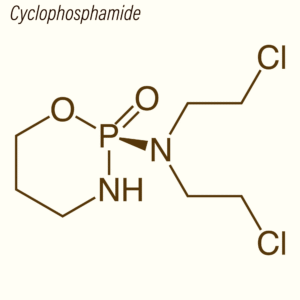
| Molecular Formula | C7H15Cl2N2O2P |
| Molecular Weight | 261.1 g/mol |
| Purity | ≥99% |
| Appearance | White to off-white crystalline powder |
| Solubility | Soluble in water, DMSO, and ethanol |
| Storage Temperature | 2–8 °C, protect from light and moisture |
| Category | Small-molecule research chemical |
| Applications | DNA crosslinking studies, cytotoxicity research, apoptosis modeling, preclinical pharmacology |
| Formulation | Solid powder suitable for solution preparation and in vitro/in vivo studies |
| Stability | Stable under recommended storage conditions |
| Shelf Life | 24 months |
| Supplier Type | Laboratory research chemical supplier |
| Intended Use | For laboratory research use only |
Mechanism of Action
Cyclophosphamide functions as a prodrug that, once metabolized in experimental systems, generates alkylating intermediates capable of forming covalent DNA crosslinks. This activity prevents DNA replication, induces strand breaks, and triggers apoptotic pathways.
DNA Alkylation and Crosslinking
Cyclophosphamide forms reactive intermediates that attach to DNA bases, primarily guanine, creating intra- and interstrand crosslinks. Laboratory studies investigate how these modifications interfere with replication and transcription fidelity.
Cytotoxicity and Apoptosis
By inducing DNA damage, cyclophosphamide activates intrinsic apoptosis pathways. Researchers can monitor caspase activation, mitochondrial membrane potential changes, and cell cycle arrest in experimental models.
Reactive Metabolite Generation
In in vitro and in vivo systems, cyclophosphamide generates electrophilic metabolites, such as phosphoramide mustard, which mediate alkylation. These metabolites also allow mechanistic studies on detoxification and oxidative stress.
Experimental Applications
Modeling DNA damage and repair in cancer or normal cell lines
Investigating apoptosis, necrosis, and cell cycle regulation
Assessing reactive oxygen species generation and antioxidant responses
Dose-response and pharmacodynamic studies
Combination studies with DNA repair modulators or other chemoprotective agents
Cyclophosphamide’s predictable small-molecule behavior and chemical stability make it a widely used tool for mechanistic and preclinical research in laboratory oncology and toxicology.
Side Effects
In experimental models, cyclophosphamide demonstrates dose-dependent cytotoxicity. Laboratory researchers may observe transient modulation of ROS, DNA damage markers, or cell viability changes. It is not intended for clinical use and should be handled strictly according to laboratory safety protocols.
Keywords
Cyclophosphamide, alkylating agent, DNA crosslinking, cytotoxicity research, apoptosis modeling, preclinical pharmacology, laboratory research chemical, reactive metabolite studies, oxidative stress research, small-molecule chemotherapeutic analog, factory chemical supplier, chemical wholesale China, low-price chemical supplier, China research chemical manufacturer, OEM & bulk chemical production, high-purity chemical compound
Shipping Guarantee
All shipments of Cyclophosphamide are handled using validated cold-chain and protective packaging logistics to maintain compound integrity. Each package is sealed in moisture-proof containers with secondary protective wrapping and continuous temperature monitoring. Products are shipped via express international couriers with full tracking and insurance coverage, ensuring safe and timely delivery.
Trade Assurance
We guarantee the authenticity and high purity (≥99%) of Cyclophosphamide. Each batch undergoes rigorous analytical verification, including HPLC, MS, and NMR, to confirm identity, purity, and chemical structure. A Certificate of Analysis (CoA) is provided with each batch. Our trade assurance policy guarantees replacement or refund for any deviation from listed specifications.
Payment Support
We provide secure and flexible global payment options, including PayPal, major credit cards (Visa, MasterCard, American Express), telegraphic transfer (T/T), and cryptocurrencies (USDT, Bitcoin, Ethereum). All transactions are encrypted and verified, ensuring confidentiality and fund security.
Disclaimer
All Cyclophosphamide products are intended for laboratory research use only. They are not drugs, medical devices, or diagnostics and should not be administered to humans or animals. Researchers must adhere to institutional biosafety and chemical safety guidelines. The information provided is for scientific reference only and does not imply therapeutic efficacy, safety, or regulatory approval.

Additional information
| Weight | 1 kg |
|---|---|
| Dimensions | 18 × 16 × 18 cm |
Q1: What is Cyclophosphamide used for in research?
A1: Cyclophosphamide is used to study DNA crosslinking, cytotoxicity, apoptosis pathways, and preclinical models of cell proliferation and cell cycle regulation.
Q2: Is Cyclophosphamide a high-purity compound?
A2: Yes, it is synthesized to ≥99% purity, verified by HPLC, MS, and NMR to ensure reproducibility in laboratory studies.
Q3: How should Cyclophosphamide be stored?
A3: Store at 2–8 °C in a dry, light-protected environment. Avoid moisture and prolonged exposure to heat.
Q4: What is the typical appearance of Cyclophosphamide?
A4: White to off-white crystalline powder.
Q5: Can Cyclophosphamide be used in combination studies?
A5: Yes, it is suitable for studies with DNA repair modulators, antioxidants, or other chemoprotective agents to explore synergistic effects.
Q6: Is Cyclophosphamide stable during storage?
A6: Yes, stable under recommended conditions for up to 24 months.
Q7: Where is Cyclophosphamide manufactured?
A7: Produced under research-grade chemical standards in China, ensuring batch consistency and verified high purity.
Q8: Are OEM or bulk production services available?
A8: Yes, OEM, bulk, and contract manufacturing for laboratory research purposes are supported.
Q9: What documentation is provided with each batch?
A9: Each batch includes a CoA verifying identity, ≥99% purity, and analytical verification.
Q10: Is Cyclophosphamide soluble in laboratory solvents?
A10: Yes, it dissolves in water, DMSO, and ethanol, suitable for solution preparation and experimental assays.
Q11: What type of supplier provides Cyclophosphamide?
A11: Professional laboratory research chemical suppliers specializing in high-purity small molecules.
Q12: Does the product contain preservatives?
A12: No, it is supplied in pure form without stabilizers or preservatives.
Related products
Limertinib (ASK120067) 80mg — Laboratory Research Grade Chemical
Limertinib is a high-purity, irreversible small-molecule inhibitor that selectively targets mutant EGFR in vitro. Designed specifically for laboratory research, it is ideal for investigating signal transduction, kinase activity, and receptor molecular mechanisms in cell-free or in vitro systems. This compound is suitable for mechanistic studies, target validation, and enzymatic assays. Original price was: $3.00.$2.00Current price is: $2.00.Regorafenib 40mg | High Purity | Factory Manufactured | Laboratory Research Use Only
High-purity Regorafenib, factory-manufactured for in vitro mechanistic studies and molecular pathway research. Supplied as a stable solution or powder for laboratories requiring bulk, wholesale, or customized research-grade supply. Original price was: $3.00.$2.00Current price is: $2.00.Propranolol Hydrochloride Solution 10 mg/mL (40 mL)
Propranolol Hydrochloride Solution (10 mg/mL, 40 mL) is a high-purity small-molecule reagent manufactured under controlled factory conditions for laboratory research and in vitro molecular mechanism studies. The solution format enables precise concentration control, reproducible assay preparation, and seamless integration into biochemical and signaling pathway research workflows.
$1.00Temozolomide 100mg — Laboratory Research Grade Chemical
Temozolomide is a high-purity alkylating research compound widely used in in vitro molecular mechanism studies focusing on DNA methylation, damage response pathways, and cell cycle regulation. It is suitable for laboratory-based biochemical and mechanistic research applications only.
Original price was: $6.00.$3.00Current price is: $3.00.


Reviews
There are no reviews yet.