
No products in the cart.
Sale
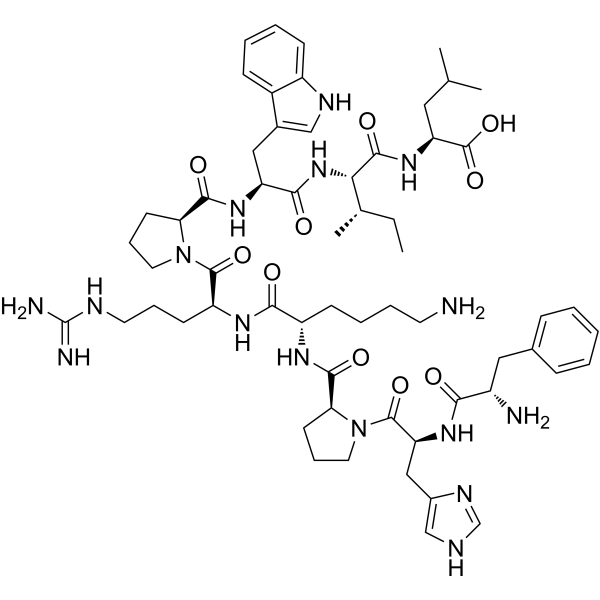
Xenopsin-Related Peptide 2 | CAS 117442-29-2 | Avian Xenopsin Analog for Histamine Release and Mast Cell Activation Research
Original price was: $36.00.$23.00Current price is: $23.00.
Xenopsin-Related Peptide 2 (XP-2) is an avian neuropeptide structurally related to amphibian xenopsin. XP-2 has demonstrated potent histamine-releasing activity in isolated rat mast cells, comparable to that of Bradykinin, making it valuable for mast cell and neuroendocrine research.

Description
Product Description
Xenopsin-Related Peptide 2 (XP-2) is a bioactive avian neuropeptide sharing structural and functional homology with amphibian xenopsin. This peptide represents an evolutionary counterpart that maintains conserved sequence motifs responsible for receptor binding and biological activity across vertebrate species.
Originally isolated from avian tissues, XP-2 plays a regulatory role in neuropeptide signaling, mast cell activation, and histamine release mechanisms. Its biological potency is comparable to that of Bradykinin, a well-characterized inflammatory mediator, making it an effective experimental agent for studying neuroimmune communication and vascular permeability.
Structural and Functional Characteristics
Xenopsin-Related Peptide 2 consists of a short amino acid chain similar to the xenopsin family, exhibiting high affinity toward G protein-coupled receptors (GPCRs). Upon receptor interaction, XP-2 induces intracellular calcium mobilization, leading to histamine secretion from mast cells and promoting vasodilation.
Studies indicate that XP-2 acts through both direct mast cell stimulation and indirect modulation of neuropeptide release, creating a bridge between the endocrine and immune systems.
Research Significance
Due to its unique receptor activity, Xenopsin-Related Peptide 2 serves as an important tool for:
Investigating mast cell activation mechanisms
Exploring neuropeptide-induced histamine release pathways
Understanding avian peptide evolution and its mammalian analogs
Screening histamine antagonists and receptor modulators
The peptide also provides a comparative model to amphibian xenopsin for cross-species peptide biology research, helping researchers understand how structural motifs determine receptor selectivity and physiological function.
Product Specifications
| Property | Description |
|---|---|
| Product Name | Xenopsin-Related Peptide 2 |
| CAS Number | 117442-29-2 |
| Synonyms | XP-2; Avian Xenopsin Analog |
| Molecular Formula | C₅₀H₈₀N₁₄O₁₃ |
| Molecular Weight | Approx. 1080.2 g/mol |
| Purity | ≥99% |
| Form | Lyophilized peptide powder |
| Storage | −20°C, protected from light and moisture |
| Solubility | Soluble in water or 0.1% acetic acid |
| Stability | Stable for ≥12 months under recommended conditions |
| Category | Avian neuropeptide analog; mast cell activator |
| Applications | Histamine release studies, neuropeptide signaling, mast cell physiology |
| Research Area | Neuroendocrinology, Immunology, Peptide Pharmacology |
| Intended Use | For laboratory research use only |
Mechanism of Action
Xenopsin-Related Peptide 2 functions by binding to G protein-coupled receptors (GPCRs) located on the surface of mast cells and neurons. Upon binding, XP-2 activates intracellular phospholipase C (PLC), leading to the production of inositol triphosphate (IP₃) and the subsequent release of calcium ions from intracellular stores.
The rise in intracellular calcium triggers histamine granule exocytosis, resulting in mast cell degranulation and the release of inflammatory mediators. This histamine release is associated with vascular permeability, smooth muscle contraction, and sensory neuron activation.
Unlike many synthetic peptides, XP-2 exhibits natural receptor selectivity, which allows it to serve as a precise model for studying neuropeptide-driven histamine release. Its activity parallels that of Bradykinin, but XP-2’s structure enables different receptor-binding dynamics, offering unique insights into receptor-ligand specificity in vertebrate species.
In addition to immune-related functions, XP-2 may also play a role in neuroendocrine regulation, influencing hormone secretion and neurotransmission under stress or inflammation.
Side Effects
In controlled experimental models, Xenopsin-Related Peptide 2 does not exhibit intrinsic toxicity. However, due to its histamine-releasing properties, excessive concentrations may lead to biological reactions resembling allergic responses, including:
Increased vascular permeability
Smooth muscle contraction
Local inflammatory response
All in vivo applications should adhere to standard safety and ethical guidelines.
Keywords
Xenopsin-Related Peptide 2, XP-2, avian neuropeptide, xenopsin analog, histamine release peptide, mast cell activator, GPCR ligand, inflammatory mediator peptide, neuroendocrine signaling compound, peptide biology research reagent
Shipping Guarantee
All shipments are handled using validated cold-chain logistics to preserve peptide integrity. Each package is sealed in moisture-proof containers with secondary protective wrapping and continuous temperature monitoring. Products are shipped via express international couriers with full tracking and insurance coverage.
Trade Assurance
We ensure product authenticity, verified ≥99% purity, and compliance with analytical standards (HPLC, MS, and NMR). Each batch is supplied with a Certificate of Analysis (CoA). Our trade assurance policy guarantees replacement or refund for any deviation from listed specifications.
Payment Support
We provide flexible and secure global payment options to support international research transactions. Accepted payment methods include PayPal, major credit cards (Visa, MasterCard, American Express), telegraphic transfer (T/T), and cryptocurrencies (USDT, Bitcoin, Ethereum). All transactions are protected by industry-standard encryption and verified gateways to ensure confidentiality and fund security.
Additional information
| Weight | 0.9 kg |
|---|---|
| Dimensions | 56 × 86 × 56 cm |
What is Xenopsin-Related Peptide 2?
Xenopsin-Related Peptide 2 (XP-2) is an avian neuropeptide that functions as an analog of amphibian xenopsin, known for inducing histamine release from mast cells.
What is the CAS number of XP-2?
The CAS number is 117442-29-2.
What is the biological function of XP-2?
It promotes histamine release, mimicking the activity of bradykinin and other neuropeptides involved in inflammatory and allergic responses.
What receptors does XP-2 interact with?
XP-2 acts primarily through G protein-coupled receptors (GPCRs) associated with histamine release and neuropeptide signaling.
Is XP-2 related to Bradykinin?
Yes, XP-2 exhibits comparable histamine-releasing efficacy to Bradykinin, although the two peptides differ in sequence and receptor affinity.
What is the purity of the compound?
All batches are verified to have ≥99% purity by HPLC and MS.
How should Xenopsin-Related Peptide 2 be stored?
Store at −20°C in a moisture-free, light-protected environment.
Can XP-2 be used in humans?
No. XP-2 is intended strictly for laboratory research use only.
What documentation is provided?
Each batch includes a Certificate of Analysis (CoA) with analytical data verifying peptide identity and purity.
Related products
Best Price with Peptides 10mg Vials – High-Purity Weight Loss Peptide in Stock with Safe Delivery
Weight Loss Peptide Moq: 10 vials per box Package: plastic or paper box Purity:99% Original price was: $36.00.$24.00Current price is: $24.00.Semaglutide Raw Material Factory: Low-Price Wholesale for High-Purity Peptides
Semaglutide Compound CID: 56843331 MF: C187H291N45O59Purity: 99%
Form: Lyophilized powder
Dosage Options: 5mg, 10mg, 15mg per vial
Packaging: Secure box packaging
Shelf Life: 2 years (store in a cool, dry place)
MOQ: 1 box
Retatrutide cost with insurance
Retatrutide cost with insurance Original price was: $38.00.$26.00Current price is: $26.00.High Purity Weight Loss Peptide Reta, Trutide, GHK-Cu, Epitalon Peptide – The Ultimate Solution for Effective Weight Loss and Anti-Aging
Weight Loss Peptide Function Dose 2mg 5mg 10mg 15mg 20mg Higher Original price was: $36.00.$25.00Current price is: $25.00.


Reviews
There are no reviews yet.